Thursday, November 23, 2006
Happy Thanksgiving!
It's a beautiful 60-degree day down here on Lake Hartwell! A good day for food, family and a long walk. I hope you have a beautiful day, too, wherever you are! :)

Wednesday, November 22, 2006
NTSB Preliminary report from Nov 12 crash
Here.
It surprises me to see that they describe it as VMC (and later they do give the quantitative numbers to support that, but it's still hard to believe that that day was ever that clear). The PHF (12 nm from JGG) reports they cite indicate much worse conditions.
Also, it says they had 10 degrees of flaps down. I don't know what that plane's standard procedures are for short-field takeoff (as requested when departing 31), but that just seems weird to me for conditions and whatnot. The pilot had 2140 hours at the time of his last medical, so he probably knew what he was doing.
Geez, it's hard to say "he probably knew what he was doing" given how it went. And it makes my stomach knot up to say any of this, to question his decisions like I'm some jerk with enough knowledge or experience to pass judgment.
It surprises me to see that they describe it as VMC (and later they do give the quantitative numbers to support that, but it's still hard to believe that that day was ever that clear). The PHF (12 nm from JGG) reports they cite indicate much worse conditions.
Also, it says they had 10 degrees of flaps down. I don't know what that plane's standard procedures are for short-field takeoff (as requested when departing 31), but that just seems weird to me for conditions and whatnot. The pilot had 2140 hours at the time of his last medical, so he probably knew what he was doing.
Geez, it's hard to say "he probably knew what he was doing" given how it went. And it makes my stomach knot up to say any of this, to question his decisions like I'm some jerk with enough knowledge or experience to pass judgment.
Tuesday, November 21, 2006
Boo hoo!
You know, too many posts on this blog in the past two weeks have been about negative or disappointing things! But here's another anyway...
Husband and I had planned to fly down to Georgia for Thanksgiving with my family, leaving either today or tomorrow. A big stupid band of storms is moving in from the ocean, though, so it's not going to work out. The winds at our destination for our predicted arrival time are 17 kts gusting to 30, and the TAFs since last night have been calling for progressively lower and denser cloud layers, with PIREPs of icing in the clouds. Ignoring the low stuff and landings, we'd have had a 20-kt tailwind and the trip would be < 3 hours.
It's a really, really unhappy decision to call off that flight and accept the drive. Eight and a half hours, mostly on I-85, on a holiday. Probably in rain, too. Nightmare. Avoiding exactly this was the primary reason why I agreed that buying into 388 made sense.
But that's how it goes, right? Yeah, it's the right decision, but it's still really disappointing. The trade-off sucks.
Husband and I had planned to fly down to Georgia for Thanksgiving with my family, leaving either today or tomorrow. A big stupid band of storms is moving in from the ocean, though, so it's not going to work out. The winds at our destination for our predicted arrival time are 17 kts gusting to 30, and the TAFs since last night have been calling for progressively lower and denser cloud layers, with PIREPs of icing in the clouds. Ignoring the low stuff and landings, we'd have had a 20-kt tailwind and the trip would be < 3 hours.
It's a really, really unhappy decision to call off that flight and accept the drive. Eight and a half hours, mostly on I-85, on a holiday. Probably in rain, too. Nightmare. Avoiding exactly this was the primary reason why I agreed that buying into 388 made sense.
But that's how it goes, right? Yeah, it's the right decision, but it's still really disappointing. The trade-off sucks.
Monday, November 20, 2006
Winds NOT unreliable
After today's flight, I stopped in at the FBO and chatted with the friendly folks inside (Jean, the airport manager, and Bill and Charlie, the senior linemen/UNICOM operators/everything else). During the course of conversation, the local AWOS came up and I asked when they were going to have the wind reporting checked out. They just kinda looked at me for a second like I was crazy.
"You do know there's a NOTAM saying the winds are unreliable, right?"
They knew that there was one that had been issued at the end of June that was supposedly canceled two or three weeks later. Apparently the cancellation had never gone through.
Bill hopped on the phone to flight service that very moment and reissued the cancel request. I just checked using AOPA's flight planner, now ~2 hours after Bill's call, and the NOTAM is gone.
Huzzah for reliable wind reports!
"You do know there's a NOTAM saying the winds are unreliable, right?"
They knew that there was one that had been issued at the end of June that was supposedly canceled two or three weeks later. Apparently the cancellation had never gone through.
Bill hopped on the phone to flight service that very moment and reissued the cancel request. I just checked using AOPA's flight planner, now ~2 hours after Bill's call, and the NOTAM is gone.
Huzzah for reliable wind reports!
JEP FII-14: VOR, ADF, instrument work, CROSSWIND LANDINGS
[Updated: VOR discussion, for a third time!]
Goals:
Flight:
JEPII-12 and 13 are solo work.
Preflight, check. We talked about basic operations of the VOR (which senses a VOR or VORTAC) and ADF (which senses an NDB). We talked briefly about low-level wind shear. We talked about how in the utility category W&B envelope the maneuvering speed is closer to the stalling speed. I dialed in the Harcum (HCM) VOR on nav2 and FAF's NDB on the ADF.
We started off toward 31 -- the first time for 31, I think, since my solos a month ago. We talked a little on the way down there and I was thinking about VORs and after pulling to a stop at the runway hold-short line to finish our conversation, I announced that we were departing. The second I got off the mike, Chuck said, "After the run-up, right?"
Holy freakin' crap. Where was my brain? Did I leave it in the car??!?!?!! I was mortified with myself and could feel my face grow exceptionally hot. I pulled out the checklist -- checklist, checklist, checklist! -- and went through it. Luckily, everything else on the flight went much better than this goof up.
We went up and headed back toward the river and almost immediately went under the foggles and stayed there for a while. We played with the ADF and VOR under the hood for a while. Harcum was generally NNW of us and first we dialed it in to find the general heading, and then we dialed in a ENE radial and continued NNW until we intercepted it. We flew along it and crossed over the VOR, noticing the increased sensitivity of the indicator at such close range, and then the cone of confusion, then the switch from "to" to "from".
We swung around and tracked back to it, crossed it, and then looked at the reverse sensing behavior of having the opposite radial dialed in for the direction of travel relative to the VOR.
Still under the foggles, I slowed for slow-flight maneuvers. Holding altitude using pitch and power and still trying to stay slow, I did some left and right turns. Then it was time for a few power-off stalls followed by a few power-on stalls. Next I did left and right steep turns, and then finally the foggles came off. Another steep turn in each direction and it was back to the airport for 4 landings in 7-10 kt crosswinds.
Discussion:
Self-Assessment: New things to work on as the old ones get polished up.
Next: I've got the plane at 11 am on Monday, which will be either solo or lesson depending on weather.
Hours logged total: 22.1
Instrument hours logged this lesson: 0.5
Instrument Hours logged total: 1.3
Take-offs and landings this flight: 4
Take-offs and landings total: 62
PIC hours total:: 3.2
Goals:
- Intro to ADFs.
- Intro to VORs.
- IR maneuvers (including stalls).
- Crosswind landings -- WOO!
Flight:
JEPII-12 and 13 are solo work.
Preflight, check. We talked about basic operations of the VOR (which senses a VOR or VORTAC) and ADF (which senses an NDB). We talked briefly about low-level wind shear. We talked about how in the utility category W&B envelope the maneuvering speed is closer to the stalling speed. I dialed in the Harcum (HCM) VOR on nav2 and FAF's NDB on the ADF.
We started off toward 31 -- the first time for 31, I think, since my solos a month ago. We talked a little on the way down there and I was thinking about VORs and after pulling to a stop at the runway hold-short line to finish our conversation, I announced that we were departing. The second I got off the mike, Chuck said, "After the run-up, right?"
Holy freakin' crap. Where was my brain? Did I leave it in the car??!?!?!! I was mortified with myself and could feel my face grow exceptionally hot. I pulled out the checklist -- checklist, checklist, checklist! -- and went through it. Luckily, everything else on the flight went much better than this goof up.
We went up and headed back toward the river and almost immediately went under the foggles and stayed there for a while. We played with the ADF and VOR under the hood for a while. Harcum was generally NNW of us and first we dialed it in to find the general heading, and then we dialed in a ENE radial and continued NNW until we intercepted it. We flew along it and crossed over the VOR, noticing the increased sensitivity of the indicator at such close range, and then the cone of confusion, then the switch from "to" to "from".
We swung around and tracked back to it, crossed it, and then looked at the reverse sensing behavior of having the opposite radial dialed in for the direction of travel relative to the VOR.
Still under the foggles, I slowed for slow-flight maneuvers. Holding altitude using pitch and power and still trying to stay slow, I did some left and right turns. Then it was time for a few power-off stalls followed by a few power-on stalls. Next I did left and right steep turns, and then finally the foggles came off. Another steep turn in each direction and it was back to the airport for 4 landings in 7-10 kt crosswinds.
Discussion:
- Automatic Direction Finder (ADF): The ADF is an old technology that picks up low-frequency transmissions from non-directional beacons (NDBs). It can also function as an AM radio receiver, which is neat because (1) you can listen to the radio and (2) if you know where the station's transmission is coming from, you can use it as a navaid.
It basically works like this: The NDB sends out a signal in all directions. You tune its frequency in on the ADF. If you turn the volume up, you can listen for its Morse code, which is how you verify that you're tuned to the right signal. When you're in range, the ADF bearing indicator comes alive. What the indicator tells you is where the beacon is relative to your location.
The indicator itself can be a little confusing, because beneath the indicator needle is a movable heading card. One approach to using this indicator is to just leave 0 degrees at the top, regardless of what your actual heading is; your direction of travel is always "up" on the indicator. This is good because it brings home the fact that this is all relative information and it seems to me it would prevent misinterpretation of the info it's giving; I'll call this relative bearing. So if you look at the indicator, and you're going up toward 0, and the ADF needle is pointing to 350, that means the NDB is 10 degrees left of your current track. In reality, if you're on a heading of 140 and you wanted to go to the NDB, you'd point over to 130.
The other approach, which I'll call absolute bearing, is to use the movable heading to dial in your actual heading and then the needle will point to the heading you'd need to fly to go to the NDB. So if you're on a heading of 140 and you dialed 140 into the ADF bearing indicator, it would then be pointing to 130, the heading that would take you to the NDB.
The main thing I don't like about the second approach is the possibility for error in headings. The directional gyro will precess, and if you haven't remembered to set it recently or it was set incorrectly, then why would you want to propagate that error into another instrument? If you're using it for a relative bearing, then it doesn't matter what your DG actually says; you're going to change that reading by a certain absolute delta, and while the resulting heading will have the same error as the original heading, you'll be in sync with the navaid.
And how do you know if you're in sync with the navaid? Well, if it says the NDB is 10 degrees to your left, and you redirect yourself to the left by 10 degrees, the ADF needle should then be pointing straight up, meaning the NDB is directly in front of you. Pretty simple. Kinda like a magnet -- the arrowhead is drawn to the ADF, and you follow the arrowhead.
The ADF/NDB system has quite a few limitations. Distance, weather, terrain, occasional random 40-degree errors, ... I don't know all the details here yet, but I know enough to know I'm thankful for GPS! Homing and correcting for wind deviations are for another time... - VHF Omnidirectional Range (VOR): The VOR is a newer yet still old technology that eliminates lots of the problems with ADFs/NDBs. For one, it's a VHF signal, so it's stronger and less susceptible to distortion and noise.
The VOR has two rotating signals, one that goes "slowly" and one that goes "quickly." The quick one, the differential, sends out a little blip on each 1-degree section. The slow one, the reference, sends out an omnidirectional blip every time the quick one gets to 360. The VOR indicator in the plane digests that signal by noting the time between receiving the reference and the differential signals and therefore it knows which radial its on.
So what's this radial thing? There are 360 radials eminating from a VOR, one on each whole degree. They're numbered according to the direction relative to north (north = 360 = 0). The radials are also vectors, always eminating from the VOR. If you're on a heading taking you to a VOR, you're actually flying the radial coming out the other side since that's the radial that's in the same direction as your travel.
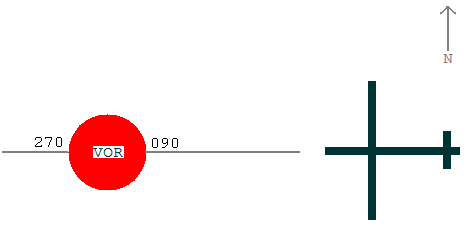
Let's say we're traveling east to west on a calm day with a VOR directly in our path. We're flying a heading of 270. The VOR has two radials on our path; 270, going out the far side to the west, and 090, coming out the near side toward the east. If we want to dial in the VOR for use in navigation, we'd dial 270 using the "bug" (the OBS, omnibearing selector) and when within 10 degrees left or right of that radial, the needle comes alive. In this example, we'd expect that needle to immediately be centered since we're flying right along that radial.
As we get closer to the VOR, the indicator becomes more sensitive. When we're 10 miles away, being 100 feet to the left or right of the actual signal source doesn't make much of a difference. But when you're 1/4 mile away that 100 feet is a much larger error, so the closer you get, the more deviation the needle will display. Those numbers are just to illustrate the point and shouldn't be taken as real guides for how it works. When you get right over the source, the indicator doesn't really know what to tell you, kinda like how a magnetic compass at the north pole doesn't know where to point.
 As we cross over the VOR and move away to the west, the needle will have decreasing sensitivity and will stabilize. Also when we pass the VOR the indicator will switch its "to" flag over to the "from" flag. When we dialed in the 270, the indicator sensed that the VOR site was still in front of us and activated the "to" flag -- this is solely based on the fact that, if you drew crosshairs over the VOR with one axis on our selected radial and the other axis perpendicular, our position is on a radial in the semi-circle opposite from the selected radial. Once we passed it, we were on the same semi-circle as the radial so the indicator activated the "from" flag. That matches our travel and all is well.
Suppose on our east to west travel that the VOR was not directly in our path, but instead was 30 degrees off to the right of our "starting" position and we really want to fly over it heading northwest. In this case, we know we want eventually to be traveling on its 315 radial, so we dial that into the VOR. As we fly along and get closer to the intersection of our 270 heading and the bugged heading of 315, the VOR needle will come "off the wall." The VOR needle isn't magical and doesn't know that the VOR is to the right of the plane; it does not have that spatial awareness. What it does know is that (a) we're currently on some given radial of that VOR (say, 122 -- if we turned to 122+180=302 we'd be going straight to the VOR) and (b) we've dialed in to go to the VOR on 315. If we were on the 135 radial (the opposite of what we have dialed in), our needle would be centered because we'd be going roughly towards the VOR (we're SE of the VOR, heading W); alternately, if we redialed the OBS to 302, the needle would be centered since that's the radial that would take us directly to it from our current position. But we're actually on 122. In order to intercept the 315, we need to go further to the "left" -- in a north-up sense, we know we're to the right of the VOR, on a radial that is to the right of our target radial. The needle tells us this by sticking to the left wall. Since we're already traveling west, we can keep that heading and just wait. When we get close to that intersection, the needle begins to move closer to the upright position. At 125, specifically, it comes to life. For every two degrees closer to the target radial we go, the needle gets one dot closer to center. When it's straight up and down, we're smack on the radial.
Now that we're on the radial, what? We're still pointed west as we cross over the 315 radial. We want to go to the VOR, and the indicator is telling us that the heading of 315 will take us directly to the VOR, so we have to change our travel heading to 315 (a right turn, in this case).
What if we don't change our heading, but instead keep trucking right along at 270? Approaching the selected radial, the needle was coming from left to center. Right on the radial, the needle was centered. As we pass the radial, the needle deflects to the right.
Reverse sensing. What we've seen so far is that when the VOR needle is to one side, that means you need to turn in the direction of the needle's deflection to get to the radial that you've dialed in with the OBS. Reverse sensing means you have the opposite radial dialed in, and so the indicator will give you "backwards" directions.
When we're flying east to west on a heading of 270, we dial in the 270 radial and the indicator says we're going to the VOR (the one that's right in our path). If we had dialed in the 090 radial, it would be the opposite vector of our flight path, and so the flag would show up as from. I think this means that, in the second example, if we dialed in 135 for our VOR that's 30 degrees to the right of our "starting" point, the indicator would show from with a right needle deflection. That only makes smile-and-nod sense to me right now, but I think that's how it's supposed to work. - Crosswind landings: The big secret to crosswind landings? Constant corrections. I can do that. On the first landing, I did my usual crab into the wind and just made sure to straighten out a moment before touching down. On the second one I tried wing low, and found myself constantly adjusting the bank – analyzing the situation for effectiveness was difficult since the wind was kinda punchy, and of course the 31 swamp monster… On the third one I leveled the wings a few feet over the runway and the wind pushed us off to the left of centerline (not close to the grass, though), so I learned about that effect and on the fourth aligned with the right side of the runway and it worked out just fine.
It’s just constant corrections. Especially getting down to tree level, then past it to the runway environment where the wind is different than it was 30-50’ higher. The slip part will take some refinement, but it’s nowhere near as intimidating as it was a month ago.


Self-Assessment: New things to work on as the old ones get polished up.
- Flying
- Preflight: Good.
- Taxiing: Good.
- Normal takeoff: Good.
- Short-field takeoff: Needs practice; maybe it was just the winds today and the aileron corrections but 388 seemed to stick to the ground more, but not once did I actually get off the ground at Vx.
- Soft-field takeoff: Needs practice.
- Maintaining airspeed: Good.
- Stalls: Okay.
- Slow flight (VR and IR): Good.
- Maintain attitude, altitude, heading by instruments: Good.
- Change attitude, altitude, heading by instruments: Acceptable.
- Recover attitude, altitude, heading by instruments: Acceptable.
- Forced landing: Good, need more practice.
- Forward slip:: Dunno, needs more practice.
- Pattern: Good.
- Normal landing: Improved.
- Crosswind landing: Improved, ha ha ha ha ha.
- Short-field landing: Okay, needs more practice.
- Soft-field landing: Not sure... need to establish the goals and then I can assess it!
- Directional control after landing: Better.
- Radio calls: Good.
- Navigating
- ADF: Okay for an intro, needs practice.
- VOR: Okay for an intro, needs practice.
Next: I've got the plane at 11 am on Monday, which will be either solo or lesson depending on weather.
- More landings of different types.
- Practicing everything.
Hours logged total: 22.1
Instrument hours logged this lesson: 0.5
Instrument Hours logged total: 1.3
Take-offs and landings this flight: 4
Take-offs and landings total: 62
PIC hours total:: 3.2
JEP FII-11: Homework
Homework from last Wednesday was to determine what the "utility" envelope in the W&B graph means.
I checked my textbook, I check a bunch of sites on the web, and unfortunately I don't have the POH with me to see if it gives meaning for it.
Cobbling together clues from these different resources, however, it seems to me that the utility envelope expresses the safe range for maneuvers with a high load factor. I did see one site that said if you're trying to spin an airplane to load within the utility envelope.
The utility range is the lower left corner, which indicates a lighter load with a more forward CG. The lighter load will result in lower load factors for the same maneuvers than would a heavier load, so if you're planning to push the plane or do aerobatics, you'd obviously want to contribute to the load factor by your actions rather than your bulk.
The location of the CG affects aircraft handling. Forward CGs make for more stable aircraft, but too forward a CG increases the stalling speed.
I checked my textbook, I check a bunch of sites on the web, and unfortunately I don't have the POH with me to see if it gives meaning for it.
Cobbling together clues from these different resources, however, it seems to me that the utility envelope expresses the safe range for maneuvers with a high load factor. I did see one site that said if you're trying to spin an airplane to load within the utility envelope.
The utility range is the lower left corner, which indicates a lighter load with a more forward CG. The lighter load will result in lower load factors for the same maneuvers than would a heavier load, so if you're planning to push the plane or do aerobatics, you'd obviously want to contribute to the load factor by your actions rather than your bulk.
The location of the CG affects aircraft handling. Forward CGs make for more stable aircraft, but too forward a CG increases the stalling speed.
Friday, November 17, 2006
Sigh.
[Updated: Husband and Chuck both say that the METAR contains the same unreliable wind info as what AWOS reports.]
I had planned to fly at 8 am to get in some solo time since 388 will be busy from 10 am today through my lesson at 2 pm on Monday.
Unfortunately, the winds are not favorable. They're only 8-10 kts, but it's all crosswind and I'm only endorsed for a 5-kt crosswind when flying solo. I've left a few emails for Chuck (it's too early to call him) to see if we can get in some crosswind landing practice, but I'm not optimistic that it'll work out.
:(
The other thing that totally sucks is the uncertainty. Not only about this last minute "Will I fly this morning?" uncertainty, but the NOTAM for JGG says the AWOS-reported winds are unreliable. Does that also mean the METAR-reported winds are unreliable? Do they come from the same source? Beyond that, the two nearest TAF sites are KFAF (Fort Eustis, ~8nm) and KPHF (Newport News, ~12nm). Fort Eustis is close enough that when departing 13, avoiding their Class D airspace is a quickly approaching concern. However, their METARs are frequently nothing like what JGG is showing, but sometimes they are. PHF's METARs are usually fairly close, but with slightly higher wind speeds (but if JGG's are unreliable, who really knows?). One example I noted earlier this week was when JGG and PHF said it was a clear and fairly calm day, which matched my observation out the window, but FAF said it was overcast at something low like 1200' with 15-kt winds. So what should I use for forecasts? Husband uses PHF with a caveat that the winds will probably be different. I'll follow his lead unless new information convinces us we should do otherwise.
I had planned to fly at 8 am to get in some solo time since 388 will be busy from 10 am today through my lesson at 2 pm on Monday.
Unfortunately, the winds are not favorable. They're only 8-10 kts, but it's all crosswind and I'm only endorsed for a 5-kt crosswind when flying solo. I've left a few emails for Chuck (it's too early to call him) to see if we can get in some crosswind landing practice, but I'm not optimistic that it'll work out.
:(
The other thing that totally sucks is the uncertainty. Not only about this last minute "Will I fly this morning?" uncertainty, but the NOTAM for JGG says the AWOS-reported winds are unreliable. Does that also mean the METAR-reported winds are unreliable? Do they come from the same source? Beyond that, the two nearest TAF sites are KFAF (Fort Eustis, ~8nm) and KPHF (Newport News, ~12nm). Fort Eustis is close enough that when departing 13, avoiding their Class D airspace is a quickly approaching concern. However, their METARs are frequently nothing like what JGG is showing, but sometimes they are. PHF's METARs are usually fairly close, but with slightly higher wind speeds (but if JGG's are unreliable, who really knows?). One example I noted earlier this week was when JGG and PHF said it was a clear and fairly calm day, which matched my observation out the window, but FAF said it was overcast at something low like 1200' with 15-kt winds. So what should I use for forecasts? Husband uses PHF with a caveat that the winds will probably be different. I'll follow his lead unless new information convinces us we should do otherwise.
Wednesday, November 15, 2006
JEP FII-11: Short- and soft-field takeoffs and landings
Goals:
Flight:
I preflighted and was reviewing the flight maneuvers handbook for today's new takeoff and landing procedures when Chuck arrived. We talked about a handful of things, including mechanical turbulence caused by wind across the treetops, whether/how that could have contributed to Sunday's flight, and strategies for dealing with it. We talked about weight and balance and performance charts in the POH. We talked about why and how we'd do short-field takeoffs and landings.
To start the flight, we did a short-field takeoff. We then headed out to the practice area. With a mild wind out of 170, we did two turns around a point to each side (total of 4). Next were two S-turns along Route 5 near the Chickahominy bridge, and then back to the airport.
At the airport, we did five landings total, four of which were short-field landings. Of the takeoffs, I did two soft-field takeoffs, Chuck did a soft-field takeoff in between my attempts, and then I did one more short-field takeoff.
Discussion:
Self-Assessment: Progress!
Next: I've got the plane for 8am Friday then it's booked through our scheduled lesson at 2 pm on Monday. We'll start navaids.
Hours logged total: 20.4
Instrument hours logged this lesson: 0.0
Instrument Hours logged total: 0.8
Take-offs and landings this flight: 5
Take-offs and landings total: 58
PIC hours total:: 3.2
- Ground reference maneuvers with altitude tolerance of +/- 150'.
- Short-field takeoffs and landings.
- Soft-field takeoffs and landings.
Flight:
I preflighted and was reviewing the flight maneuvers handbook for today's new takeoff and landing procedures when Chuck arrived. We talked about a handful of things, including mechanical turbulence caused by wind across the treetops, whether/how that could have contributed to Sunday's flight, and strategies for dealing with it. We talked about weight and balance and performance charts in the POH. We talked about why and how we'd do short-field takeoffs and landings.
To start the flight, we did a short-field takeoff. We then headed out to the practice area. With a mild wind out of 170, we did two turns around a point to each side (total of 4). Next were two S-turns along Route 5 near the Chickahominy bridge, and then back to the airport.
At the airport, we did five landings total, four of which were short-field landings. Of the takeoffs, I did two soft-field takeoffs, Chuck did a soft-field takeoff in between my attempts, and then I did one more short-field takeoff.
Discussion:
- Weight & balance: One subtle thing that Chuck pointed out with regards to weight & balance is that those calculations are done for the takeoff configuration. During flight, however, that obviously changes as fuel is consumed. With 172s, that's not really a problem, but for other planes it could be, especially planes that have fuel tanks in places other than the wings.
Related to weight and balance is the idea of performance estimates. In my W&B post a day or two ago, I looked through the take-off and climb charts in the POH and talked about how loading the plane affects ground run in different conditions and whatnot. Those numbers, however, certainly don't apply to me yet! And they may not ever apply to me! Those numbers are derived by sampling the maneuvers of the professional test pilot who flew a nice new 172I 40 years ago, not a student pilot flying a 40-year-old version of it. They're guidelines, and the lesson is that you've gotta expect the flight characteristics to change by big relative percentages when flying in different conditions. - Mechanical turbulence: This is turbulence caused by wind shears or the influence of uneven surface features. The areas surrounding the Williamsburg airport are pretty varied, but all within probably 100-150'. It's trees, neighborhoods, roads, shopping centers, and the swamp and river. In any case, as the wind blows over the tops of those trees and then hits the wide opening for the airport environment, it can flow downward and back on itself, causing little vertical eddies in the air. Given the high wind speeds with much higher gust levels, that effect could have been very bad on Sunday when the plane hit the trees out there. Reports from witnesses at the airport included that the plane started to climb, then sank, then climbed some more, then sank again and then crashed. That sounds like a possibility.
One strategy for reducing the effect of turbulence is to go through it faster. (We'll ignore the better strategy for this particular situation of just staying on the ground.) When your airspeed is higher, the impact of the wind is smaller. - Short-field takeoff: This entails entering the runway, lining up, holding the brakes as you throttle up to full power, then releasing the brakes and beginning to roll (right rudder required!). The goal is to stay on the ground until you hit Vx (best angle of climb) and then climb out at Vx until the obstacle (if there is one) has been cleared and then transition to Vy to continue the climb.
This should be natural for me, since that's what I learned on 13, which requests a short-field takeoff as part of the noise-abatement procedure to avoid the school. I do lift off at Vx, but I guess the part before that -- the throttle up with brakes applied -- made it seem like something entirely new and I really didn't do it all that well. I was late getting off the ground once and was at Vy before I knew it, and the other time I got off early and kinda settled back down before really lifting off. It was stupid, because I've been doing it fine. I guess my brain just needs to think of it not as a new takeoff procedure but rather an expansion of the 13 takeoff procedure.
Our POH says that flaps are not encouraged for the short-field takeoff. 10 degrees reduces the ground run by 10%, but that advantage is lost during the climb at Vx, it says. So we use no flaps for this. - Short-field landing: Full flaps and as slow as possible! On a real short field, you'd also stand on the brakes (without locking the wheels) to further arrest the forward momentum, but we didn't do that since I already have an overly emphatic braking habit on landing (and doing so differentially is why I keep mowing the grass). The goal is to have a steep final (clearing that 50' billboard) and a slow, float-less touchdown followed by a very short roll-out.
I actually did this ok. My finals were good and steep. The first landing was fast so we floated a little but had a super soft touchdown and just barely missed the early turnoff (just past the windsock); we were "pretending" that this turnoff was actually the end of our short field. The second landing was not as good. I was paying more attention to my airspeed, and it was in a good place, but I flared late and we bounced twice. That bounce, though, helped to kill off the airspeed and we did make the early turnoff. For the third landing, I was watching my airspeed and paranoid about flaring too late so I flared too early. We floated, the stall horn was blaring, and then we plopped down the last foot or two. No bounce, but a thud, and we again made the early turnoff. The final landing of the night was also a good short-field landing, a little too fast but decent as I recall. - Soft-field takeoff: The goal here is to get off the ground ASAP. You also roll as much as possible, meaning that if you can do your run-up at your tie-down spot, do it! On a soft field, you don't want to risk stopping and getting bogged down in the soft ground. So on the way to the runway threshold I made the call and we just rolled right into it.
10 degrees of flaps are used, and back-pressure is applied to the yoke from the start. As you roll out onto the runway and get aligned, you keep rolling and power right on up. With the back-pressure, as soon as the plane can fly, it will. This is a little disconcerting because on takeoff the stall warning is on! After the plane lifts off, however, the goal is to fly just a foot or two above the runway while accelerating to Vx. This low height keeps you in ground effect, and at Vx you're ready to bust out of it and start the climb and can then accelerate to Vy.
Two things here were difficult for me. First, that stall warning. Chuck probably said it would come on, but I was still surprised by it and did a double-take to see if there was impending doom. The second thing is how very, very hard I had to fight to keep nose-down! Next time I'll have to check the trim (which was probably trimmed for 80ish). Could it have been that, or the effect of those flaps? Or the ground effect? Or all three? Plus something else?
And one thing was an eye-opener: pulling in the flaps! I've done go-arounds before with some flaps down, so it really shouldn't have been anything new. I attribute it to being in a place of higher understanding now that I can notice and appreciate the secondary things -- just getting up has been the primary effort! Anyway, after climbing to Vy, I put the flaps up. 10 degrees of flaps doesn't look like very much, and 388's control is fully manual (no nice "notch" control), so with my right hand I reached over, found the flaps lever, and just put them up. Whoa! Now I gotta pull back more to compensate for that missing lift! Neat! (I also find it interesting that now I think "Neat!" whereas before I'd have thought "Holycrap!What'sgoingon?WhatdidIdowrong?AmIgoingtocrash?") - Soft-field landing: Hmmm, I'm actually going to have to come back to this. The goal is to have a shallow short-final, to land slow and light, preserving the integrity of the nosewheel, and to keep moving all the way off the field, for the same reasons as described in the soft-field takeoff. What I'm having trouble recollecting is whether we used full flaps. I don't think that we did, but the Jeppesen "Flight Maneuvers Illustrator" card deck that Chuck loaned me says to use full flaps. I want to cross-check my maneuvers book.
The other thing that I'm unsure about is whether it's important to keep the nosewheel off the surface for as long as possible or just keep the weight off the nose; I suppose it's both. Obviously if you're too nose-high, you run the risk of dragging the tail. I've seen enough landings where the mains touch down and it's only when the plane slows itself enough that the weight of the nose overcomes the force and lift of the wind that the nose rotates forward and comes down. With a soft field, you want to protect that direction-controlling gear, and keeping it off the ground altogether would be the best insurance, but it seems like a fine line. - Mindset: Being up with Husband a couple of days ago and being up with Chuck were both instances where I was very comfortable and confident while we were actually up. I get the butterflies before going, but when I'm not PIC (even if I'm doing the work) they go away as soon as we get going. When I am PIC, it take a little more effort to dispel them.
The last time I was up with Chuck was nearly a month ago, and there's a pretty dramatic difference between the pilot I was then and the pilot I am now. Then, even with him on-board to take over should I do something very bad, I was still somewhat anxious while we were doing stuff. I would lean forward in my seat the whole time and be tensed up. Now I'm much more relaxed, much more confident, much more capable.
When I'm up alone, however, I'm still extremely wary and, as you have seen if you've been reading along, very nervous about my low level experience should something go wrong. Before the last time I went up alone, I told Husband that it's not fun at this point because the bad what-ifs and anxiety override the feeling of accomplishment and the enjoyment that should come from it.
I reckon it will be a lot like riding the motorcycle. We took a safety course to learn how to ride and it took a while before I was ready to leave the neighborhood, before I was confident in my ability to control the bike, feel safe and watch out for the other drivers who just don't see motorcycles. The fundamental safety concerns are still there and hopefully with never wear off -- protective gear is a must, follow certain riding strategies, etc. (The only problem with that, of course, is that I dropped our bike in the driveway (because I ran over a freaking sweetgum ball and it kicked the front wheel off to the side) about two years ago and have hardly ridden since; I couldn't pick it back up by myself and had to wait half an hour before someone happened to drive by and stopped to help me, all the while with fuel leaking out the air vent of the tank. That feeling of helplessness and being out of control was too much. Aside from the minor off-road adventures on landing, if something more serious happens in the plane, I doubt I'd be able to fly again.)
Self-Assessment: Progress!
- Preflight: Good.
- Taxiing: Good.
- Normal takeoff: Good.
- Short-field takeoff: Needs practice.
- Soft-field takeoff: Needs practice.
- Maintaining airspeed: Good.
- Stalls: Haven't done it in a while, needs practice.
- Slow flight (VR and IR): Good.
- Maintain attitude, altitude, heading by instruments: Good.
- Change attitude, altitude, heading by instruments: Acceptable.
- Recover attitude, altitude, heading by instruments: Acceptable.
- Forced landing: Good, need more practice.
- Forward slip:: Dunno, needs more practice.
- Pattern: Good.
- Normal landing: Improved.
- Short-field landing: Okay, needs more practice.
- Soft-field landing: Not sure... need to establish the goals and then I can assess it!
- Directional control after landing: Ehn.
- Radio calls: Good.
Next: I've got the plane for 8am Friday then it's booked through our scheduled lesson at 2 pm on Monday. We'll start navaids.
- More landings of different types.
- Practicing everything.
Hours logged total: 20.4
Instrument hours logged this lesson: 0.0
Instrument Hours logged total: 0.8
Take-offs and landings this flight: 5
Take-offs and landings total: 58
PIC hours total:: 3.2
Learning emergency procedures
I've been kinda slack about actually memorizing the emergency checklists. Our plane has 4 -- engine out on takeoff, engine out in flight, fire during startup, fire in flight.
Engine out in flight I've pretty much got down. What I've been doing to commit it to memory is every day when I go into work and sit down at my desk, I pull out a piece of paper and write it all down. The first few times I had to double-check against the list I previously had copied into a post for easy access. Now it's easy, and since there's a pattern to it it's even easier to "logic" my way through it...
-- ABC (airspeed -- best glide -- 80mph, best landing site -- select and head to it, checklist)
-- try to restart
---- Carb heat on, mixture rich, fuel to both, mags to both or try them individually
-- communicate the emergency
---- squawk 7700, mayday on 121.5 (plane, position, people), brief the passengers (what's happening, when exiting move toward the back and where to meet, etc)
-- shutdown and prepare to land
---- mix/mags/master/fuel to off, seats and seatbelts secure, store items, brace, doors ajar just before touchdown
Starting tomorrow, I'll add the engine failure on takeoff procedures to my self-quiz.
Engine out in flight I've pretty much got down. What I've been doing to commit it to memory is every day when I go into work and sit down at my desk, I pull out a piece of paper and write it all down. The first few times I had to double-check against the list I previously had copied into a post for easy access. Now it's easy, and since there's a pattern to it it's even easier to "logic" my way through it...
-- ABC (airspeed -- best glide -- 80mph, best landing site -- select and head to it, checklist)
-- try to restart
---- Carb heat on, mixture rich, fuel to both, mags to both or try them individually
-- communicate the emergency
---- squawk 7700, mayday on 121.5 (plane, position, people), brief the passengers (what's happening, when exiting move toward the back and where to meet, etc)
-- shutdown and prepare to land
---- mix/mags/master/fuel to off, seats and seatbelts secure, store items, brace, doors ajar just before touchdown
Starting tomorrow, I'll add the engine failure on takeoff procedures to my self-quiz.
:(
The wife from Sunday's crash at JGG died on Monday. The husband is still in critical condition at the burn unit at VCU.
So many things about that situation make me cry. I wish they had stayed here an extra day.
So many things about that situation make me cry. I wish they had stayed here an extra day.
Tuesday, November 14, 2006
Slipped back in
We went a little earlier than planned and had a good flight. We had three objectives:
We did all three. For the VOR check, we intercepted the Harcum 178 radial for Victor 189-260 airway and picked a point on the sectional around Wakefield (AKQ) with some good landmarks to verify where we were. The VOR was indicating about 1 degree off to the right. We have been unable to find any record of previous VOR checks for 388 in the bookoos of docs in the plane's binder, so we started a new system for tracking it in the Hobbs notebook.
On our way down toward Wakefield, Husband slowed our airspeed and then powered up for a power-on stall. His climb was much steeper than mine was when I attempted it solo last week, so that's probably the main reason why we actually stalled today and I got tired of hanging on the prop last week. The stall warning came on at something like 70 mph and it was a noticeable stall, though the nose didn't dump over.
We picked a nice straight clearing where power lines were running through some trees to use as the reference for forward slips. Husband did one; he was in the left seat and put the left wing down (thus I couldn't see much), but since I'm more knowledgable now than I was a month ago when Chuck introduced them it made sense and felt normal. He talked through everything as he did it. I'm sure if I was doing it today with Chuck it would have been the same thing.
Then I did one with right wing down (so I could see "the runway" (powerlines clearing) I was trying to track). It was exactly what I now expected it to be, and the trick to it was constant minor corrections. I did a little playing with more or less bank and more or less rudder to see that the plane and course reacted as I expected. Then I did one with left wing low and it was harder to see my target (from the right seat) but it was still ok.
We were doing it from 2500-3000', and the descent rate was hard to gauge for me. When Husband did it, he had a ~1200'/min rate. My descent rate was whatever would keep me at ~80 mph (slightly high airspeed for a final approach). I didn't have much opportunity to really focus on how much control input corresponded to different descent rates, but more of one means more of the other and on final the sight picture is a heck of a lot easier to use to judge altitude changes.
After circling Wakefield and doing the VOR check, we headed back north toward JGG and he let me do another forward slip on each side. They weren't scary or unsettling at all. They take constant corrections, but it's easy to feel and easy to react. Except that holding the rudder in like that exhausts my leg... Doing it several times in a row for what seemed like a long time exhausted it, anyway.
The emphases for forward slips:
I do still have most of the ingrained wariness of cross controls that I had this morning, but during those slips, while maintaining good airspeed, it never once felt out of control or sluggish.
71 degrees (in November!) under just a few scattered clouds, playing hooky from work with the Husband to fly. Sweet.
- VOR check
- Power-on stall
- Forward slips
We did all three. For the VOR check, we intercepted the Harcum 178 radial for Victor 189-260 airway and picked a point on the sectional around Wakefield (AKQ) with some good landmarks to verify where we were. The VOR was indicating about 1 degree off to the right. We have been unable to find any record of previous VOR checks for 388 in the bookoos of docs in the plane's binder, so we started a new system for tracking it in the Hobbs notebook.
On our way down toward Wakefield, Husband slowed our airspeed and then powered up for a power-on stall. His climb was much steeper than mine was when I attempted it solo last week, so that's probably the main reason why we actually stalled today and I got tired of hanging on the prop last week. The stall warning came on at something like 70 mph and it was a noticeable stall, though the nose didn't dump over.
We picked a nice straight clearing where power lines were running through some trees to use as the reference for forward slips. Husband did one; he was in the left seat and put the left wing down (thus I couldn't see much), but since I'm more knowledgable now than I was a month ago when Chuck introduced them it made sense and felt normal. He talked through everything as he did it. I'm sure if I was doing it today with Chuck it would have been the same thing.
Then I did one with right wing down (so I could see "the runway" (powerlines clearing) I was trying to track). It was exactly what I now expected it to be, and the trick to it was constant minor corrections. I did a little playing with more or less bank and more or less rudder to see that the plane and course reacted as I expected. Then I did one with left wing low and it was harder to see my target (from the right seat) but it was still ok.
We were doing it from 2500-3000', and the descent rate was hard to gauge for me. When Husband did it, he had a ~1200'/min rate. My descent rate was whatever would keep me at ~80 mph (slightly high airspeed for a final approach). I didn't have much opportunity to really focus on how much control input corresponded to different descent rates, but more of one means more of the other and on final the sight picture is a heck of a lot easier to use to judge altitude changes.
After circling Wakefield and doing the VOR check, we headed back north toward JGG and he let me do another forward slip on each side. They weren't scary or unsettling at all. They take constant corrections, but it's easy to feel and easy to react. Except that holding the rudder in like that exhausts my leg... Doing it several times in a row for what seemed like a long time exhausted it, anyway.
The emphases for forward slips:
- DO NOT STALL. (The consequences of this stall are what make me nervous.)
- Make minor and gradual changes. For instance, if using a forward slip to get down to land, exit the slip in a slow and coordinated fashion -- let out rudder and level the wings in sync.
- The airspeed indicator isn't necessarily correct when slipping since the "ram" air isn't coming straight on when you're flying a little sideways.
I do still have most of the ingrained wariness of cross controls that I had this morning, but during those slips, while maintaining good airspeed, it never once felt out of control or sluggish.
71 degrees (in November!) under just a few scattered clouds, playing hooky from work with the Husband to fly. Sweet.
Slipping away
Husband and I are slipping out of work today around 4 pm to go fly. He'll be PIC (of course!); all my talk of learning and practicing maneuvers has given him the desire to do a practice flight.
He's also going to do some forward slips. They're "fun" for him.
For me, I think I have a law of primacy defect: Cross-controls make me very, very nervous.
What I first learned of cross-controls is that that's what leads to spins and ultimately death. Ok, maybe that's an exaggeration but that's the basic idea, that cross-controlling the plane is bad.
I understand the concepts of forward slips. I do. I see why it works. But it still makes me nervous because (1) it involves crossed controls (and that's bad, m'kay), (2) it's done at low altitudes (reduced margin for error), and (3) it's done at low airspeeds (reduced control effectiveness). And there's the usual nervousness associated with it just being a "new" maneuver (in that I haven't really done it yet).
In combined lesson #6 & 7 Chuck introduced forward slips and I tried one very unsuccessfully -- we ended up far to one side of the runway. In the phase check Dan did it very abruptly when we needed to lose altitude on final for the practice emergency landing procedure. So I've seen it and I've tried it once, but there's obviously a level of "feeling it out" that has to happen.
We'll see how it goes.
He's also going to do some forward slips. They're "fun" for him.
For me, I think I have a law of primacy defect: Cross-controls make me very, very nervous.
What I first learned of cross-controls is that that's what leads to spins and ultimately death. Ok, maybe that's an exaggeration but that's the basic idea, that cross-controlling the plane is bad.
I understand the concepts of forward slips. I do. I see why it works. But it still makes me nervous because (1) it involves crossed controls (and that's bad, m'kay), (2) it's done at low altitudes (reduced margin for error), and (3) it's done at low airspeeds (reduced control effectiveness). And there's the usual nervousness associated with it just being a "new" maneuver (in that I haven't really done it yet).
In combined lesson #6 & 7 Chuck introduced forward slips and I tried one very unsuccessfully -- we ended up far to one side of the runway. In the phase check Dan did it very abruptly when we needed to lose altitude on final for the practice emergency landing procedure. So I've seen it and I've tried it once, but there's obviously a level of "feeling it out" that has to happen.
We'll see how it goes.
... minus a damn, that leaves us with...
JGG got word last night that their fuel is ok and they can sell it again.
The pilot and wife are still in critical condition. FAA/NTSB say the investigation could take a year.
The pilot and wife are still in critical condition. FAA/NTSB say the investigation could take a year.
Monday, November 13, 2006
388 W&B
Based on the numbers I have at home for arms and empty weight, our Thanksgiving trip easily falls within the moment envelope, even with 80 lbs of make-believe luggage.
That's right smack in the middle of a line that diagonally bisects the envelope long-ways.
If Husband and I each put on 50 lbs eating Thanksgiving dinner, we're still well inside the envelope.
If I flew and Husband sat in the back with the Dog, we'd be ok.
According to the W&B, we'd be okay if all of us sat in the back! (Wait, who's flying?!?!?!)
We'd be ok if we brought one of my Brothers and his luggage back with us. We'd be ok with three adults, one black lab, 120 lbs of luggage and full fuel. And at that, we've just about maxed out the useful room in the plane without exhausting the useful load!
The constraints for 388 are (1) total weight must be less than 2300 lbs, (2) no more than 120 lbs in the luggage area, and (3) total moment must be less than 109 lb-in. It's pretty flexible within those limits. Husband says this is the most flexible plane for which he's ever done the W&B.
But one point of this lesson was to think about the plane crash from Sunday morning. The couple was on vacation and the crash happened on takeoff. Bad loading of the plane can result in bad takeoff performance. In 388 on a calm and comfortable fall day, a gross weight of 1700 lbs (basically me on a solo flight) has a ground run of 435' and it would take 780' to clear a 50' obstacle. JGG is 3200' long, so that's ok.
Load the plane to a gross weight of 2000 lbs and that ground run goes up to 630' or 1035' to clear that 50' obstacle -- up by ~50%.
Max it out at 2300 lbs and those numbers go to 865' and 1525', roughly double the solo numbers.
Max it out at an altitude of 7500' on a cold day and the distance required to clear that obstacle tops 3800'. I wonder if their numbers are for normal or short-field take-off procedures (it doesn't specify, so I'd assume normal).
Based on the numbers in the take-off data chart in the POH (from whence the numbers above also came), weight has a larger effect than altitude, which has a larger effect than temperature (for 388, anyway).
Bad loading can also cause control ineffectiveness of varying degrees. Weight in general affects load factor, which must be regarded during turns and other situations where the plane is physically stressed.
| Weight (lbs) | Arm (inches) | Moment (lb-in) | |
| Empty weight | 1392.4 | 37.54 | 52270.7 |
| Fuel | 228 (38 gals*6lbs/gal) | 48 | 10994 |
| Oil | 15 (8qts*1.875/qt) | -0.2 | -3 |
| Front | 290 | 36 | 10440 |
| Rear | 95 | 70 | 6650 |
| Baggage | 100 | 95 | 9500 |
| Total | 2120.4 | 89.8 | |
That's right smack in the middle of a line that diagonally bisects the envelope long-ways.
If Husband and I each put on 50 lbs eating Thanksgiving dinner, we're still well inside the envelope.
If I flew and Husband sat in the back with the Dog, we'd be ok.
According to the W&B, we'd be okay if all of us sat in the back! (Wait, who's flying?!?!?!)
We'd be ok if we brought one of my Brothers and his luggage back with us. We'd be ok with three adults, one black lab, 120 lbs of luggage and full fuel. And at that, we've just about maxed out the useful room in the plane without exhausting the useful load!
The constraints for 388 are (1) total weight must be less than 2300 lbs, (2) no more than 120 lbs in the luggage area, and (3) total moment must be less than 109 lb-in. It's pretty flexible within those limits. Husband says this is the most flexible plane for which he's ever done the W&B.
But one point of this lesson was to think about the plane crash from Sunday morning. The couple was on vacation and the crash happened on takeoff. Bad loading of the plane can result in bad takeoff performance. In 388 on a calm and comfortable fall day, a gross weight of 1700 lbs (basically me on a solo flight) has a ground run of 435' and it would take 780' to clear a 50' obstacle. JGG is 3200' long, so that's ok.
Load the plane to a gross weight of 2000 lbs and that ground run goes up to 630' or 1035' to clear that 50' obstacle -- up by ~50%.
Max it out at 2300 lbs and those numbers go to 865' and 1525', roughly double the solo numbers.
Max it out at an altitude of 7500' on a cold day and the distance required to clear that obstacle tops 3800'. I wonder if their numbers are for normal or short-field take-off procedures (it doesn't specify, so I'd assume normal).
Based on the numbers in the take-off data chart in the POH (from whence the numbers above also came), weight has a larger effect than altitude, which has a larger effect than temperature (for 388, anyway).
Bad loading can also cause control ineffectiveness of varying degrees. Weight in general affects load factor, which must be regarded during turns and other situations where the plane is physically stressed.
Canceled and homework
The clouds didn't lift like they were supposed to, so we've canceled today's lesson on account of a 1000' ceiling.
For Wednesday, I've got homework: do the weight and balance for our up-coming Thanksgiving trip. We'll be taking the Dog (~90 lbs) and while we try to travel light, for this exercise I'm to give us each a 40-lb suitcase. We've got the, er, what do you call them? The distance from the datum to the loading point... That distance times weight is the moment, compare totals to POH W&B envelope... What are those distances called? Arms? Arm length? Anyway, we've got all of that info at home and I've done it before using our family members as ballast for their visits, so it should be easy enough. Husband turned it all into a spreadsheet, too, so I'll do it both ways.
For Wednesday, I've got homework: do the weight and balance for our up-coming Thanksgiving trip. We'll be taking the Dog (~90 lbs) and while we try to travel light, for this exercise I'm to give us each a 40-lb suitcase. We've got the, er, what do you call them? The distance from the datum to the loading point... That distance times weight is the moment, compare totals to POH W&B envelope... What are those distances called? Arms? Arm length? Anyway, we've got all of that info at home and I've done it before using our family members as ballast for their visits, so it should be easy enough. Husband turned it all into a spreadsheet, too, so I'll do it both ways.
Damn damn double damn
I just learned from another owner of 388 that JGG is not allowed to sell fuel until the FAA gives them the go-ahead. This is apparently standard procedure to ensure that if the fuel contributed to the crash that it won't contribute to any more crashes. JGG should hear in a day or two whether they can resume fuel sales.
Don't know either whether that should affect my flight today. I suppose we could do our thing then fly down to PHF, gas up and make the 15-minute flight back to JGG with a mostly full tank. Plus I've never flown to PHF so that might be neat.
Don't know either whether that should affect my flight today. I suppose we could do our thing then fly down to PHF, gas up and make the 15-minute flight back to JGG with a mostly full tank. Plus I've never flown to PHF so that might be neat.
Damn damn damn
I went out to the airport at 8 this morning to reinstall the panels into the plane. On the road going out to the airport, I saw yellow tape and a police car. As I passed, I glanced off to the right and beheld the gut-wrenching scene of a plane hanging twisted in a tree.
The Piper Cherokee Lance (N9430K) crashed on takeoff yesterday morning from 31. Story here and here and here. After striking the tree, the plane caught fire. The two passengers were badly burned and broke bones getting to the ground. They're in critical condition at a hospital up in Richmond; that by itself says something about their condition -- a brand new hospital opened here a few months ago, but they were taken an hour farther up to Richmond for treatment.
The weather was nothing but nasty yesterday. Rain, low fast clouds, and 20 kt winds gusting to 38 at the time that I had checked it, early afternoon. I don't know the exact conditions at 11:30 am when they were leaving, but Husband and I stayed inside the house all day it was so miserable.
The Piper Cherokee Lance (N9430K) crashed on takeoff yesterday morning from 31. Story here and here and here. After striking the tree, the plane caught fire. The two passengers were badly burned and broke bones getting to the ground. They're in critical condition at a hospital up in Richmond; that by itself says something about their condition -- a brand new hospital opened here a few months ago, but they were taken an hour farther up to Richmond for treatment.
The weather was nothing but nasty yesterday. Rain, low fast clouds, and 20 kt winds gusting to 38 at the time that I had checked it, early afternoon. I don't know the exact conditions at 11:30 am when they were leaving, but Husband and I stayed inside the house all day it was so miserable.
Sunday, November 12, 2006
Odds and Ends
Yesterday I removed the panels from the plane that make the interior surfaces next to the front seats' occupants' legs. They originally were part vinyl and part carpet with only two very small pockets in the vinyl portion. Over time, however, the glue had broken down and the carpet had formed really huge makeshift pockets. Not only are they ugly, it's very difficult to find something once put into that abyss and the carpet flaps get in the way of sliding the seats around.
So my project for last night was to make some pockets and reattach the carpet to the panels. I finished up at about 1 am and was fairly happy with the results. Tomorrow morning I'll go reinstall them before John's 9:00 am training flight.
I finally got into bed with an aching back and was delighted to lay down and unwind. On the verge of sleep, that damn annoying voice in my head volunteered "What are your options if the engine fails on takeoff from 13?" Drat. The voice knows I can't leave a question like that alone. So I mentally went through as much as I could, and the part that's really hard is landing site. With little altitude you have two options: aim for the marsh or the winding bit of tributary going through the marsh. I don't know which is better; Husband thinks the water because at least that way there's not marsh grass bogging down the landing gear and it might be a little smoother. With a little more altitude, there's the vineyard that has some open fields (next to the vined fields) off to the right at about 90 degrees, and there's the Colonial Parkway about 30 degrees to the right a little farther out, a nice 3-lane road with no medians, few signs but generally enough traffic to be unappealing. Beyond that, there's the river. Off to the left is a big well-treed neighborhood.
During preflight for Friday's solo flight, the AWOS said something I had never heard before: "Density altitude 1500." (Not that I haven't heard of density altitude, but I had never heard it included in the weather report.) Field elevation is 49'. I had no idea whether that changed anything, and since I had never heard that before I assumed it was significant. With the engine still running, I pulled out my cell phone, turned it on and called Husband. He succinctly said that at 1500 it was nothing to worry about and to go on with my flight; we'd talk about it later. So I did, and the lesson effectively was that the density altitude is the altitude the engine will "think" it's at. Performance will be akin to what it would you'd expect there. The time to be concerned about it is when it's much higher than field elevation (I think Husband said 3000' counts as much higher), because it will cause a longer takeoff roll and faster landing groundspeed (for the same airspeed).
Tomorrow I have a lesson at 1 pm. It feels like forever since the last time I went up with Chuck (21 days tomorrow, in fact). We're covering short- and soft-field takeoffs and landings. What I know of them now are:
Those seem to have practical value with regards to emergency procedures and the short-field stuff could apply to regular landing strips, too. In fact, JGG requests short-field takeoffs as part of the noise-abatement procedures. I guess it's time for me to learn them!
So my project for last night was to make some pockets and reattach the carpet to the panels. I finished up at about 1 am and was fairly happy with the results. Tomorrow morning I'll go reinstall them before John's 9:00 am training flight.
I finally got into bed with an aching back and was delighted to lay down and unwind. On the verge of sleep, that damn annoying voice in my head volunteered "What are your options if the engine fails on takeoff from 13?" Drat. The voice knows I can't leave a question like that alone. So I mentally went through as much as I could, and the part that's really hard is landing site. With little altitude you have two options: aim for the marsh or the winding bit of tributary going through the marsh. I don't know which is better; Husband thinks the water because at least that way there's not marsh grass bogging down the landing gear and it might be a little smoother. With a little more altitude, there's the vineyard that has some open fields (next to the vined fields) off to the right at about 90 degrees, and there's the Colonial Parkway about 30 degrees to the right a little farther out, a nice 3-lane road with no medians, few signs but generally enough traffic to be unappealing. Beyond that, there's the river. Off to the left is a big well-treed neighborhood.
During preflight for Friday's solo flight, the AWOS said something I had never heard before: "Density altitude 1500." (Not that I haven't heard of density altitude, but I had never heard it included in the weather report.) Field elevation is 49'. I had no idea whether that changed anything, and since I had never heard that before I assumed it was significant. With the engine still running, I pulled out my cell phone, turned it on and called Husband. He succinctly said that at 1500 it was nothing to worry about and to go on with my flight; we'd talk about it later. So I did, and the lesson effectively was that the density altitude is the altitude the engine will "think" it's at. Performance will be akin to what it would you'd expect there. The time to be concerned about it is when it's much higher than field elevation (I think Husband said 3000' counts as much higher), because it will cause a longer takeoff roll and faster landing groundspeed (for the same airspeed).
Tomorrow I have a lesson at 1 pm. It feels like forever since the last time I went up with Chuck (21 days tomorrow, in fact). We're covering short- and soft-field takeoffs and landings. What I know of them now are:
- for short-field takeoffs, you climb out at Vx instead of Vy after going to full power with the brakes still applied (to get a running start instead of a rolling start); good for obstacle avoidance
- for short-field landings, you have a steeper descent (obstacle avoidance) and try to land really slowly (it's a short field, after all, right?)
- for soft-field takeoffs, I don't know anything yet, but you probably want to get off that soft field sooner rather than later so maybe it's like a short-field takeoff
- for soft-field landings, you want to be slow and hold the nosewheel off as long as possible to minimize opportunity for damaging the nosegear; a soft field example is an emergency landing in a crop field where there might be dirt clumps and furrows and whatnot, and if you want any hope of flying the plane out later, you want to preserve the equipment.
Those seem to have practical value with regards to emergency procedures and the short-field stuff could apply to regular landing strips, too. In fact, JGG requests short-field takeoffs as part of the noise-abatement procedures. I guess it's time for me to learn them!
Friday, November 10, 2006
Short flight
After a series of bad and annoying little things (like setting of the house alarm while getting my flight bag, not being able to find the remote antenna for the garmin, etc) I did finally get to the airport and settled down, but I was in a very bad mood.
My maneuver card was for clearing turns, steep turns, slow flight, power-off stall and power-on stall. I didn't really think I'd do all of that since I was in a bad mood, but wanted to have enough planned in case getting up turned things around.
Preflight, taxi, takeoff -- normal.
One thing that was kinda neat was that as I crossed through 400' and turned out to the southwest I had a very natural feeling, and I became aware of how natural it felt. Looking at the instruments and out at the terrain wasn't so... I don't know how to describe it. Immediate, I guess. It was comfortable. Not that I was relaxed by any means, but my perception of the situation and the changes going on was more... natural is all I can say.
I headed up to the Chickahominy and despite the natural feeling, was still in a bad mood. I decided then that I'd keep it short. A steep turn left, a steep turn right, and I headed back. I feel that I did a lot better managing altitude this time, but would like to verify on the GPS track.
Back at the airport it was a normal 45 entry to right downwind for 13. The pattern was good, final was good, even the roundout and flare were good. I was trying Husband's tactic of trying to keep flying at 2 inches over the runway while bleeding off the last bits of airspeed, letting the plane settle down when it was ready. Muttering to myself "Keep flying, keep flying," I did keep flying for just a bit and had a nice soft touchdown before the windsock. Unfortunately, I totally screwed up again with directional control and careered off the right of the runway into the grass. I was so pissed off at myself for ruining a good landing, but I did have complete control and actively dodged the runway lights. I got back onto the runway and turned off mid-field. There was only a tiny crosswind, so I'm not sure why I had so much rudder in on touchdown. I'll have to try chanting on short final "Keep flying, straighten out, keep flying, straighten out."
I went twice more through the pattern, and the next two were good enough that I was happy. The second was not as soft as the first, and the third was a little bit longer, but they were both soft and steady and straight.
I need to get back into the "lesson" format of posts for these solo excursions. That'll give a better analysis and to-do list for next time...
As I was leaving the airport, I saw a low-wing aircraft do a really pretty landing, something for me to visualize and strive towards. It looked like a low final, but it was probably the way it's supposed to be; I thought he was going to be short! But he rounded out just before the threshold, flew a few yards, and then had a soft, silent and very slow-looking touchdown of his main wheels right past the numbers, and then a few seconds later the nosewheel came down ever so gently. It seemed that when his wheels touched that I could have run faster than he was going. (It was only a 6kt wind, almost down the runway at this time.) He probably made the really early turnoff. It seemed peaceful.
My maneuver card was for clearing turns, steep turns, slow flight, power-off stall and power-on stall. I didn't really think I'd do all of that since I was in a bad mood, but wanted to have enough planned in case getting up turned things around.
Preflight, taxi, takeoff -- normal.
One thing that was kinda neat was that as I crossed through 400' and turned out to the southwest I had a very natural feeling, and I became aware of how natural it felt. Looking at the instruments and out at the terrain wasn't so... I don't know how to describe it. Immediate, I guess. It was comfortable. Not that I was relaxed by any means, but my perception of the situation and the changes going on was more... natural is all I can say.
I headed up to the Chickahominy and despite the natural feeling, was still in a bad mood. I decided then that I'd keep it short. A steep turn left, a steep turn right, and I headed back. I feel that I did a lot better managing altitude this time, but would like to verify on the GPS track.
Back at the airport it was a normal 45 entry to right downwind for 13. The pattern was good, final was good, even the roundout and flare were good. I was trying Husband's tactic of trying to keep flying at 2 inches over the runway while bleeding off the last bits of airspeed, letting the plane settle down when it was ready. Muttering to myself "Keep flying, keep flying," I did keep flying for just a bit and had a nice soft touchdown before the windsock. Unfortunately, I totally screwed up again with directional control and careered off the right of the runway into the grass. I was so pissed off at myself for ruining a good landing, but I did have complete control and actively dodged the runway lights. I got back onto the runway and turned off mid-field. There was only a tiny crosswind, so I'm not sure why I had so much rudder in on touchdown. I'll have to try chanting on short final "Keep flying, straighten out, keep flying, straighten out."
I went twice more through the pattern, and the next two were good enough that I was happy. The second was not as soft as the first, and the third was a little bit longer, but they were both soft and steady and straight.
I need to get back into the "lesson" format of posts for these solo excursions. That'll give a better analysis and to-do list for next time...
As I was leaving the airport, I saw a low-wing aircraft do a really pretty landing, something for me to visualize and strive towards. It looked like a low final, but it was probably the way it's supposed to be; I thought he was going to be short! But he rounded out just before the threshold, flew a few yards, and then had a soft, silent and very slow-looking touchdown of his main wheels right past the numbers, and then a few seconds later the nosewheel came down ever so gently. It seemed that when his wheels touched that I could have run faster than he was going. (It was only a 6kt wind, almost down the runway at this time.) He probably made the really early turnoff. It seemed peaceful.
Idiot, gosh!
I had a moment of revelation, immediately followed by disbelief at what a freakin idiot I am.
With turns around a point, you enter on the downwind part of the circle. What is downwind? I realized I had no idea so I walked over to Husband's office and asked.
"It's when the wind is behind you."
It's when it's a tailwind.
So if the winds are from 130, the turn should start from a heading of 310.
Downwind. What is that? At this point it's still just nodding and accepting, like accepting that 1+1=3, I mean, 2.
I've been so utterly confused thinking about slips and how they say to use downwind rudder and upwind aileron, but a slip is for when the wind is coming at the plane's side. Downwind of the runway is the leg parallel to it (beside it). So all this time I've been thinking that downwind was perpendicular to the wind. My logic doesn't make sense? Exactly. It didn't make sense to me either, and thus I've been struggling to think through the turn around a point.
Husband said, "Where's the wind when you're on downwind in the pattern?"
DING DING DING DING DING DING DING!!!!!!
You land into the wind, with a headwind, so downwind is when there's a tailwind!
DUH!
With turns around a point, you enter on the downwind part of the circle. What is downwind? I realized I had no idea so I walked over to Husband's office and asked.
"It's when the wind is behind you."
It's when it's a tailwind.
So if the winds are from 130, the turn should start from a heading of 310.
Downwind. What is that? At this point it's still just nodding and accepting, like accepting that 1+1=3, I mean, 2.
I've been so utterly confused thinking about slips and how they say to use downwind rudder and upwind aileron, but a slip is for when the wind is coming at the plane's side. Downwind of the runway is the leg parallel to it (beside it). So all this time I've been thinking that downwind was perpendicular to the wind. My logic doesn't make sense? Exactly. It didn't make sense to me either, and thus I've been struggling to think through the turn around a point.
Husband said, "Where's the wind when you're on downwind in the pattern?"
DING DING DING DING DING DING DING!!!!!!
You land into the wind, with a headwind, so downwind is when there's a tailwind!
DUH!
Subscribe to:
Posts (Atom)