Showing posts with label stall. Show all posts

Sunday, February 25, 2007

Checkride Part 2a: The flight exam

So you know from reading the the beginning of the oral exam post that it was uncertain due to winds whether the checkride would actually transpire today. The little voice in my head was thinking about the wind conditions for my first solo, and I gotta admit that made the hairs on the back of my neck stand up. But I've come a long way, baby, and am much better equipped to handle some bumps now.... Still, these could be major bumps, and the questions of (1) aircraft crosswind limitations and (2) personal limits had to be asked.

When I departed for AKQ, the winds had settled somewhat and were within both plane and personal limits. On the high end of the limits, but within. Pre-checkride forward-slip landing practice was canceled on account of the winds, but closer to the zero hour it was acceptable.

This is what the conditions were between the time when I arrived at AKQ just before 11 am and just after I left a little after 4 pm:
KAKQ 241954Z AUTO 03011G16KT 10SM CLR 09/M12 A3018 RMK AO2 SLP222 T00941117 TSNO
KAKQ 241854Z AUTO 03005KT 10SM CLR 09/M12 A3019 RMK AO2 SLP226 T00891122 TSNO
KAKQ 241754Z AUTO 01007KT 10SM CLR 08/M12 A3021 RMK AO2 SLP233 T00781122 10078 21061 58018 TSNO
KAKQ 241654Z AUTO VRB06KT 10SM CLR 06/M14 A3024 RMK AO2 SLP243 T00561139 TSNO
KAKQ 241554Z AUTO 36010G16KT 10SM CLR 04/M14 A3026 RMK AO2 SLP250 T00441144 TSNO
KAKQ 241454Z AUTO 33008KT 290V010 10SM CLR 03/M16 A3026 RMK AO2 SLP251 T00281156 50009 TSNO

Big fun, eh?

So after the oral exam, we headed out to 388 and Linda asked me to do a thorough preflight, except that fuel samples wouldn't be necessary. I was to talk her through the process and point out where samples would be taken. I was actually caught a little off-guard by that. I figured that since the plane had been out of my sight for over 2 hours at an unfamiliar airport that sampling I would need to do. It may have been a challenge from her to see if I, as PIC, would do the conservative thing or not. I did not check the fuel, and she didn't say anything about that.

I walked around with my checklist, and about the time I got past the right wing up to the nose she got chatty. Ah, perhaps this is a distraction test. She asked me a question, and I heard her but blocked her out long enough to mark my place on the checklist. I then talked to her and came back to my checklist, letting her know I was going back two items in the list to ensure that I hadn't missed something. Score! A minute later the same thing happened again, and I responded the same way. Then another pilot based at AKQ came out and talked to her so I was largely unsupervised for the rest of the preflight.

We hopped in and got organized. I noticed that she didn't fasten her seatbelt, and assumed that was another test -- she has to have billions of hours, so not buckling up wouldn't be a mistake on her part. I didn't say anything yet, knowing that it was one of the first few items on the in-cockpit checklist. Preflight inspection, complete. Passenger briefing -- here we go. I explained how the seatbelts work and asked her to fasten in and tighten down, then explained the door operation, then asked her to not touch anything unless we had an understanding about it, and asked her to continue the briefing so we would know what to expect on the flight. She said we'd start with the x-c and at some point would break off to do instrument work, maneuvers, and so forth then do some landings and debrief at AKQ. Super! I was so excited!

The rest of the preflight was fine and normal and before long we were rolling to the threshold. At AKQ you enter the runway pavement on the numbers for 2, so if you want 20 you have to back-taxi the entire length. I paused before the threshold line to assess the current winds. Variable, still, but favoring 2. Well at least that part would be easy! I announced that I was departing 2 and would leave the pattern to the northeast.

And that I did, though the mechanical turbulence over the treetops, and began my climb to the x-c cruise altitude of 4500'. It was bumpy all the way up, as expected! The surprise was that at about 4400' the chop switched off, just like that. The whole x-c portion at 4500' was actually nice and smooth! I got an opportunity during the climb, though, to demonstrate traffic-scanning effectiveness; maybe ~2500' I saw a twin-engine out in front of us going the opposite direction, perhaps half a mile or so to our left and a couple thousand feet above. I pointed him out as "no factor" and continued the climb.

Here's an overview pic of the checkride flight (click to enlarge):


What I've learned from x-c planning is to not start the timer between checkpoints from takeoff, but rather from the first checkpoint, selected to coincide with reaching cruise altitude. I had shown Linda the calculations that did take that climb leg into account for total trip time and fuel consumption, and she ok'd that plan. I hit checkpoint #1 just below 4500', but started my timer anyway and jotted down the time and the ETA for checkpoint #2. I then checked the sectional to be positive of our position. Linda was pointing out features here and there and amidst scans for traffic and scans of the instruments I would indicate whether they were or were not on the sectional. (In the debrief she praised my pilotage skills! :) ) Of course, those could have been distraction attempts, too, because she had quite a few things to point out.

The second checkpoint would be a turn in the power lines we were following. We got there just barely behind schedule, which surprised the hell out of me since the winds now were supposed to be dramatically lighter than the ones predicted when I had done the calculations earlier in the morning. Something was wrong, but I didn't put my finger on it yet... I knew the plan was to fly straight (as though the power lines hadn't turned) until we hit I-95, then turn SSW. We got to I-95 ahead of schedule, according to my navlog calculations. Hmmmm...

I turned off SSW and followed the interstate with it out my window, since that was the plan. I consulted the sectional to make sure that the interchange on I-95 that was the checkpoint was indeed the one I expected. It was. So what was wrong? Why were the times off, and off inconsistently?

Duh! I wanted to throw myself out the window in shame! For the whole trip, I had picked 17 checkpoints, and that required two navlog forms. I had the second page of checkpoints on top and hadn't noticed! Bonehead! I made this realization and was analyzing my options (transfer times to the right log boxes? ignore those first two and just get back on track by starting the timer at the next checkpoint?) when Linda asked me to calculate our groundspeed based on the past checkpoints and then estimate remaining time en route. I immediately admitted my mistake and said that I planned to start the timer at the next checkpoint to get on track, and that after the following checkpoint I could do that calculation.

Still suffering my self-humiliation, after hitting the checkpoint and starting the clock I realized that I didn't need to do that to give her the time en route. The last minute of shame fell away completely as I refocused and pointed out that the GPS gave me groundspeed and suggested that I could calculate from that. She approved, I did the math, and came up with roughly an hour to get to LHZ. She was satisfied with that, and I felt a little better.

After one more checkpoint, Linda had me go under the foggles under the guise that we had just unexpectedly flown into clouds. I said I'd be doing a left 180 to go back to VFR weather, but first I wanted to tip my left wing so she could check for traffic for us (brownie points!). I did a nice standard-rate 180, maintaining altitude pretty closely.

Then she asked me to descend to 3000' while maintaining heading. I felt I did that right-on, but the GPS shows some slight right deviation. My first thought is precession of the heading indicator, but it wouldn't precess that quickly, I wouldn't think, and I don't remember which way it precesses anyway.

Anyhow, at altitude she had me turn to headings by IR. These were, in effect, clearing turns. Foggles off, time for stalls!

I swear we did a full-flaps approach-to-landing stall first, but the GPS track indicates a power-on stall first. In any case, I was glad that Chuck had run stall drills in one of our recent pre-checkride flights! The power-on stall was good, and the full-flaps stall, done while turning, seemed good to me. In training we rarely did full-flap stalls, if ever (I'll have to review my flight (b)logs!). The only thing I could remember was what I knew I had been taught about a go-around from a full-flaps configuration: half power, flaps to 20, full power, Vy, milk the flaps the rest of the way. Not using full power initially is to avoid a sudden nose-up; made sense to me that you'd use the same procedure to avoid a secondary stall. So that's what I did, and didn't lose much altitude at all. She didn't say anything then, but when we got back for the debriefing, she laid down the law: always go full-power when recovering from a stall, period. Period.

Staying in slow flight, I let the stall warning squeal while doing requested clearing turns. The foggles then came back on for unusual attitudes. The most inexplicable part of the GPS track is, naturally, during this portion! See that abrupt left (you can't tell from this view, but the side-view shows a roller coaster for altitude, too!) followed by some straight flying (the recovery portion, regaining desired heading and altitude), then a tight-tight climbing turn? Yeah....


After the unusual attitudes, which went just fine, Linda asked for a steep turn. I said that I'd do clearing turns and then start a left-hand steep turn. Near the end of the first half of the clearing turn, she suggested that I go right into the steep turn, and I agreed after vocalizing that I thought it would be ok to use that as the completion of the clearing turn. My left steep turn wasn't very pretty -- a little tight and not ended in quite the right place -- but the altitude was good and that's the #1 thing I was being anal about! As I got perhaps 3/4 of the way through it, she instructed me to go straight into a right-hand steep turn, which I did. Again, not beautiful, but better than the first and the altitude was right on.

I stabilized coming out of the steep turns and had my hand on the throttle, finishing the throttle/altitude/airspeed balancing act, when suddenly she put her hand on top of mine! If I hadn't been surprised I would have been suspicious -- odd time to put the moves on! :) Ha ha ha... I hesitated for a second, glanced over at her, and when she didn't move her hand I decided to withdraw mine. You probably guessed it: simulated engine failure. She pulled out the throttle and sat back to watch.

Instinct is a good thing, and practice gives you that! I talked through what I was doing: trim for best glide speed of 80 mph, pick a landing site and fly towards it.... As you can see from the pictures, southside Virginia is thoroughly bespeckled with fields, so finding a landing site should have been easy, considering we were at something like 3000' when I "lost my engine." But I had a dickens of a time picking a field! First, thinking out loud all the while, I was attempting to assess the winds to see if a particular field orientation would be better and to determine my landing direction. The surface winds had been generally NNW (but variable) when we left the airport, and we were within 15 miles of Wakefield, by my estimation. But I wasn't positive that that was correct now, especially given the variability. Franklin was basically directly in front of us, and the smoke stacks there seemed to indicate a wind from the southeast.

Ok, I'd go by that. I wanted to land on an southeasterly heading, so I started eliminating fields: this one's too short in that direction, that one's good-sized and aligned right but those power lines, ... I swear, it seemed like we had all the time in the world, so I let the standards be too high and just kept looking, confident that I'd spot the right one for the exercise, and frequently checking out the right side as well.

My training says to cross mid-field at 1100' AGL, hit the key point between 800' & 900', and do what you gotta do to get down from there. About the time we were at 1500', I checked the smokestacks again -- the smoke was blowing *to the southeast* now! Yay, variable winds! It was also about that time that I realized the field I was going for had goats in it. Drat, scramble time! Luckily, I looked out Linda's window and there was a gorgeous big green perfect field to shoot for, so I immediately turned right to fly over it, and was over at just under 1100', then did a good normal pattern with 20 degrees of flaps, and as soon as we cleared the trees she told me to abort.

Whew! You can certainly see the lesson in that, in what I did wrong, and we talked about it at the debrief.

As I was cleaning up and climbing, she pointed out my window at a trio of old abandoned-looking barns in the middle of a patch of fields. She asked me to do a turn around a point around those. I said I'd go up to 1000' and do it from there. Another check of the smokestacks indicated winds from the southwest; I explained that I'd use a northeast heading as my downwind entry into the maneuver and did that big loop-de-loo to get positioned right. It became obvious that the winds were not what I thought, or at least they weren't being consistent. I really don't think she had noticed how non-circular my turn was -- she was dialing in Franklin's ATIS and CTAF (presumably so we could shoot landings there). About 2/3 of the way through, though, I was irritated by my turn performance (altitude was just fine) and told her that I was dissatisfied, that I felt that just at that moment the winds were at our back. She said "Okay, then do another one."

Me and my big mouth, huh? But I did it, and as you can see from the GPS track this one was pretty darn good! :)

You know what, that's quite enough for this post! I'll publish the finale, including the reasons why I thought I wouldn't pass, in a bit!

Monday, February 19, 2007

JEP FIII-24: Checkride prep #1

Goals:
  • Checkride prep flight #1!
  • Practice maneuvers, keeping to standards.
  • Get more of the remaining required instrument time in.

Flight:
Today we went up for 1.6 of the 3 required hours of checkride prep flights. Normal preflight, and for takeoff we rolled into a 12-kt headwind with rotation and climb-out at Vy to push through the expected mechanical turbulence as we rose above the trees. We turned out west and rose through the bumpiness to 2000', where the foggles came on.

We did a full half-hour of hood work, starting with turns to a heading in both directions, cruise climbs and descents while turning to headings, and slow flight maneuvers. The chop was challenging, especially the updrafts that would knock me around right as I was reaching a target altitude, but I did what I could do -- correct as quickly as possible. The chop was also challenging, and a little nerve-wracking, as we dangled off the prop during slow flight, but again, I just managed as best as possible with power and pitch.

Next we practiced stalls -- Chuck had read my post about how rusty my stall recoveries were -- again and again and again! It was good, and it was easy enough. We did power off stalls both straight-ahead and while turning, clean and with 20 degrees of flaps. My one goof was starting to pull in the flaps before I established a positive rate of climb, but the stalls with flaps after that one I did correctly.

We then headed down toward the intersection of the James and Chickahominy to do ground reference maneuvers. Remember me complaining (or revelling, depending on the day!) that there were never winds when I was learning turns around a point and S-turns? Well, today we got good noticable winds and the practice was very useful! We started with a right-hand turn around a point, but I was in too close to the landmark and grew frustrated as I lost sight of it -- not a good feeling when doing the maneuver for the first time in a long time and with winds for which I'd actually need to compensate! I asked to do a left-hand turn first, and Chuck assented, so I picked a point and headed for it. We estimated the winds to be from 280, and so the maneuver would start from 100 (after a false-start heading into the wind), and overall it went pretty well. I could see the point the whole time, and at the end I got in a little tighter, but not too bad. Then we did a loop to the right around a pair of very close cell towers, and it went a lot better. I did two loops here, the first being a little oblong and the second being much closer to round.

Next we did S-turns. My first attempt at an S-turn was pretty crappy. I did enter downwind as appropriate, but I started with waaaaay to much left bank, so instead of being a nice deep round half-circle, it was as shallow as a parenthesis! We didn't even bother with the second half, but instead did a big rectangle to get back into position for a restart at the same point over the railroad tracks. This time, Chuck advised me on a better target to keep in mind for the mid-point crossing of the tracks, and I did a much better job. Even the second half to the right to complete the S was pretty decent. As I concluded the first full S, Chuck instructed me to keep going for another S to get us back to our start. I did so, and did mostly good, but got straightened out approaching the last crossing of the tracks a little early (banked too aggressively entering that last downwind portion). So, that became a figure-8. I wish I had taken the GPS! :)

By this time, I was feeling a little icky. Be it from not flying much recently or from the pregnancy hormones, I don't have the endurance I used to have, at least not when higher G's and unusual attitudes are the bulk of the flight. Oh, that reminds me, sometime in there we did recovery from unusual attitudes by instrument reference.

It didn't take long to get back to the airport. I entered crosswind for 31 and had a good pattern and landing. The wind had died down quite a bit, only 5 kts from 290. There was the usual chop over the approach end of 31, but not horrible. We did two more times through the pattern for short-field takeoffs and landings. The takeoffs were fine. On the first landing, I was a little low turning final and on final the full 40 degrees of flaps come out for short field, so I had to throttle up to ensure we'd make the field and ended up dragging it in and floating a little before touchdown; we still stopped well short enough to make the first turnout, so it was satisfactory for the exercise. On the second one, I was more focused on my altitude and let my airspeed get a little too high, so when I flared we ballooned and then landed firmly (no bounce); had I kept braking we would have stopped just past the first turnout, but since it was obvious we'd need to roll to mid-field I let it go. Chuck said that would also count as satisfactory, but obviously I need to keep all of those factors under control!

Chuck is happy with my status. He believes I'm ready for the checkride now. We've got 1.4 hours of checkride prep and that 0.8 of instrument to finish up to meet the requirements, and I've got to finish the oral prep.

Discussion:
  1. Instrument time: I've still got 0.8 hours to get in! We haven't worked on it much because I don't have a problem with it. I'm an engineer, it's easy for me to trust the instruments and do what they tell me! So in our next flight, we'll have a stretch of hood time to wrap that up.

  2. Right-hand turns around a point: From the left seat, it's harder to keep an eye on a landmark out the right window. It's better for the right-hand maneuver to pick a landmark a little farther out and to make a wider turn (thus a longer (duration) turn) because it's easier to keep it in sight. For me, at least, that's the case.


Self-Assessment: Feeling better about coming off a long stint. For 1.6 hours of flight time today, we sure did a lot of stuff! The practice was really good. Overall, I'm feeling mostly confident. I haven't done emergency procedures in a while, so next time we're going to do several of those; then I'll feel prepared.

    Flying
  • Preflight, taxiing, normal takeoff, short/soft-field takeoff: Good.
  • Maintaining airspeed, stalls, slow flight (VR/IR), maintain/change attitude/altitude/heading by instruments: Good.
  • Recover attitude, altitude, heading by instruments: Good.
  • Forced landing: Good, need more practice.
  • Forward slip:: Dunno, needs more practice.
  • Pattern, normal landing, directional control after landing: Good.
  • Crosswind landing: Decent.
  • Radio work: Good.
  • Short/soft-field landings: Good, need to practice hitting the aim point.
  • Night operations: Decent.
    Navigating
  • ADF: Haven't used it since the intro, needs practice.
  • VOR: Good, will get more practice.
  • Dead reckoning: Improving but needs practice.


Next: Wednesday morning we'll go for the next (and possibly final) prep flight. If that is the final one, I'll probably go up with Husband on Friday. Checkride is scheduled for Saturday at 11 am. Woo!
Hours logged this flight: 1.6
Hours logged total: 51.3 (44.2 counts toward reqs)
Instrument hours logged this lesson: 0.5
Instrument Hours logged total: 2.2
Take-offs and landings this flight: 3
Take-offs and landings total: 110
PIC (solo) hours total:: 14.7

Saturday, February 17, 2007

Refresher flight

Goals:
  • Knock the dust off.
  • Practice maneuvers again.
  • Flying with a pseudo-DPE and being critiqued.

Flight:
One month to the day since my last time in the cockpit. Sad, eh?

Husband was kind enough to go up with me today (his much more succinct account of the flight is here). On account of the hidden passenger and it being my first time going through these, shall we say, state changes, I'm disinclined to fly solo right now, just to be on the overly-cautious safe side. Since I've got all the solo time in that is required, and the rest of the requirements are with an instructor, it should be all good.

Like it's hard to convince Husband to go flying... sheesh! :)

The winds were forecast(ed?) to pick up throughout the day, so we hit the airport ~9:15. No frost on the wings, despite a 15-degree night and 31-degree morning so far. Everything outside looked good. It was cold, so I gave 388 4 1/2 shots of primer to get started. Not enough. Another 1 1/2. Not enough. 3 more. Not enough. After 12 pumps, the engine wanted to catch, but I may have messed up with adjusting the throttle because it conked out. 3 more pumps and stable throttle so almost had it, but as I added some throttle it conked out again. 3 more, for a total of 18, stable throttle, and it rolled over like our familiar trusty ol' happy plane.

Winds were 240@4, so we'd use 31. Altimeter, set. Radio check, check. Lights and coms, as desired. Seats and seat belts, taxi, brake check, run-up, all good. Thank goodness for checklists.

Husband DPE (HDPE) asked for a short-field takeoff. I think he planned to ask for that anyway, but that would give us a chance to run the engine full out and check gauges with time to change our minds about leaving. I pulled out the trusty maneuver flip-book and read through the process before moving onto the runway (after announcing, of course) and lining up with as little pavement behind us as possible.

Brakes on, throttle up, check gauges, release brakes, right rudder, all felt normal. Airspeed alive. Vx, time to rotate and climb out. I wasn't compensating for the crosswind so we drifted a little right of centerline, which HDPE pointed out. I corrected, and before long we were at 400', time to turn west for noise abatement. We continued the climb to 2000', then HDPE asked me to track to HCM. The VOR was dialed in, I spun the indicator knob to find the "direct to" heading of 015, then tipped the right wing up and turned us to that heading.

Again I wasn't compensating for the winds, which seemed to be stronger at 2000'. The needle was persistently left of center, and at first I didn't recognize that the wind was the problem. First I realized that I hadn't set my DG once we got airborne, so I flew straight-and-level, correct the DG (which was only slightly off), redialed for the direct-to heading and set up on that. After not more than 30 seconds, the needle was off again. I looked down and saw that I wasn't dead-on my desired heading, so I chalked it up to sloppy out-of-practice-ness, dialed again for the direct-to heading and vowed to pay closer attention. Another 30 seconds later, the needle was off again, and as I thought about what my problem could be, I was checking for traffic and saw the smoke from the West Point factory -- blowing completely parallel to the ground -- and that's when it hit me.

So I took one final desired-heading reading from the VOR indicator, and pointed myself left of that by about 10 degrees. That turned out to be too much, but at least I was on the right track and could feel it out for an appropriate correction after that. HDPE critiqued my choice to re-set the VOR indicator to new headings, and said that instead I should have corrected myself onto the original heading. I knew when I was off course that I had two choices: get on the original heading or update to a new direct-to heading. Since I was trying to limit the variables and minimize the time spent chasing it while doing so, I opted to update. But I can see that it could (or would) be viewed as weak that for something as simple as tracking a VOR radial that the pilot picked a newer, more convenient radial instead of correcting onto the desired one.

Once I was established, I think HDPE realized that I was not as busy and so he started chitchatting. I grinned at his distraction attempts. It killed some time as we got to, over, and past the VOR. The test here was to maintain the same direction coming out the other side, and using the VOR in "from" mode to assure that. With that reasonably accomplished, Husband had me turn to 060 and climb to 3000'. We were heading for a cluster of fields over which we'd do steep turns.

As we got there, I did clearing turns left and right, then entered a left steep turn. Using all of the controls, including power, I did a fairly good job and maintained altitude pretty well. HDPE asked for more bank at one point in the turn, and so I banked harder, pulled back harder and throttled up. I forget now what heading we were on when we entered, but I rolled out perfectly on it, reduced power and kept at 3000'.

I felt good about that! Husband complimented the maneuver and pointed out that when you bank more in the middle of the turn, it takes noticeably more back pressure (and throttle) to maintain altitude. A few nights ago a question came up in the oral review questions about how you compensate for the loss of vertical lift in a turn, so it was theory in practice... :)

We were getting up toward the Tappahanock River by this time, so I chose to point us southwest to get back safely over land and near a nice patch of fields. Once there, I went into the right steep turn. It did not go well. I think I overbanked and overcompensated at first, because we were climbing and that sight picture was moving awfully fast. I tried to rectify the maneuver, but then we were descending too much and still turning very tightly. We were maybe 2/3 of the way through it when I called it off. After that nice left one, I was a little shaken and disappointed to have done so badly on this one. But I stabilized, got my head back in it, and tried again. This time around it went much better, but I rolled out about 10 degrees too early. HDPE reminded me to shoot for at most 30 degrees leading to start the rollout.

Since we knew we were limited on time, we pointed back to JGG. Whilst over the upper peninsula still, HDPE had me slow to slow flight, maintaining 3000', with 20 degrees of flaps. I didn't anticipate well enough the power and pitch changes that were needed as the flaps came out, but I did correct quickly enough to not bust altitude. With the stall horn complaining and us drifting along at about 60 mph airspeed, I performed the requested 90-degree left- and right-hand turns, overshooting the left-hand target heading by a few degrees. HDPE asked me to accelerate to 70, maintain 3000', and milk in the flaps, which I did and which required constant tweaks of pitch and power. Then he asked for a power-on stall. I know how to do that, and I certainly know the recovery, but since it has a checklist in the flip-book, I thought I'd just take a look to show the DPE another instance of using checklists. HDPE didn't really like that for this particular maneuver, and absolutely for the recovery a checklist MUST not be consulted(!) but for setting it up I figured it was ok.

Anyway, that aside, I powered up, pitched up, and we climbed a bit and we got slower and slower, then I pulled back that last inch on the yoke and it broke cleanly. And my recovery totally sucked, and that was so scary because the suck was mental. Nosing over is not a problem; the plane does that pretty much by itself. But when I checked the instrument panel, my eyes didn't go to the airspeed, they went to the VSI, and it wasn't showing a positive rate of climb and I got confused. I didn't spend any time on the confusion, but rather looked back outside and pulled the nose up to the horizon. I glanced at the VSI again and still not a positive rate of climb. Well, duh, I had just leveled off. I started to raise the nose, but Husband said we were high enough (from the pre-stall climb) and to just get stabilized at 3000' again.

Man, that totally bit. I'm just appalled at how bad such a critical thing became after a month off. I'll have to look back through my training logs and see when the last time actually was that I did a stall; it's been a while. That's so scary, though, because while I figured it was something I'd practice periodically after getting my license, now it seems like it needs to be practiced frequently!

Anyway, next HDPE had me don the foggles and he punched JGG into the GPS and use that instrument to get back home. I corrected the DG again, then turned to 190, the desired track announced by the GPS. Not long, again, and the destination was to the right of my track. Dumb, dumb, dumb! When would I learn! I have to correct for wind! The VOR and GPS headings don't do that for me! As we got back over the middle peninsula, we hit a lot of turbulence. That was ok for a little while, but I started to get kinda icky feeling and elected to take off the foggles so I could see the horizon.

HDPE vocalized our position, told me to descend to 2000' and then to do what I would normally do when approaching an airport to land. I appreciated the cue, since I was still trying to get my physiology back on track and wasn't keeping track of our distance to the airport. It was still more than 10 nm at this point, but that's ok. I tuned in AWOS and heard 270@7, so we'd land 31. HDPE asked me to cross midfield to enter the pattern.

At about 5 miles out, in between the chatty jerks at another nearby airport, I was able to announce my location and intention. I slowly descended to 1200' just before the airport, and then just as we got over the field they shut up long enough for another announcement. I turned left downwind, descended to pattern altitude of 900', and began to drop airspeed as quickly as possible, seeing as we were still going about 110 and I wanted 80. When we were abeam the numbers, I was still dropping speed, but felt it was under control and we were in the flaps-ok range, so I put out 10 degrees and kept pulling out the throttle. Upon the next glance at the runway, I saw that yet again I had failed to compensate for the wind, and we were being blown in tight. I told my HDPE what was up, that I was going to crab to prevent further deviation and would extend my downwind since we'd have a short base.

By the time we got around on final, I was set up exactly the way I wanted to be. A little higher than usual since we were longer than usual, airspeed at 80, power (and carb heat) out, and 10 degrees of flaps. For the typical landing I'd do 20, but what with the wind and upcoming swamp monster and all...

HDPE instructed me to land long to avoid the swamp monster. I did as requested since I gotta be able to hit the DPE's target. Setting up for this, however, I kept a little too much altitude and then suddenly wished I had the extra 20 degrees of flaps because I was carrying a little extra speed anyway and now needed to descend faster. We weren't in danger of running out of runway, so I just rode it down. Being fast, I floated a good deal after the flare, and we touched down a little harder than I would have liked, but no bounce.

After that, it was a normal rollout, turn off, announce clear, checklist for post-landing, and taxi back through the empty parking lot for our spot. I called for a fuel refill, and we buttoned up our worthy old flying mobile.

Later in the day I would file a POREP -- not a PIREP for the turbulence, but a police report for the identity theft. What jerks there are out there!

Discussion:
  1. The good and the bad: I'm obviously a little rusty on these flight logs, too, since I did so much analyzing up above in the narrative! The main point that I take away from all of this is that I surprised myself in good and bad ways today. Going a full month with no flying, and more than that since the last time I practiced any maneuvers, really left me lacking. Lots of pilots say it, and I'm living proof: Today I was current but not proficient. On the other hand, the everyday stuff -- using checklists, taking off, pattern and landing -- all of that was just like it ever was.

    But I wonder, and I put this to you, dear reader: In the time that you've been licensed, how often do you practice the things you learned while training? Steep turns and S-turns aren't something you use very often, but they're obviously something that takes practice to keep sharp. How about more important items like stalls? I'd like to hear from you.

  2. Husband: I'm so thankful to have him, and that he's so supportive and helpful! :)


Self-Assessment: Oh, geez. Man do I need the upcoming practice with instructors!

    Flying
  • Preflight, taxiing, normal takeoff, short/soft-field takeoff: Good.
  • Maintaining airspeed, stalls, slow flight (VR/IR), maintain/change attitude/altitude/heading by instruments: Good.
  • Recover attitude, altitude, heading by instruments: Acceptable.
  • Forced landing: Good, need more practice.
  • Forward slip:: Dunno, needs more practice.
  • Pattern, normal landing, directional control after landing: Good.
  • Crosswind landing: Decent.
  • Radio work: Good.
  • Short/soft-field landings: Good, need to practice hitting the aim point.
  • Night operations: Decent.
    Navigating
  • ADF: Haven't used it since the intro, needs practice.
  • VOR: Good, will get more practice.
  • Dead reckoning: Improving but needs practice.

Next: I'm due for that phase check with Dan, then three hours of checkride prep, two of which will be with Chuck and the third should be with the chief pilot at the flight school, Mark. I really need to practice engine-outs again, in addition to freakin' everything else.
Hours logged this flight: 1.2
Hours logged total: 49.7 (42.8 counts toward reqs)
Instrument hours logged this lesson: 0.0
Instrument Hours logged total: 1.7
Take-offs and landings this flight: 1
Take-offs and landings total: 107
PIC (solo) hours total:: 14.7

Wednesday, January 17, 2007

JEP FII-16: Local night flight

Goals:
  • 8 night landings, with and without landing lights.
  • Light night maneuvers.
  • Night VFR navigation.

Flight:
We met up at 6 at the terminal to sign me off to take the written exam and to chat about a few things I missed on the "official" groundschool completion test. I got 94 out of 100 questions right. We chatted about some night topics and the plan for the flight. Sunset was at 6:15, and at 6:45 we headed out to 388 for preflighting.

During the day it had been windy, 13+ kts, but tonight I got lucky and scored calm conditions. But man oh man was it cold! Earlier in the day Chuck had called to ask what the owners' policy was concerning cold-temp starts of the plane. This had not yet come up for us with 388, so I had no idea. Husband indicated that the policy on planes he had rented in the past required preheating at or below freezing, and tonight it was expected to drop below freezing around 7 pm (where'd our unusually tropical winter weather go?!?). I called Kevin (mechanic) to ask if they had a preheater and, upon hearing that they didn't, asked his advice. He relayed that most POH's say preheating isn't required unless the temp is in the teens (Fahrenheit, obviously!) and that provided the engine was "willing" to start he saw no reason for us to cancel the flight on account of temp.

Preflight was cuh-old. Thank the heavenly stars that there was no wind, or else we'd have canceled on account of not physically being able to do the preflight! Ok, maybe I'm a wimp, but it was unpleasant. Husband had given me his hat with bill-clip light again and this time I remembered to bring it. It was fantastic, making the whole process more efficient! Soooooo much easier than fumbling with a hand-held flashlight while using two hands to preflight and hold a checklist.

I found that frost crystals were starting to branch out on the fuselage, and thin smooth patches of frost were forming in various areas on the wings, especially near the tips. Chuck looked it over and said it wouldn't affect airflow and that we'd be ok; it was due to temp differential between the fuel inside the wing and the cooling surface of the wing.

Chuck showed me about rotating the prop a few times manually to get some oil moving up from the sump into the engine as a preparatory action. Finally we got in (although it was not any warmer inside yet, of course).

Three shots of primer. Not enough, engine wouldn't catch. Three more shots. Engine wants to catch, but won't. Three more shots, plus a loaded shot that, while I cranked and Chuck managed the throttle, I'd smoothly feed. This got it, and 388 came to life just like its normal happy self.

On to the flight... I turned on the runway lights (7 mic clicks in 5 seconds) and turned off the blinding runway end strobes (3 long clicks), plugged in the FYJ AWOS in the standby com slot and tuned the HCM VOR on the nav, then executed a standard takeoff on 31. As soon as I rotated and began to climb, all I could see was a gorgeous big sky full of stars. Wow. But weird, too -- was I pitched too far?!??! A quick check of the airspeed indicator said all was as it should be, so after running through the other instruments to verify that we were in good shape, I returned my gaze to that beautiful picture. That must be what the lucky shuttle astronauts get to see.

We climbed to 2500' and headed north. Immediately I could see the telltale city and factory lights that are West Point. For good measure, I dialed the VOR indicator to take us to HCM (after verifying the Morse code), knowing that the 337 would kick us over to the airport. Once departing the VOR and hearing on the AWOS that the winds were calm, I began the descent and set up for a 45 entry into downwind for 27 and clicked on the pilot-controlled lights. As we got onto downwind, however, I noted that the well-lit smoke coming from the well-lit factory was blowing gently westward; perhaps there would be a light tailwind, but it shouldn't be much. We'd give it a shot.... (Famous last words!)

This first approach was probably the worst as far as organization. I was very preoccupied with the differences compared to a daytime pattern, with making my pattern turns at the right time, using the runway lights as the visual cues, and, knowing that 27 has a displaced threshold on account of trees that I most likely wouldn't be able to see, I was major-preoccupied with not being low on final. Also, FYJ has no VASI or PAPI, so it would have to be all based on my judgment and gut feeling about the situation.

Predictably, I came in way high. I was probably still at 300' at least as I came over the threshold at idle power with at least 20 degrees of flaps, maybe 30. Ok, I had wanted to be some high, but that was too much. Also amidst the new distractions of a not-so-well-lit airport environment, I did a poor job of managing my airspeed and was probably ~85 mph on short final where it should be more like 65-70. Go-around #1. I was a little frustrated with myself, but being conservative assured that I'd get to try again!

Second time around was better, but resulted in another go-around. This time I was very careful with my airspeed, keeping it where it ought to be, and at the beginning of final when I realized I was high I put out the full 40 degrees of flaps. I should have made it down this time, but that's when I realized that that tailwind was having a bigger effect than anticipated and was forcing my glidepath to be longer than what I wanted. So a night go-around from full flaps ensued.

Third time around, I was on downwind and Chuck said to turn this pattern into a crosswind entry for runway 9. I was a little glad at that moment to not have to do 27 again since it wasn't going well. My downwind leg was a little too close to the runway, so I decided to extend to compensate for a short base. I ended up drilling along on final, trying not to lose too much altitude too far out, and the landing lights clearly lit the trees below us short of the threshold (they were well below us, but still...). That was proof of two things: 1 - don't wanna be low on final! What if the landing light was out? I wouldn't have seen those trees and while seeing the trees is not what determined how I tweaked my power/glide, it's nice to see something if you know you need to avoid it. 2 - I never saw the trees on 27, so I must have been way-plenty-extra high.

The landing was just fine. No problem. I rolled out to the end of 9, turned around and departed 27 for another attempt at 27. And yet another go-around! Can you believe it?!?! I couldn't. I was starting to feel very frustrated. Things were going wrong, we were talking about them, I was fixing them. Airspeed under control, check. Wide-enough pattern to descend on base, check. Flaps set appropriately, check. Corners of the pattern at proper altitudes, check. Beginning the go-around, I put in the power, started on the flaps, and let out a little of the tension by swearing, followed by an apology to Chuck for the swearing.

Next time around was very similar. I thought I was doing well and anticipating the tailwind. Turning final I was at ~375' AGL. Full flaps. Power off. 75 mph, pulling up a tad to slow those last few mphs off. And we just drifted. Still probably 100' above crossing the threshold. I was ready to go around yet again when Chuck said to land it. This, I felt, was doable but pushing it. Part of the lesson on this landing was that the runway looks shorter at night than it really is. We did finally get down, and with plenty of runway to spare, but I was still feeling very negative about the whole thing and voiced that it wasn't working for me. We talked more about all the variables and left it basically at "more practice needed;" I thought I was compensating for everything already, with the exception of selecting an aim point short of the runway, knowing the wind would drift me past it.

2 landings, 5 approaches. Ugh. (Although if it was baseball, .400 would be heroic!)

I turned us around for a 9 departure, and Chuck called for a soft-field takeoff. I considered going for the checklist, but instead I rattled off the procedure from memory: 10 degrees of flaps, get airborne asap, accelerate in ground effect to Vx, climb out. And so that I did.

When I got abeam the numbers for the landing on 9, Chuck called for a soft-field landing. Again from memory: Full flaps, shallow approach (which I would consciously forgo), hold the nose up for as long as possible after landing. This wasn't so good. Final was fine, and I was good and slow, <65 mph. The stall warning came on before we crossed the threshold, which made me a little nervous since that was not typical for my landings -- horn during the flare was normal. I just tried to be careful with it, and as I flared, we stalled, plopped down a few inches, and I was unable to hold the nose off the surface. I pulled back to at least keep the weight on the mains, but failure on the soft-field landing.

3 landings down.

Roll-out to the end of 9, turn around and prepare to depart 27. Chuck wanted another soft-field takeoff but asked me to use my checklist, basically saying that if I have a checklist for something, even if I know what needs to be done, to use it. A point well made and well taken; the DPE will like that. That's one of the fundamentals, right? It did make me wonder if he disapproved of my technique on the previous one, but he didn't critique it at all. I was doing the right things, but obviously I was being a little overwhelmed by new stuff and different stuff and feeling frustrated. I never felt overwhelmed, but in retrospect I think that might have been the case.

After a good soft-field takeoff, we were downwind for 27 when Chuck said that the landing on 27 should be non-standard, but lady's choice for how. I opted for a short-field landing. Full-flaps, slow, steep approach. Again I thought I had accounted for the tailwind but didn't land until 2/3 of the way down the runway, as the side lights changed to red. We stopped in an extremely short distance (good short-field landing except for completely missing the target landing zone!) and had to throttle up to get rolling to the end of 27. I turned around and reviewed the checklist for a short-field takeoff: hold the brakes, no flaps, throttle up, check the gauges, release the brakes, roll to Vx, rocket upward! And thusly was it done.

4 down.

By this time my approaches and landings on 9 were going just fine, so on final my landing light "failed" at Chuck's whim. That was totally awesome! As instantaneously as the light went off, my brain shifted gears and my eyes focused on the red strip at the far end of the runway. I mean, it was really just amazing how that naturally happened. And it perfectly, perfectly demonstrated what I should have been using to judge height and flare point this whole time! Man that was cool, and it was a really good landing, too. Chuck reminded me as we continued the rollout to turn that light back on.

5 down.

At the end of 27 we turned and departed 9 as a standard takeoff. This time around would be a standard landing with no landing light. Despite how fantastically awesome the previous no-light landing was and how enthusiastic I was about doing it that way, I still had trepidation about the trees and my inability thus far to aptly land with the tailwind. But I did what I could do: manage airpseed, manage altitudes, try to land "early"... On final the light went off and while the landing happened long again, it happened just fine and was again a very cool experience.

6 down.

The next two were normal takeoffs and normal landings, one on 9 and the last one on 27. Hmmm, you know, something must be out of order above, because the final departure was on 27, followed by a left turn to the south to head home, so the final landing was on 9. In any case, you get the point: we exhausted the West Point pattern and accomplished the night training, with various styles of landings and takeoffs and with and without the landing light!

After departing FYJ, we crossed the river, got to 2500' and I slowed for slow flight. The stall horn was squealing as I held ~65 mph (clean). A 90-degree turn to the west, and I had to add a little power to keep from losing altitude. A 90-degree turn back to south, again with power management. Approximately south I pulled out the power and pulled back to stall. It was a normal stall recovery with the added experience that the *visual* horizon seemed more obvious as the windscreen full of stars transitioned to a combination of stars and city lights. Given the unreliability of horizons at night, that's not something to rely on, and I was actively checking the instruments to verify attitude and climb/descent rate, but it was neat. Immediately upon establishing a positive climb, I moved on to the power-on stall, which took a good deal of effort to induce and with all those stars and no sense of horizon I was sure we were about to flip over backwards! (Go, little Cessna, go! :) Ha ha ha ha...) Again, the stall recovery was normal and it illustrated that I still need to work on getting a clean break to demonstrate to the DPE.

Getting back to JGG was an adventure. After the slow flight and stalls, I didn't have my bearings for where we were, even with the peninsula spread out before me all lit up. I couldn't immediately tell where I was based on city lights and roads, so I started searching for the beacon. (Turns out the beacon was on this time, thankfully, but that it's kinda hard for me to make out until within ~6 nm or so.) Chuck asked what I was going to do. I said there were two primary options: first, HCM VOR 188 is part of the instrument approach to JGG, and I had HCM tuned in so I dialed in the radial and turned eastward to intercept. Second option, head south, knowing we'd eventually cross the James River, at which point we'd be able to identify the telltale features like curves in the river, Jamestown Island, the power station, etc. After puttering along for a few minutes and still not hitting the 188, which would have sent us right to the airport when we really wanted to be to the west of the airport for a 31 landing, I changed methods with Chuck's approval and went river-hunting. It was not long at all before we found it. I was still looking for the beacon along the water's edge when Chuck knowingly said, "Aha! What's that?" and pointed just off the left of the nose. The ferry docks!

From there, I clicked on the runway lights and got on downwind, where the runway lights were promptly obscured by the treeline. The approach was normal, although I do remember being a little tense about it. Probably on account of the fact that 31 is the less predictable of the two finals at JGG because of the swamp monster; but he would probably be hibernating right now anyway... JGG does have three lit bars that align when you're on the glidepath (APAP?), and so I used those to bring us in for a decent landing.

Discussion:
  1. Tailwinds are bad, m'kay: Well, I suppose not necessarily bad, but they definitely require adjustments to the standard landing setup. When possible, I will be avoiding that situation! I believe I proved tonight that despite my efforts to correct the elements that were not working, it still didn't come under control adequately.

    And that was such a light tailwind, too! AWOS said calm, but the smoke from the factory was disturbed. That was good proof of why you land into the wind, even when the reports say there's no wind at all! :)

  2. Maneuvers at night: Theoretically, maneuvers at night should be quite a lot like maneuvers during the day. On a reasonably clear night, even with no moon, there's still a horizon. Well, let me rephrase: Last night it was clear with no moon and we could pick out the horizon here. Maybe it was as simple as where the stars stopped. Maybe there was a subtle color difference between sky and dark land. But the horizon was there and that was useful for stall recovery. It would have been usable for steep turns and the like as well. For slow-flight turns, with squealing stall warning, airspeed, DG and attitude indicator were my primary inputs.

    The obvious difference, however, is the trouble scenario. NTSB reports that the vast majority of accidents happen during maneuvering flight. An emergency at night is more serious since it's so much harder to find a safe landing site. In stark contrast to the night x-c a few weeks back under a full moon, tonight I could barely tell the difference between water and land, let alone pick fields out from trees or even gauge the size of fields. We did the maneuvers last night with caution, with confidence in the plane's performance in the conditions, and to a minimal extent.

    Doing night stalls was a valuable experience. I'm glad we did those. I don't think that doing steep turns at night would add much to my skill set or comfort level or whatever. Stalls are always practical to practice, and since the visuals are quite a bit different at night, it was good to do it. In the end, it went to show that the process is the same (naturally!) but that the instruments play a more important role since a horizon may not be available.

  3. Landing at night: The number one thing to remember about landing at night is that it follows the exact same procedure as landing during the day. The same procedure. Altitudes are the same. Airspeeds are the same. The pattern is the same. The visual cues are different, especially for runways with no approach path indicators, but it's still the same process.


Self-Assessment: More polish, more practice!
    Flying
  • Preflight, taxiing, normal takeoff, short/soft-field takeoff: Good.
  • Maintaining airspeed, stalls, slow flight (VR/IR), maintain/change attitude/altitude/heading by instruments: Good.
  • Recover attitude, altitude, heading by instruments: Acceptable.
  • Forced landing: Good, need more practice.
  • Forward slip:: Dunno, needs more practice.
  • Pattern, normal landing, directional control after landing: Good.
  • Crosswind landing: Decent.
  • Radio work: Good.
  • Short/soft-field landings: Good, need to practice hitting the aim point.
  • Night operations: Decent.
    Navigating
  • ADF: Haven't used it since the intro, needs practice.
  • VOR: Good, will get more practice.
  • Dead reckoning: Improving but needs practice.

Next: ??? Husband wants to act as DPE for me before I take my checkride, and that's a good idea since I haven't done maneuvers recently and only typically grade myself on altitude. This week we need to do that, and I need to do a phase check with Dan. Then I leave on Saturday to visit a friend in Florida for 5 days, and when I get back 388 will be gone for two weeks. So, I'll start scheduling a DPE for the end of Feb, and plan to do the 3 hours of pre-checkride flights, which will include the remainder of the required instrument time, during the third week of Feb.
Hours logged this flight: 1.8
Hours logged total: 48.5 (42.8 counts toward reqs)
Instrument hours logged this lesson: 0.0
Instrument Hours logged total: 1.7
Take-offs and landings this flight: 8
Take-offs and landings total: 106
PIC (solo) hours total:: 14.7

Star light, star bright...

I'm super tired right now and am going to bed! But first I just wanted to report that I got in my 8 night landings tonight with Chuck, and we did a little slow flight and two stalls by starlight.

Pitching up to depart JGG was surreal, beautiful and a little unsettling -- having a windscreen full of stars just felt wrong! I had to keep double-checking the airspeed :)

It went well. Three go-arounds on 27 at FYJ thanks to a minor tailwind (also a learning experience), short- and soft-field takeoffs and landings, landings with and without landing lights -- without is totally awesome!

Monday, December 11, 2006

Solo 9: Slow flight, soft-fields

The move to the new blogger appears to have gone well... yay!

Goals:
  • Slow flight & maneuvers.
  • Power-off stall.
  • Soft-field takeoffs.
  • Soft-field landings.
  • Use of checklists.

Flight:
The x-c for today was canceled since Chuck is sick (get better!). I used the time to get in some solo work, after getting all wound up last night when reading through the PTS. Normal preflight -- complete with verification that the ELT antenna was there and secure. Soft-field takeoff on 13, followed by a climb and turn out to the west to go to the Chickahominy River to do maneuvers. I consulted the checklist for cruise flight, which included turning off the landing lights and setting the mixture and throttle for efficient flight.

As I approached the river and did a final scan before starting my clearing turns, I noticed a bright white Cessna at my 3 o'clock, same altitude, same heading. We could have been flying in formation. I can't guess at how close he was, nor where he came from. I couldn't see people or read the tail number. He was probably at least 3000' away -- I'm trying to picture what he'd look like if we were sitting on opposite ends of the JGG runway, and I think he was smaller (farther) than that. I pushed my talkie button and announced to Williamsburg traffic -- not really knowing how better to try to alert him to my presence -- that I was 6 miles west of the field at 2500' with traffic (white Cessna) in sight. I kept an eye on him, and after 10 seconds or so he started climbing. I was at the point where I wanted to turn up north to go along the river in the direction of West Point, so I turned left (away from the plane) to start a clearing turn, and when I turned back he was well to the west of my position and my heading was now perpendicular, so it was all good.

I slowed for slow flight and listened to the blasted stall horn for ages as I flew for several minutes straight, focusing on maintaining altitude exactly on 2500'. I then used the rudder to turn left and right, scanning as much as I could -- when the stall warning is going, paranoia pulls my eyes back to the altimeter first and then the airspeed indicator. Anyway, the turns were fine so it was time for a power off stall.

I pulled back. And climbed. And the stall warning squealed away. I pulled back more. And climbed more. And the stall warning squealed away. I wish I had looked at the airspeed indicator then. I pulled back more aggressively and it broke. Carb heat and throttle, nose below the horizon, airspeed up, nose up, and rest.

So at 2500' I pointed up to FYJ and pulled out the checklist again for the "before landing" section. We've talked about, at Chuck's suggestion, creating a new checklist for "approaching the destination." This checklist includes figuring out when to start the descent, tuning in AWOS/ATIS/whatever is available, contacting ATC if appropriate, etc. I dialed in AWOS and it reported calm winds. I then dialed in CTAF and listened for several minutes as I started my descent (for such a low-altitude local flight I didn't rehearse the descent calculations, but probably ought to). The before-landing checklist reminded me to put the mixture to rich and turn on my landing light. I've also been instructed by Husband in the GUMPS mantra, even though U and P don't really apply to 388.

No one was manning UNICOM, no other calls were coming over the frequency, and my scans of the air and the ground showed no activity. I decided to set up on 9 for a soft-field landing after overflying the field at ~1300' (pattern altitude is 824). The wind sock indeed looked limp and there was no sign of life down there. The first landing was fine, fine, just fine. I landed nose-high and kept some back pressure to keep the weight on the main wheels. After rolling a bit down the runway, I eased forward and there was no shimmy -- yay! Since no one else was around, I announced that I'd roll out to the approach end of 27 (again, I should have made reference to the runway I was on -- 9), turn around and immediately depart.

As I rolled I did as much cleaning of the plane as I could remember: flaps up (from full extension), carb heat cold. During the interminable roll I grabbed the checklist and chose not to do the other after-landing items, such as switching the altimeter to stdby and killing landing/nav lights. I was going to do another soft-field takeoff and therefore wouldn't be stopping at the beginning of the runway, so I put out the recommended 10 degrees of flaps, then began the turnaround as I announced my departure to remain in the pattern.

It went fine. It's a weird-feeling takeoff. Departing 27 I turned off to the left and stayed in the pattern. Paying attention to altitude, I set up for another soft-field landing. On final I had a nice, slow approach and the short final was shallow. I was afraid it was a little too shallow and so throttled up just a tad to be absolutely sure to not touch down before the threshold! It would have been fine without the extra throttle, but really I should have picked a touchdown spot farther down the runway since it's so long and that's such a long rollout.

But rollout I did for an immediate turnaround and another soft-field takeoff to remain in the pattern. Left turn onto crosswind, normal pattern, another soft-field landing (not as shallow this time), a nosewheel shimmy when I allowed the nose to rotate down followed immediately by an opposite rotation, then after slowing the roll another shifting of the weight forward (no shimmy), a long rollout and I pulled off the runway. At this point I turned on the cell phone to call Husband so he could meet me at the airport for some engine examination.

Cell phone off, soft-field takeoff, and heading home. JGG was right-hand traffic for 13 and a normal, albeit very breeze-buffeted, landing and another nosewheel shimmy.

Husband met me at the airport and we took the upper nose cowl off to have a look around (thanks, FD, for the suggestion!). If energy persists through the evening I'll try to post some about what I learned there, but for now we just have to mention the ELT antenna since its loss was part of this flight. That's right, it was missing when I got down. WTF? Where did that go? And what else is going to just fall off mid-flight? Bizarro. Long story short, training flights within 50 nm can be legally conducted (FAR 91.207f) without a working emergency locator transmitter -- I'm just going to assume that missing the antenna counts as an inoperative transmitter. So no x-c until that is replaced; the mechanic is ordering one for us but it won't be here until Wednesday. Another partner in 388 was scheduled to fly up to Atlantic City tomorrow, but he can't do that legally now.

Discussion:
  1. Checklists and natural reactions: Checklists are good. No need to justify that. Use of checklists is insanely important to the FAA examiner; just read the PTS if you need proof. I use checklists for preflight, cruise, before landing, after landing and for shutdown/secure. I bought a little maneuver book that effectively is a collection of checklists for each maneuver, from normal takeoffs to s-turns to stalls to short/field work to crosswind stuff to commercial maneuvers.... I've gone through and annotated the maneuvers I've been taught and will be expected to demonstrate with information relative to our plane; things like the POH recommends 10 degrees of flaps for the soft-field takeoff and accelerating in ground effect to 65 mph then climbing.

    I used the booklet checklist before taking off to review the short-field takeoff and landing procedures since that was to be the main focus. I did not use the booklet for slow-flight setup and maneuvers, nor for the stall and subsequent recovery. I am going to try to get into the habit of using it every time it's practical.

    For the stall, I knew what I needed to do for the recovery and it was a natural reaction. Usually when preparing for any maneuver -- especially stalls -- I'll walk through it mentally to be sure I've got the actions there at the tip of my brain. This time, though, I wasn't worried or nervous about being on the brink of the stall, and when it broke my hand was pushing in the carb heat and throttle before my eyes got down there and I don't think I lost much altitude at all. It was a reassuring stall.

    The bad part of it is that I wasn't at idle when I started to provoke the stall, and that's why I kept climbing instead of pitch-breaking. My checklist would have reminded me about that.

  2. Slowing for slow flight: Previously when slowing down for slow flight maneuvers, I've felt that I was juggling too many things: throttling back, keeping altitude, adjusting trim, maintaining heading, scanning, reducing airspeed, etc. Husband and I chatted about it over lunch and he conveyed his tactic as ignoring airspeed and reducing the number of instruments to monitor down to two: RPM and altimeter. It doesn't take much pitch for me to lose visual field out the front, so I have to periodically check the DG, too, but dropping the airspeed indicator helped a lot. I also felt that I did a much better job of maintaining altitude during slow flight (with power adjustments) compared to the usual graceful, slow, nose-high descent. And yes, that's the anti-descent power that I should have removed when transitioning to a stall.

  3. Soft-field takeoffs: They're just weird. It feels weird. Today I wasn't totally positive I was off the ground until I started to drift laterally over the runway. Well, FYJ is a little easier to assess because it's a much rougher runway. But it's just weird, unnatural. I'd like to try it at a real soft field sometime.

    Speaking of which, we had dinner recently with Gordon and Christine, the proprietors of Campbell Field on the Eastern Shore. It's a little grass strip across the bay from here, 42 nm. Perhaps we shall get some soft-field practice by going to one of their Soup on Sunday events.


Self-Assessment: Practice practice practice practice practice practice must ace checkride practice practice practice.
    Flying
  • Preflight, taxiing, normal/short-field/soft-field takeoff: Good.
  • Maintaining airspeed, stalls, slow flight (VR/IR), maintain/change attitude/altitude/heading by instruments: Good.
  • Recover attitude, altitude, heading by instruments: Acceptable.
  • Forced landing: Good, need more practice.
  • Forward slip:: Dunno, needs more practice.
  • Pattern, radio calls, normal landing, directional control after landing: Good.
  • Crosswind landing: Improved.
  • Short-field/soft-field landing: Improved.
    Navigating
  • ADF: Okay for an intro, needs practice.
  • VOR: Needs practice.

Next: Maybe on Wednesday if Chuck has recovered we'll get Husband's BFR and my x-c done.
  • Soft-field and short-field landings in succession to emphasize the differences (approach slope & speed).
  • Radio.
  • Practicing everything.
Hours logged this flight: 1.1
Hours logged total: 30.9
Instrument hours logged this lesson: 0
Instrument Hours logged total: 1.3
Take-offs and landings this flight: 4
Take-offs and landings total: 84 (this number seems wrong... must check logbook)
PIC hours total:: 7.8

Sunday, November 26, 2006

Solo 6: VOR, stalls, short-field takeoffs and landings

Goals:
  • Play with the VOR.
  • Short-field takeoffs and landings.
  • Stalls.

Flight:
I went to the airport ~11 this morning and could not find my plane. Curious, you say? Curious indeed. I checked with Kevin in the maintenance hangar since he's going to look at the landing light circuit breaker that keeps popping and the oil leak over the right seat's left rudder pedal; he didn't have 388. In the terminal Charlie told me that another owner took it out around 10:30 -- no mention of this on the schedule, of course, since Husband and I had the plane booked for today. I got his voicemail every hour until ~3 pm, and I was taxiing to 13 by ~3:45.

JGG was a happening place today, traffic all over the place. No wonder since it was a beautiful 65-degree (on Nov 26!!) calm and cloudless day. I did a short-field takeoff (only slightly over my target airspeed this time at ~70 mph) and headed up river toward the Chickahominy.

I turned northward to look for the Harcum VOR. I cleared for traffic then looked down at the sectional to verify the frequency for HCM***, punched it into nav2, and turned up the sound to verify the Morse code. It looked and sounded good. My plan was to use the VOR indicator to take me to it so I could look down and see it from above; I've seen it when Husband was flying, but this seemed like a productive-in-a-tangible-way exercise for my first solo experiment with the VOR.

I know that from the western Williamsburg area HCM is relatively north, across the York River, and east of FYJ. So I dialed the VOR indicator until the needle centered with the "to" flag active. Odd, it said 270. That didn't make any sense to me. I maintained my heading while clearing for traffic and mulling this over in my head. Why would it say I was on a radial of 270? By the time I looked back down 15 seconds later, the needle had deflected a few ticks to the left. My heading hadn't changed, so now I was really confused. I could see the VORTAC just left of my nose (GPS track coming soon to verify that I was pointing mostly north -- the sun was low to the left).

I decided to chase the needle to see what would happen. As I turned left, it seemed like the needle just kept going farther left. Now I was really really confused. There was HCM in sight off to the right, and I was heading due west; I should have been crossing the 360 radial any time, so I decided to start over and find the "take me to HCM" radial. I twisted the OBS until the needle centered, expecting to see something in the neighborhood of 360... but it centered on 240. What was going on?!?! I must REALLY not understand VORs!

Hang it all, I called it off. Surely you all know what was going on. It dawned on me as I drove home from the airport what was happening -- I'll save it for the discussion. Here's a hint:

I cleared for traffic out to the left and headed back down toward the junction of the Chickahominy and James. At ~3300', I picked out a few options for emergency landing sites, should they be needed, then throttled back and trimmed for slow flight. With the stall warning squealing I rudder-turned to the left a bit, then straightened out and pitched up to stall. I recovered in ~150'. Not great, so I tried it again and got ~100'. (I realized, too, that the GPS isn't going to help me assess my recoveries very much since it only samples every 6 seconds.)

I returned to slow flight and powered up for a takeoff stall. In contrast to the power-off stalls, this one kinda surprised me. I was able to get a clean break -- right before it felt like I was going to tip over backwards! -- and the plane dipped to the right. I was expecting it to dip left. My assumption here is that I was using a lot of right-rudder to maintain heading during the throttle application and still had it in when 388 stalled. Well, no problem, I released the right rudder and applied some left rudder and a little left aileron, too, and leveled out then recovered. I didn't note the altitude at which the stall occurred, so the altitude-loss statistic is unknown.

I descended into the airport vicinity and heard that the activity around the airport was still fairly high. Over the ferry docks (~4 nm SW of the field) I announced that I was at 2000' inbound for 13. I heard a fella 8 miles north of the field and another fella 5 miles east of the field, in addition to two in the pattern. A minute later someone else who seemed to be practicing had taken off and was staying in the pattern and asked for inbound traffic to give locations, so I announced ~3 nm SW over Jamestown Island.

The spacing worked out fine so my 45 entry to right downwind was unobstructed. As I was abeam the numbers and putting out the first 10 degrees of flaps for a short-field landing, someone announced that they were on downwind. Eeek! That was a little alarming. I advised that I was abeam the numbers and asked if they had me in sight; they confirmed. I relaxed a little and turned base and decided that with 3 planes in or near the pattern, a short-field landing would be not just useful for me but also practical so I could remove myself from the busy traffic as soon as possible.

Anyway, long story short, a steep and fast final produced a 2-bounce landing and I missed the short-field turn out but made the mid-field turn out.

I did three more short-field takeoffs (all were good), two short-field landings (not one of which produced a short-field turn out, but they were close), one go-around with 20 degrees of flaps out (was fine), and one normal landing (was fine).

Discussion:
  1. VOR practice: Idiot, gosh! I had stupid Hopewell tuned in, not Harcum! Diligence in preflight and in-flight verification only got me so far! I truly believe this was caused by carelessness and being a girl. I knew where the VOR was. When I looked at the sectional both times, I traced NW from JGG, found the big blue ring, saw the H in the name and took that freq. Shame on me!

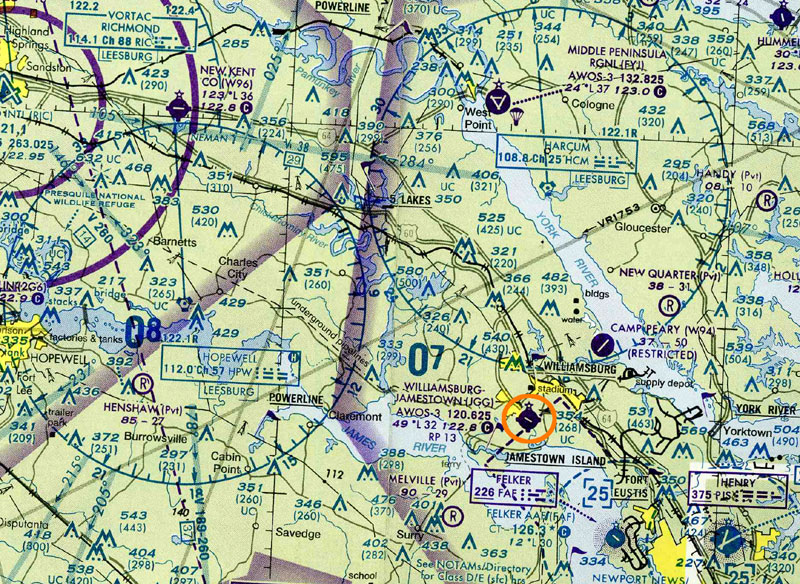
    How many strikes do I get for this one? One for bad geospatial reasoning -- HCM is almost due north of JGG, as you can see on the sectional excerpt below, not NW. Now that I really take a good hard look at the sectional (and in making that GPS track pic above), I'm so embarrassed! 240 still doesn't quite make sense -- maybe it was more like 250. Another strike for jumping the gun when I saw the H in the name and not reading the entire name. I'll take two strikes for that.


    But I do feel good about the in-flight experience. All that confusion was justified -- it was not behaving as I expected because it was following orders and my orders were flawed. My situational awareness in the air was better than on the ground. In retrospect, it all makes perfect sense for HPW being tuned in.

    That was actually kind of a good learning experience. I have a little more faith in my interpretation of the instrument, as well as some insight into using multiple VORs to determine your position.

  2. Stalls: The power-off stalls were fine. I don't care for the stall warning, and probably never will, but this time up it wasn't the worst thing to hear all by myself. The power-on stall had that little right-dip surprise, but as has been the case with many of the recent little lessons, I just did what had to be done to level and recover.

  3. Short-field landings: Why were my landings "so long" today? I overshot the short turn out on every last one of them! Procedurally, I was aiming for 500' when turning final, then putting out the remaining flaps and killing the already-low power. It was a steep descent, but at this point I was aiming for the numbers, not for a particular airspeed. My gut says I was fast, and my brain says I should have been aiming short of the numbers, although it seems that would just have made me faster. Maybe 500' (field elevation of 49') is too high for that approach, or I need to go to a glide much earlier.

    I gotta say, though, that it feels good to think of having to go to the mid-field turn out as a "long" landing, as compared to one of the earlier solo landings where I used up every last foot of the 3200'-long runway! Progress, eh?

    As for the takeoffs, you can see me turning for the pattern earlier and earlier as I got comfortable with the climb-out. The first departure is missing because I forgot to turn the GPS on before takeoff; you can also see the go-around in there...


Self-Assessment: Coming along...
    Flying
  • Preflight, taxiing, normal takeoff, : Good.
  • Short-field takeoff: Improved.
  • Soft-field takeoff: Needs practice.
  • Maintaining airspeed, stalls, slow flight (VR/IR),: Good.
  • Maintain/change attitude/altitude/heading by instruments
  • Recover attitude, altitude, heading by instruments: Acceptable.
  • Forced landing: Good, need more practice.
  • Forward slip:: Dunno, needs more practice.
  • Pattern, radio calls, normal landing, directional control after landing: Good.
  • Crosswind landing: Improved.
  • Short-field landing: Okay, needs more practice.
  • Soft-field landing: Not sure...
    Navigating
  • ADF: Okay for an intro, needs practice.
  • VOR: Needs practice.

Next: I've got the plane at 11 am on Monday, which may be a lesson or solo. If a lesson, the syllabus calls for basically a review of everything we did in 14 -- VR/IR use of navaids and stalls, short/soft-field takeoffs and landings -- plus forward slips to a landing and more IR recovery from unusual attitudes.
  • More landings of different types.
  • Practicing everything.
Hours logged this flight: 1.2
Hours logged total: 23.3
Instrument hours logged this lesson: 0
Instrument Hours logged total: 1.3
Take-offs and landings this flight: 4
Take-offs and landings total: 66
PIC hours total:: 4.4