It's a beautiful day here. Gorgeous. 388 had been scheduled to be out of town but that trip was cancelled so I'm heading out to the airport at 1 pm. TAFs predict ~5kt winds, mostly as crosswind.
As soon as I scheduled the plane 10 minutes ago, my tummy started clenching and I got jittery. At the same time, though, I picture myself sitting in the car at the airport going over everything and chilling out, so it's not so bad.
I haven't decided what my maneuver card will say today. Steep turns, power-on stall, slow-flight maneuvering, power-off stall, pattern and landings. That sounds good. I'm still uncertain about anticipating the wind for turns around a point, so I don't see the value in practicing that or S-turns today.
On the other hand, I will likely not be able to concentrate on work and may end up researching that instead!
Edit: I've been looking at "See how it flies!" and its maneuvers section. There's some good stuff in there. I will probably try this one today.
Edit: Too much! Overload! I read through a lot of the maneuver stuff on that page and talked about some things with Husband and it became obvious that I don't truly understand how it works and so I became frustrated to the point of tears. Right now I really think it will be more valuable this afternoon to just do the same thing as last time, maybe even less. You see, I had been thinking about slips and crabbing and wind correction and the turns around a point and how I could get the whole process straight in my head (see the next post!) and was just getting more and more frustrated. To the point of tears. Being up there and doing it is much easier than being down here trying to reason through it. At this stage, at least. I mean, the repitition of seeing how to deal with crosswinds on landing is really helpful and is making it sink in, but how it works in my head and how it feels to me is different from how it apparently really works and that's frustrating!
Friday, November 10, 2006

Monday, November 06, 2006
First solo maneuvers
[Update: altitude gain while trying to stall (power-on) was ~650'.]
Goals:

An overhead view of today's GPS track. Click to enlarge.
Flight: I had the plane scheduled for 2 pm and around 10 am I started to get nervous. This would be my first time flying out of range of the airport by myself, and I was going to the airport alone. This was to be all me. And that made me nervous.
Husband was asking around lunchtime why I was getting so worked up. After some thought, all I could really come up with was (1) it would be more "firsts" and (2) what if something goes horribly wrong? What if the engine gets rough? What if I get surprised by something, like colliding with a plane when rolling out of a steep turn? What if I have another reversal (i.e., thinking that pulling up will give me more airspeed)? For those kinds of fears, there's nothing he or anyone can say to allay them. They're possibilities, and they're things that only diligence and more experience can help with. But the more we chatted, the worse it got and I could see psyching myself out of going if we kept at it so I had to leave.
All the way to the airport it got worse. "Maybe I'll cut out the other maneuvers and just do a steep turn then come back." "Maybe I'll scrap it all and just stay in the pattern again today." "Maybe I should just go back to work."
Underneath it all, though, I knew the only factor there was my fear of the unknown. So I parked the car and sat for a few minutes. I closed my eyes and planned everything out. Preflight, taxi, run-up, takeoff, climb out, straight-and-level to the practice area, steep turn left, steep turn right, turn around a point left, turn around a point right, point back south, slow flight, power-on stall, head toward the airport, descend, enter the pattern, throttle back early, do the pattern, flare, land, and do another pattern/landing if things were going well.
I made my maneuver card (a 3x5 notecard) with steep turns, turns around a point and power-on stalls. I pulled out my maneuvers booklet and re-read the sections on those maneuvers. The last time I had read those was before doing any of them; amazing how much more meaningful they are now! They matched what I expected. I made extra note cards, one for each maneuver, with the basics. Steep turns: clearing turns, determine heading and altitude, roll in, gradually increase power, use opposite rudder and pull back as necessary, roll out ahead of the heading, decrease power/rudder/back pressure. This way, if i felt I needed a double-check or refresher right before doing it, I'd have a maneuver checklist. I didn't need them, but they were there.
I was prepared. Being prepared and planning took away my nerves. If everything went according to my plan, it would be just fine. If anything went awry, there would be only one option -- do the best I can.
And I followed my plan. Mostly. After taking off, I realized that it was a little bumpy. The winds were 6 kts from 150, so just a tiny crosswind for 13; I didn't notice it then but over the trees it was a little turbulent. I got up to the practice area at ~2000' and forgot to do my clearing turns. The radios were not busy in the least, and I had made a big sweeping turn to set up for my first steep turn. Not all planes have radios and despite the sweeping turn I should still have done clearing turns, but I just didn't think of it. I should have written "clearing turns" at the top of my maneuver card as a reminder; I'll do that next time.
It was turbulent out here, too. I almost called it off since I was focusing on sticking my altitude and didn't want the wind to be hosing it for me, but I decided that developing competence in calm skies was not developing competence as a pilot and moved on. I did the steep turn to the left, using more throttle (maybe full, as Chuck had advised this morning, but I don't remember specifically), right rudder and back pressure. The turn cycled between rising and falling, but I think it stayed reasonably close to my target altitude. I'd like to figure out how to get Google Earth to tell me the altitude deviations.
I rolled out and did a steep turn to the right following the same process. This one felt much, much more stable. Almost too stable... ;)
 This image (click to enlarge) is a side view of the GPS track as seen in Google Earth. From right to left it shows the left-hand steep turn, the right-hand steep turn, and then the turn around a point.
I then picked a ground reference and did a crappy turn around a point. I know why it was crappy: I couldn't visualize the wind relative to me and the reference point. I didn't know whether I was entering the turn downwind. I did the best I could manage, but decided to only do the one since there was an underlying issue that would keep me from performing up to snuff on the second.
Turning back south toward the river, I slowed down to about 60 mph IAS and initiated a power-on stall. Attempted to, anyway. I throttled up, pitched up, used my right rudder, and spent what seemed like several minutes listening to the stall warning squeal as my airspeed dropped to under 40 and the plane just kept climbing. I kept pulling back farther and farther, and my climb rate decreased but stayed positive. Eventually I got frustrated, not knowing what more I should be doing to induce it, and called that one off. I think I gained nearly a thousand feet during that.
From there it was just descend and locate the airport. On the descent I was managing RPMs, throttle and airspeed, which was super happy to get up to V(A) if I used pitch to descend. So I trimmed for about 125 and throttled back to sink more gradually.
Upon entering the pattern at ~900' (yay!), I got abeam the numbers, pulled back to ~1700 RPMs, and put down one notch of flaps. This pattern went really well, though it seemed pretty wide. On final I used the VASI to check the glide path (and I was gliding!) and it showed me as right on, even though my conservative nerves thought I was low (stupid school, houses, trees, dirt mounds!). I put in a little power for a few seconds and then went back to idle just to be sure I'd clear the threshold. It was a really nice slow landing, just a teensy bit left of centerline, no bounce, no squealing brakes! I pulled off mid-field, radioed that I was clear and did a little cockpit dance of happiness while cleaning up for another go around the pattern.
The second pattern was pretty much just like the first. It was very well set up, nicely aligned, nice and slow. Unfortunately, I didn't flare early enough or aggressively enough -- I still thought I was a little high when I did start my flare -- and I bounced it. Not a hard bounce like I've done in the past, but a bounce nonetheless. I had a few oscillations this time as I tried to figure out where neutral elevator was, and eventually I just put in a little power and tried to hold steady and it was over. No stress, no scares of running out of runway (since I had touched down in the first probably quarter of the runway), no anxiety... just a "let's fix this" feeling.
I taxiied back and parked with a big smile! :)
Discussion:
Self-Assessment: Yay! Happy cockpit dance! I talked Husband into celebrating tonight, since this was a good solo experience worth celebrating!
Next: Next Monday at 3 pm for a lesson, probably Thursday morn or Friday afternoon for another solo practice flight.
Hours logged total: 18.1
Instrument hours logged this flight: 0.0
Hours logged total: 0.8
Take-offs and landings this flight: 2
Take-offs and landings total: 50
PIC hours: 2.3
Goals:
- Leave the airport vicinity by myself.
- Practice steep turns, turns around a point, landings, and if bold enough, stalls.

Flight: I had the plane scheduled for 2 pm and around 10 am I started to get nervous. This would be my first time flying out of range of the airport by myself, and I was going to the airport alone. This was to be all me. And that made me nervous.
Husband was asking around lunchtime why I was getting so worked up. After some thought, all I could really come up with was (1) it would be more "firsts" and (2) what if something goes horribly wrong? What if the engine gets rough? What if I get surprised by something, like colliding with a plane when rolling out of a steep turn? What if I have another reversal (i.e., thinking that pulling up will give me more airspeed)? For those kinds of fears, there's nothing he or anyone can say to allay them. They're possibilities, and they're things that only diligence and more experience can help with. But the more we chatted, the worse it got and I could see psyching myself out of going if we kept at it so I had to leave.
All the way to the airport it got worse. "Maybe I'll cut out the other maneuvers and just do a steep turn then come back." "Maybe I'll scrap it all and just stay in the pattern again today." "Maybe I should just go back to work."
Underneath it all, though, I knew the only factor there was my fear of the unknown. So I parked the car and sat for a few minutes. I closed my eyes and planned everything out. Preflight, taxi, run-up, takeoff, climb out, straight-and-level to the practice area, steep turn left, steep turn right, turn around a point left, turn around a point right, point back south, slow flight, power-on stall, head toward the airport, descend, enter the pattern, throttle back early, do the pattern, flare, land, and do another pattern/landing if things were going well.
I made my maneuver card (a 3x5 notecard) with steep turns, turns around a point and power-on stalls. I pulled out my maneuvers booklet and re-read the sections on those maneuvers. The last time I had read those was before doing any of them; amazing how much more meaningful they are now! They matched what I expected. I made extra note cards, one for each maneuver, with the basics. Steep turns: clearing turns, determine heading and altitude, roll in, gradually increase power, use opposite rudder and pull back as necessary, roll out ahead of the heading, decrease power/rudder/back pressure. This way, if i felt I needed a double-check or refresher right before doing it, I'd have a maneuver checklist. I didn't need them, but they were there.
I was prepared. Being prepared and planning took away my nerves. If everything went according to my plan, it would be just fine. If anything went awry, there would be only one option -- do the best I can.
And I followed my plan. Mostly. After taking off, I realized that it was a little bumpy. The winds were 6 kts from 150, so just a tiny crosswind for 13; I didn't notice it then but over the trees it was a little turbulent. I got up to the practice area at ~2000' and forgot to do my clearing turns. The radios were not busy in the least, and I had made a big sweeping turn to set up for my first steep turn. Not all planes have radios and despite the sweeping turn I should still have done clearing turns, but I just didn't think of it. I should have written "clearing turns" at the top of my maneuver card as a reminder; I'll do that next time.
It was turbulent out here, too. I almost called it off since I was focusing on sticking my altitude and didn't want the wind to be hosing it for me, but I decided that developing competence in calm skies was not developing competence as a pilot and moved on. I did the steep turn to the left, using more throttle (maybe full, as Chuck had advised this morning, but I don't remember specifically), right rudder and back pressure. The turn cycled between rising and falling, but I think it stayed reasonably close to my target altitude. I'd like to figure out how to get Google Earth to tell me the altitude deviations.
I rolled out and did a steep turn to the right following the same process. This one felt much, much more stable. Almost too stable... ;)
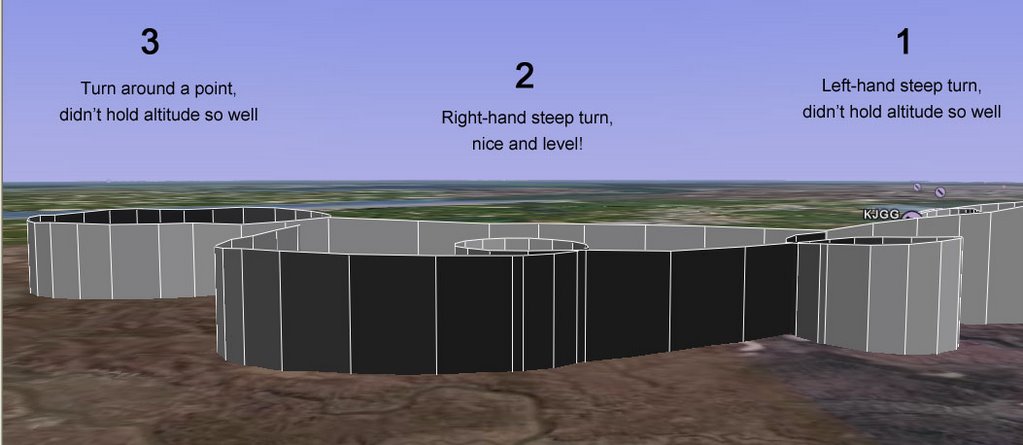 This image (click to enlarge) is a side view of the GPS track as seen in Google Earth. From right to left it shows the left-hand steep turn, the right-hand steep turn, and then the turn around a point.
 I then picked a ground reference and did a crappy turn around a point. I know why it was crappy: I couldn't visualize the wind relative to me and the reference point. I didn't know whether I was entering the turn downwind. I did the best I could manage, but decided to only do the one since there was an underlying issue that would keep me from performing up to snuff on the second.
Turning back south toward the river, I slowed down to about 60 mph IAS and initiated a power-on stall. Attempted to, anyway. I throttled up, pitched up, used my right rudder, and spent what seemed like several minutes listening to the stall warning squeal as my airspeed dropped to under 40 and the plane just kept climbing. I kept pulling back farther and farther, and my climb rate decreased but stayed positive. Eventually I got frustrated, not knowing what more I should be doing to induce it, and called that one off. I think I gained nearly a thousand feet during that.
From there it was just descend and locate the airport. On the descent I was managing RPMs, throttle and airspeed, which was super happy to get up to V(A) if I used pitch to descend. So I trimmed for about 125 and throttled back to sink more gradually.
Upon entering the pattern at ~900' (yay!), I got abeam the numbers, pulled back to ~1700 RPMs, and put down one notch of flaps. This pattern went really well, though it seemed pretty wide. On final I used the VASI to check the glide path (and I was gliding!) and it showed me as right on, even though my conservative nerves thought I was low (stupid school, houses, trees, dirt mounds!). I put in a little power for a few seconds and then went back to idle just to be sure I'd clear the threshold. It was a really nice slow landing, just a teensy bit left of centerline, no bounce, no squealing brakes! I pulled off mid-field, radioed that I was clear and did a little cockpit dance of happiness while cleaning up for another go around the pattern.
The second pattern was pretty much just like the first. It was very well set up, nicely aligned, nice and slow. Unfortunately, I didn't flare early enough or aggressively enough -- I still thought I was a little high when I did start my flare -- and I bounced it. Not a hard bounce like I've done in the past, but a bounce nonetheless. I had a few oscillations this time as I tried to figure out where neutral elevator was, and eventually I just put in a little power and tried to hold steady and it was over. No stress, no scares of running out of runway (since I had touched down in the first probably quarter of the runway), no anxiety... just a "let's fix this" feeling.
I taxiied back and parked with a big smile! :)
Discussion:
- Being alone: I can do it all by myself! And it's getting better emotionally and with confidence and all that jazz, plus it's practice so the skillz ought to be getting better, too!
- Turn around a point: I've got to figure out how to figure out what the wind is doing. The next chapter in my textbook is about weather, so maybe I'll get some theory or tricks that will set it in place.
- Power-on stall: Husband suggests that I wasn't pulling back aggressively enough. He's probably right, and I'll try it again later this week.
- Relief? I am relieved to have a good flight like that under my belt. Proof that it is getting better, after some of my experiences earlier that caused such trepidation.
Self-Assessment: Yay! Happy cockpit dance! I talked Husband into celebrating tonight, since this was a good solo experience worth celebrating!
- Preflight: Good.
- Taxiing: Good.
- Take-off: Good.
- Maintaining airspeed: Good.
- Stalls: Power-off stall, good. Power-on stall, needs practice to force it to freaking happen! Landing stall, improved, needs more practice.
- Slow flight (VR and IR): Good.
- Maintain attitude, altitude, heading by instruments: Good.
- Change attitude, altitude, heading by instruments: Good.
- Recover attitude, altitude, heading by instruments: Acceptable.
- Forced landing: Good, still need to commit the entire set of emergency procedures to memory.
- Steep turns: Great to the right, not so great to the left, obviously needs more practice!
- Turn around a point: Meh, I need to interpret/anticipate the wind.
- Pattern: Overall, good, but needs more practice.
- Landing: Improved, more practice.
- Radio calls: Decent.
Next: Next Monday at 3 pm for a lesson, probably Thursday morn or Friday afternoon for another solo practice flight.
- More of the above!
- Forward slips to landing -- me doing it!
- Crosswind takeoffs and landings
- Short/soft field takeoffs and landings
- Cross-country preparations
Hours logged total: 18.1
Instrument hours logged this flight: 0.0
Hours logged total: 0.8
Take-offs and landings this flight: 2
Take-offs and landings total: 50
PIC hours: 2.3
Wooooo!
Woo and a hoo hoo! :)
I'll post more tonight after work, but I just wanted to holler to the world that I had a good flight full of firsts right after lunch!
First solo with no one at the airport for support!
First solo leaving the airport vicinity!
First solo steep turns!
First solo turn around a point!
First solo slow flight!
First solo (attempt at a) power-on stall!
A nice first landing back at JGG!
A bouncy second landing that had no stress surrounding it!
Well, let's not celebrate that last one. Obviously I don't want to bounce, but it was notably different in that it didn't freak me out.
It was a much needed confidence booster, and I was a borderline train-wreck on my way out there, nothing but nerves.... I'll tell you how I got myself under control later. :)
I'll post more tonight after work, but I just wanted to holler to the world that I had a good flight full of firsts right after lunch!
First solo with no one at the airport for support!
First solo leaving the airport vicinity!
First solo steep turns!
First solo turn around a point!
First solo slow flight!
First solo (attempt at a) power-on stall!
A nice first landing back at JGG!
A bouncy second landing that had no stress surrounding it!
Well, let's not celebrate that last one. Obviously I don't want to bounce, but it was notably different in that it didn't freak me out.
It was a much needed confidence booster, and I was a borderline train-wreck on my way out there, nothing but nerves.... I'll tell you how I got myself under control later. :)
Friday, November 03, 2006
Sunset flight as the co-pilot
[Update: added pictures]
 Husband and I went up tonight for just under an hour. Since I've had the plane so busy, he hasn't gotten much time in and has been itching. The pretense for tonight's flight was to test the replacement VOR indicator that was just installed. For this we headed down to PHF for ILS 7.
I did the radio work, which was interesting since it was the first time that I had ever spoken on non-CTAF frequencies.
Brevity is an acquired skill. And not one that I have yet acquired!
 But as far as content goes, Husband said it was all correct. It should have been: we practiced it all several times on the way to the airport with him pretending to be ATC and Norfolk approach. Nobody yelled at me and there were no explosions or scrambled jets, so it was ok :)
What I learned from that:

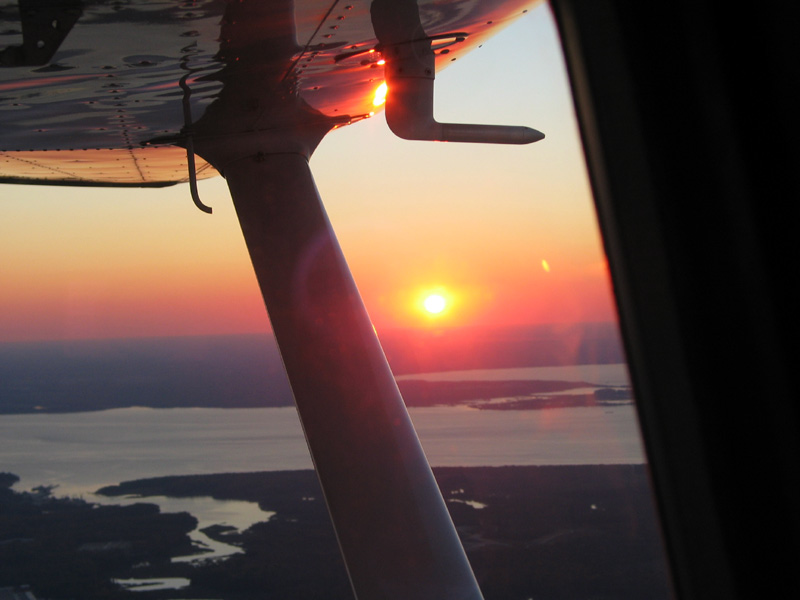
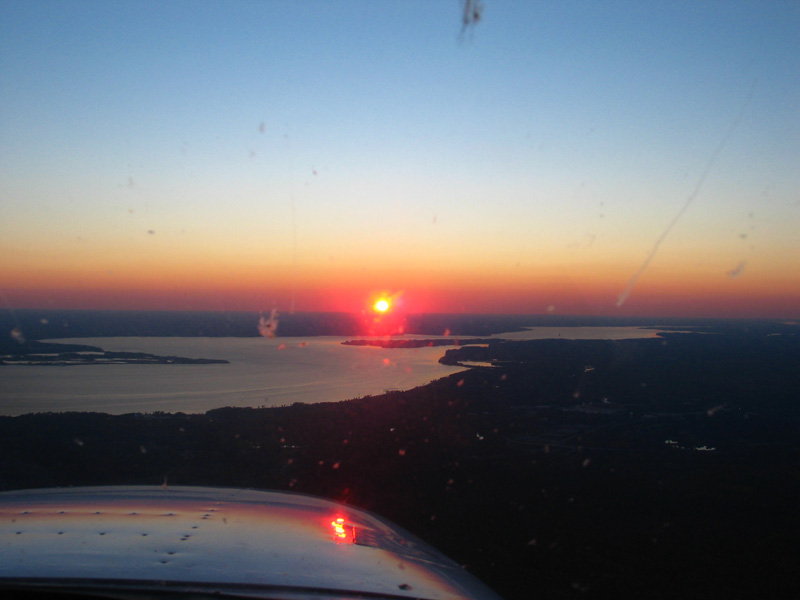
The sunset was vibrant, despite the bug guts.
He did a steep turn and we confirmed that, contrary to my previous post, I have been using the attitude indicator correctly; there are two symmetric pairs of lines in the ground portion of the indicator and the inner pair does correspond to a 45 degree bank (on our plane). The markings on the arc above the indicator still didn't show 45, so at least part of that learn-relearn-unlearn cycle was correct.
 Back at JGG, Husband had a ridiculously nice, gentle, rolling landing on 13. He was showing off. :P
 Husband and I went up tonight for just under an hour. Since I've had the plane so busy, he hasn't gotten much time in and has been itching. The pretense for tonight's flight was to test the replacement VOR indicator that was just installed. For this we headed down to PHF for ILS 7.
I did the radio work, which was interesting since it was the first time that I had ever spoken on non-CTAF frequencies.
Brevity is an acquired skill. And not one that I have yet acquired!
 But as far as content goes, Husband said it was all correct. It should have been: we practiced it all several times on the way to the airport with him pretending to be ATC and Norfolk approach. Nobody yelled at me and there were no explosions or scrambled jets, so it was ok :)
What I learned from that:
- Repeat clearances and anything that changes from what you're currently doing (different squawk, heading, altitude, etc).
- You don't have to repeat advisory info, such as winds that ATC advised of when we made first contact after being handed off by Norfolk approach.
- If your N-number can be shortened, you can't shorten it, but if the tower calls you by something shorter you can use that. (With PHF we went from 35388 to 388.)
- When doing a practice instrument approach into a towered airport and you have satisfactorily completed the approach and want to carry on without touching down, you call the tower and tell them you're "on the missed" and, if they're not too busy, tell them what you want to do. For us, we wanted to depart VFR to the NW and they gave us permission to do so, squawking 1200.
- When talking with a controller, you should end your response with your ID, especially when you're reading something back. Saying your ID is like a period at the end of a sentence. You always should say it, but sometimes it's a little more casual and obvious who's talking; there wasn't much going on over the peninsula tonight, so when Norfolk asked us to repeat what type of aircraft we were, it didn't really require a "period." I suppose that's kind of a slippery slope, though, and that good form dictates you should always end with it.
- A controller saying "Frequency change approved" means "Good-bye!"
He did a steep turn and we confirmed that, contrary to my previous post, I have been using the attitude indicator correctly; there are two symmetric pairs of lines in the ground portion of the indicator and the inner pair does correspond to a 45 degree bank (on our plane). The markings on the arc above the indicator still didn't show 45, so at least part of that learn-relearn-unlearn cycle was correct.
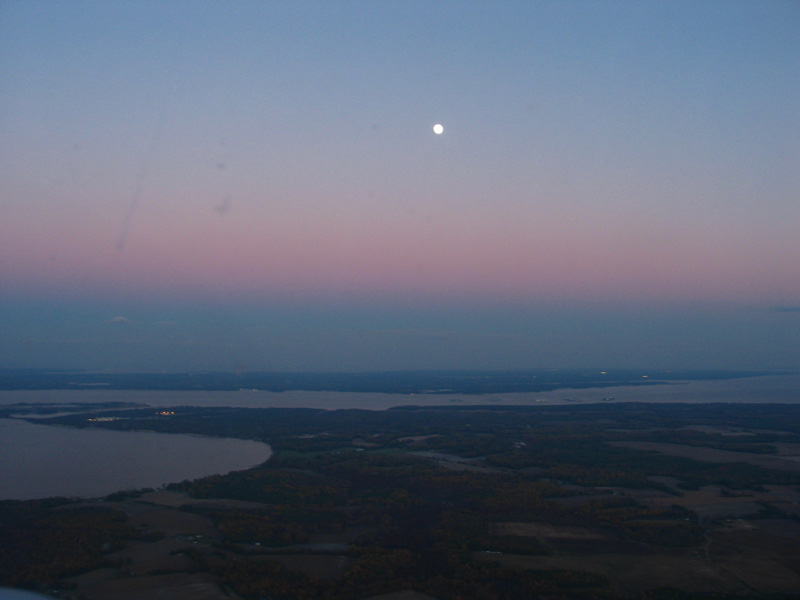 Back at JGG, Husband had a ridiculously nice, gentle, rolling landing on 13. He was showing off. :P
Thursday, November 02, 2006
Flight sim as a training aid
Husband recently upgraded to Microsoft Flight Sim X and so I got his old copy of the Century of Flight release. He had me "play" it a few times a while back, before I was even considering actually learning to fly. It was a game then.
It has a greater purpose now.
It's not very realistic since there are no rudder pedals, no carb heat (the Cessna 172 models that come in the game are more advanced than 388), no seat-of-the-pants feeling, etc. I have been unable in an hour and a half of flying in it to successfully set the trim without having to retrim within 15 seconds.
What I did like about using it last night was the chance to experiment with different control changes during a steep turn. Husband has emphasized that it's a good tool for learning to use the instruments, and that's what I was focusing on.
I got up to 2500', reduced airspeed to ~100 kts and rolled into a steep left turn. There were several learning points here.
First and foremost, I was using the indicator incorrectly to attain a 45 degree bank. The markings "on the ground" in the indicator show 30 and 60 degree bank angles; I had thought the "tighter" line was a 45 degree indication. You have to interpolate between the 30 and 60 degree markings when aiming for 45. Similarly, the notches in the arc above the indicator don't depict 45 degrees; they show 10, 20, 30, 60 and 90 degrees.
When I'm actually in the plane, it's obvious what angle the horizon is in relation to the dash and that's what I use to judge my bank. That seems pretty good for VFR training -- using the sight picture. But I do cross-check against the attitude indicator and have felt kinda sketchy about it in the past, but let it go because it looked right. Now I know better; it was sketchy because I didn't understand it.
In the flight sim, however, that narrow straight-ahead view was harder to use as a reference, so I was more focused on the indicator. Ok, good, new knowledge about the instrument.
As I began the steep turn, the VSI caught my attention as the needle swung way down, showing a high descent rate. That's not good. Descending during the turn was my problem on Tuesday, so that wasn't surprising, and I believe the extreme descent rate was attributable to the incongruence between the sim experience and real life. But here was the point of the exercise: what can I do to correct it?
Option #1: More power. This helped, but not enough. I was still sinking.
Option #2: More back pressure. This took care of it. The simulated horizon on the screen was frustratingly difficult to use, so I went back to the instruments. I tried to keep the little white "nose" dot of the attitude indicator above the artificial horizon for a little while to first stop the descent and then to ascend some.
Once I got back to 2500', I rolled out and on over to a right-hand steep turn. This time I used the attitude indicator to set up both bank and... what? Is it still called pitch when you're half-rolled-over? I guess, maybe, since it's still about the nose relative to the horizon. Now that I understood the indicator, it was much easier to hold the angle and the altitude more closely.
I also used the sim to do some stalls. Again, the reality is not there -- there's no stall break feeling, no change in G-forces, no filled vision (including peripheral) of more and more ground.... But I did get to practice slow flight in a landing configuration, coordinating throttle application with pitch control to regain airspeed and then establishing a positive climb rate, etc.
I also landed at PHF for the first time. :) It's a nice big runway, and I have not qualms about actually going there except for talking to ATC since that's not something I've done yet. I know from riding along with Husband that it's a pretty easy place to go into, so it ought to work out ok.
In summary, what good is the sim? It's realistic enough to be a useful tool for trying things out that I'm not yet confident enough to try out when life and plane are at risk. Up until last night, I was really not excited about leaving the airport vicinity by myself to go practice maneuvers all by my lonesome. I can't say that I'm really excited about it now, either, but at least less apprehensive because I have a maneuver (steep turns) that I specifically want to practice to verify the sim experience and integrate that into my "real" experience, and I feel that I can do it.
Now if this front would finish moving through so the conditions will come back down to conditions I'm allowed to fly solo in!
It has a greater purpose now.
It's not very realistic since there are no rudder pedals, no carb heat (the Cessna 172 models that come in the game are more advanced than 388), no seat-of-the-pants feeling, etc. I have been unable in an hour and a half of flying in it to successfully set the trim without having to retrim within 15 seconds.
What I did like about using it last night was the chance to experiment with different control changes during a steep turn. Husband has emphasized that it's a good tool for learning to use the instruments, and that's what I was focusing on.
I got up to 2500', reduced airspeed to ~100 kts and rolled into a steep left turn. There were several learning points here.
First and foremost, I was using the indicator incorrectly to attain a 45 degree bank. The markings "on the ground" in the indicator show 30 and 60 degree bank angles; I had thought the "tighter" line was a 45 degree indication. You have to interpolate between the 30 and 60 degree markings when aiming for 45. Similarly, the notches in the arc above the indicator don't depict 45 degrees; they show 10, 20, 30, 60 and 90 degrees.
When I'm actually in the plane, it's obvious what angle the horizon is in relation to the dash and that's what I use to judge my bank. That seems pretty good for VFR training -- using the sight picture. But I do cross-check against the attitude indicator and have felt kinda sketchy about it in the past, but let it go because it looked right. Now I know better; it was sketchy because I didn't understand it.
In the flight sim, however, that narrow straight-ahead view was harder to use as a reference, so I was more focused on the indicator. Ok, good, new knowledge about the instrument.
As I began the steep turn, the VSI caught my attention as the needle swung way down, showing a high descent rate. That's not good. Descending during the turn was my problem on Tuesday, so that wasn't surprising, and I believe the extreme descent rate was attributable to the incongruence between the sim experience and real life. But here was the point of the exercise: what can I do to correct it?
Option #1: More power. This helped, but not enough. I was still sinking.
Option #2: More back pressure. This took care of it. The simulated horizon on the screen was frustratingly difficult to use, so I went back to the instruments. I tried to keep the little white "nose" dot of the attitude indicator above the artificial horizon for a little while to first stop the descent and then to ascend some.
Once I got back to 2500', I rolled out and on over to a right-hand steep turn. This time I used the attitude indicator to set up both bank and... what? Is it still called pitch when you're half-rolled-over? I guess, maybe, since it's still about the nose relative to the horizon. Now that I understood the indicator, it was much easier to hold the angle and the altitude more closely.
I also used the sim to do some stalls. Again, the reality is not there -- there's no stall break feeling, no change in G-forces, no filled vision (including peripheral) of more and more ground.... But I did get to practice slow flight in a landing configuration, coordinating throttle application with pitch control to regain airspeed and then establishing a positive climb rate, etc.
I also landed at PHF for the first time. :) It's a nice big runway, and I have not qualms about actually going there except for talking to ATC since that's not something I've done yet. I know from riding along with Husband that it's a pretty easy place to go into, so it ought to work out ok.
In summary, what good is the sim? It's realistic enough to be a useful tool for trying things out that I'm not yet confident enough to try out when life and plane are at risk. Up until last night, I was really not excited about leaving the airport vicinity by myself to go practice maneuvers all by my lonesome. I can't say that I'm really excited about it now, either, but at least less apprehensive because I have a maneuver (steep turns) that I specifically want to practice to verify the sim experience and integrate that into my "real" experience, and I feel that I can do it.
Now if this front would finish moving through so the conditions will come back down to conditions I'm allowed to fly solo in!
Wednesday, November 01, 2006
Air legs?
You know how after you spend a few hours on a boat your legs on land are kinda wobbly and you feel like you're rocking?
I had that all day yesterday, except I felt like I was turning. Sitting in my chair at work for the afternoon I found that I was leaning to the left for much of the time, and my eyes kept wandering to the left and up. My equilibrium was slightly out of whack, too.
This must have been from doing so much turning yesterday -- clearing turns, steep turns, turns around a point, traffic patterns, etc. We probably only spent a fourth of the two hours straight and level.
It was freaky. Fitting for Halloween :)
I had that all day yesterday, except I felt like I was turning. Sitting in my chair at work for the afternoon I found that I was leaning to the left for much of the time, and my eyes kept wandering to the left and up. My equilibrium was slightly out of whack, too.
This must have been from doing so much turning yesterday -- clearing turns, steep turns, turns around a point, traffic patterns, etc. We probably only spent a fourth of the two hours straight and level.
It was freaky. Fitting for Halloween :)
Tuesday, October 31, 2006
Phase check
Happy Halloween! Bwah-ha-ha!
Goals:
Flight: Today Dan, another instructor with Colonial, braved the air with me for a phase check. The phase check is a chance for a different instructor, one who hasn't been involved in my training so far, to see how I'm progressing and verify that I'm learning what I need to know. It's also an implicit check-up on my instructor to see that he's teaching the right stuff.
The idea was pretty simple: Go up and demonstrate most everything I've learned. Takeoff, turns to headings, climb, descend, hold altitude and heading, clearing turns, steep turns, turns around a point, slow flight, turning during slow flight, power-off stalls, emergency procedures, patterns, landings. Radio work and taxiing are of course included in there, too. We talked about a power-on stall, but I truly don't remember doing it, so maybe we skipped it. We also skipped S turns since I've done only one with Chuck and obviously would need more practice.
We departed 13 and turned up river. I had a mental gaflurble when he asked for a steep turn, thinking "steep turn arount a point." After realizing my lapse into stupidity, I did it, once to the right and once to the left.
Next came the turn around a point. There was a little wind and my constant-radius turn was not quite so constant. It was decent, but not perfect and that irritates me.
We worked our way up the peninsula toward West Point doing slow flight maneuvers and a power-off stall. We talked about power-on stalls as we crossed the York River, but golly I still don't remember actually performing one. Oh, maybe it was around that time that we heard the other Cessna talking about doing a VOR hold nearby and we called it off? Well, no, I could make up a memory of doing it... I don't know. Geez, I'd be a terrible crime or accident witness.
Maybe we did do it, and climbed some then because next we did a simulated engine-out from 3000'. With Chuck I had always done them from much lower, usually 1500-2000', so this was different. It demanded a different assessment of potential landing spots since there was so much altitude (ha, like 3000' is so much!) to lose. I Vy'ed (more on this in the discussion) and picked a grouping of fields off my left. I then reached for my checklist as Dan asked what else I'd do. He said "ABC" -- Airspeed, Best landing site, Checklist. We quickly went through the checklist items and then resumed with the flying. We crossed midfield well over the 1100' I'm trained to shoot for, having started only moments ago at 3000', so I went long before turning back toward the field, reassessing the surroundings to see if a different field would be better. We were looking good for the field and still had more flaps that could be used, but Dan took the opportunity to demonstrate a forward slip at that time. I probably winced a little as we passed over a solitary farmhouse and patch of trees... We probably weren't as low as it seemed to me, but nonetheless, that was the closest to the target forced landing site I'd ever been!
We turned up to FYJ, tuned in the AWOS and decided that 27 would be the favored runway (winds out of 210). We found the guy doing the VOR hold and were well clear. We were fast and high when abeam the numbers, so went long and descended with flaps and killed off the power. As we got close to the runway, though, we saw two trucks, one on either side of the runway, about two-thirds down and decided to abort the landing. I called UNICOM for an advisory and they assured us that the trucks were off the shoulder, so we approached again and went in for the landing.
This first landing was mostly good. The value of the first go-around was to see that dropping the left wing to counter the crosswind was useful, and helped a lot on the second final approach. After rounding out, we started to drift to the right (crosswind) so I put in left rudder to stay toward the centerline. Dan said use right rudder to maintain centerline. This confused me quite a bit, since I felt we were already right of the centerline. But he's the instructor, so we right-ruddered it and landed. A long taxi back up the length of the field and we were off.
The second (third?) time around the pattern was good, too, and the landing was ok. We bounced a little, but it was ok. Another long taxi and we waited for Mr. VOR-hold as he did a touch-and-go, then we were off. We headed back down to my home airport and were being followed (ha) by a military helicopter. After a little chat we found them at our 4 o'clock at 500', out of our concern. 45 for right downwind for 13, good to go.
Except that we were high and fast. And the correction wasn't coming quickly enough. Dan was giving me instructions that I tried to follow, but his focus on RPMs was different from my focus on descent rate, so my brain wasn't working quite fast enough to convert the domains. Long story short, we were too high and went around.
Second time around was similar but not as high. We set up for a longer final and came in with more time to get down. We got down but were fast and so had a long float and had to rollout to the end of the runway. Dan actually took over the controls after I rounded out, which kind of annoyed me, but I didn't say anything since he's the instructor, he's the pilot in command, he couldn't have known one way or the other whether it would be ok for me, and I don't expect to fly with him very often.
Discussion:
Self-Assessment: Not so positive after today, but still learning.
Next: ???
Hours logged total: 17.4
Instrument hours logged this flight: 0.0
Hours logged total: 0.8
Take-offs and landings this flight: 3
Take-offs and landings total: 48
PIC hours: 1.6
Goals:
- Phase check.
- Crosswind maneuvers, weather permitting.
Flight: Today Dan, another instructor with Colonial, braved the air with me for a phase check. The phase check is a chance for a different instructor, one who hasn't been involved in my training so far, to see how I'm progressing and verify that I'm learning what I need to know. It's also an implicit check-up on my instructor to see that he's teaching the right stuff.
The idea was pretty simple: Go up and demonstrate most everything I've learned. Takeoff, turns to headings, climb, descend, hold altitude and heading, clearing turns, steep turns, turns around a point, slow flight, turning during slow flight, power-off stalls, emergency procedures, patterns, landings. Radio work and taxiing are of course included in there, too. We talked about a power-on stall, but I truly don't remember doing it, so maybe we skipped it. We also skipped S turns since I've done only one with Chuck and obviously would need more practice.
We departed 13 and turned up river. I had a mental gaflurble when he asked for a steep turn, thinking "steep turn arount a point." After realizing my lapse into stupidity, I did it, once to the right and once to the left.
Next came the turn around a point. There was a little wind and my constant-radius turn was not quite so constant. It was decent, but not perfect and that irritates me.
We worked our way up the peninsula toward West Point doing slow flight maneuvers and a power-off stall. We talked about power-on stalls as we crossed the York River, but golly I still don't remember actually performing one. Oh, maybe it was around that time that we heard the other Cessna talking about doing a VOR hold nearby and we called it off? Well, no, I could make up a memory of doing it... I don't know. Geez, I'd be a terrible crime or accident witness.
Maybe we did do it, and climbed some then because next we did a simulated engine-out from 3000'. With Chuck I had always done them from much lower, usually 1500-2000', so this was different. It demanded a different assessment of potential landing spots since there was so much altitude (ha, like 3000' is so much!) to lose. I Vy'ed (more on this in the discussion) and picked a grouping of fields off my left. I then reached for my checklist as Dan asked what else I'd do. He said "ABC" -- Airspeed, Best landing site, Checklist. We quickly went through the checklist items and then resumed with the flying. We crossed midfield well over the 1100' I'm trained to shoot for, having started only moments ago at 3000', so I went long before turning back toward the field, reassessing the surroundings to see if a different field would be better. We were looking good for the field and still had more flaps that could be used, but Dan took the opportunity to demonstrate a forward slip at that time. I probably winced a little as we passed over a solitary farmhouse and patch of trees... We probably weren't as low as it seemed to me, but nonetheless, that was the closest to the target forced landing site I'd ever been!
We turned up to FYJ, tuned in the AWOS and decided that 27 would be the favored runway (winds out of 210). We found the guy doing the VOR hold and were well clear. We were fast and high when abeam the numbers, so went long and descended with flaps and killed off the power. As we got close to the runway, though, we saw two trucks, one on either side of the runway, about two-thirds down and decided to abort the landing. I called UNICOM for an advisory and they assured us that the trucks were off the shoulder, so we approached again and went in for the landing.
This first landing was mostly good. The value of the first go-around was to see that dropping the left wing to counter the crosswind was useful, and helped a lot on the second final approach. After rounding out, we started to drift to the right (crosswind) so I put in left rudder to stay toward the centerline. Dan said use right rudder to maintain centerline. This confused me quite a bit, since I felt we were already right of the centerline. But he's the instructor, so we right-ruddered it and landed. A long taxi back up the length of the field and we were off.
The second (third?) time around the pattern was good, too, and the landing was ok. We bounced a little, but it was ok. Another long taxi and we waited for Mr. VOR-hold as he did a touch-and-go, then we were off. We headed back down to my home airport and were being followed (ha) by a military helicopter. After a little chat we found them at our 4 o'clock at 500', out of our concern. 45 for right downwind for 13, good to go.
Except that we were high and fast. And the correction wasn't coming quickly enough. Dan was giving me instructions that I tried to follow, but his focus on RPMs was different from my focus on descent rate, so my brain wasn't working quite fast enough to convert the domains. Long story short, we were too high and went around.
Second time around was similar but not as high. We set up for a longer final and came in with more time to get down. We got down but were fast and so had a long float and had to rollout to the end of the runway. Dan actually took over the controls after I rounded out, which kind of annoyed me, but I didn't say anything since he's the instructor, he's the pilot in command, he couldn't have known one way or the other whether it would be ok for me, and I don't expect to fly with him very often.
Discussion:
- Swapping instructors: At first I was looking forward to flying with another instructor, getting another point of view, getting additional pointers. But it was too different. Chuck is a retired military pilot; Dan is a college student. Their experience levels both as pilots and as instructors is different. Their generations are different. I'm absolutely not trying to say one is better than the other, but they are notably different.
This was kinda bad for me. I do things a certain way, the way that I was taught. I have it in my head that there are "correct" ways to do things, and that's how I do it because that's what my instructor taught me. I know there are different ways for doing things. I've asked three different 300+-hour pilots recently what crabbing on final means to them and I got three different answers. There's room for art among the procedures.
But I found it frustrating. Maybe it's just the point of training that I'm at. I'm in a position of trying to be confident in what I know so I can go up and practice by myself. But here I go up with someone else who does things differently and gives different clues for dealing with little things. That naturally makes me wonder whether I know what I need to know to be safe in all situations! I can't know everything, but should I know more?!?! Is my "this is how it's done" mentality too rigid or limited? I believe I've shown a level of adaptability that's good, but can I do and do I know enough?
This also reminds me of Greybeard's warning against having too many instructors... - Vy v. Best glide: For the engine-out emergency procedures I go for Vy. That's what I was taught. Vy gives you the most run for your rise. (As compared to Vx which gives you the most time for your rise, when you're on the descent side of things.) Dan questioned that, and after we finished the emergency pseudo-landing and were cruising along he asked for the POH. In there he found a chart that gave best glide speed as 80 mph, compared to our Vy of 83. Your engine dies, it's turbulent, you're not going to stick a precise airpseed, so Vy is probably close enough (for my plane). But the point here is that they're different.
- Who's landing style? A good example of the aforementioned difference in instruction is the pattern for landing. Airspeed is my primary criteria, then descent rate. I change those items based on the situation using flaps and throttle. Dan's approach is first to throttle back to a specific RPM for the plane (1700 for 388) when abeam the numbers. Turns out that's also how Husband does it, too, and Husband's training is more similar, I'm sure, to Dan's. Abeam the numbers, I expect to already be at ~80-85 mph at pattern altitude and then put out one notch of flaps; I'll adjust power and pitch to ensure my descent rate is what it ought to be without losing airspeed. But the point is that the points of reference were different and the brief busy time of abeam-base-final is not a good time to try to adapt to something new.
I hear that people prefer to do flapless landings when possible, and in the case of last-minute go-arounds or possibly even for engine failure I could see why: on go-around it's one less configuration change to worry about when transitioning from landing to taking off and on engine failure it extends your glide possibilities to not have them increasing drag and descent rate.
Today we were going to use flaps regardless, but I'm trying to evaluate the focus on RPMs. Let's say you're trimmed for 85 on downwind. If you pull out power, you descend (without flaps). I can see that. You also want to be at idle on final, so paying attention to throttle early probably helps to ensure this. Depending on when/how you turn base and final, you then have flaps to use if you want them. Flaps increase your descent rate without increasing airspeed, and from the abeam point (in our plane) you want to drop 15-20 mph. If you're high on final and already at idle, flaps (or slipping) are the only options aside from going around.
You're also not supposed to slip with more than 20 degrees of flaps on our plane, so I suppose being more conservative with the use of flaps when you can leaves more options.
I like the way I do it now. I have a decent sight picture for how the runway should look at the corners of my pattern and I have a feeling for power, flaps and descent rates. This is based on one notch of flaps abeam, and another notch on base. When I do it correctly, when my speed and altitude are correct upon entering the pattern, this works great. If I'm fast or high, I know what I can do to correct it using throttle or extending downwind or going around. - How it works: I certainly take for granted that Chuck and I know how to work together and he knows my capabilities and limitations. That landing at JGG when Dan took the controls irked me. I think Chuck would have let me land it, but he has seen me through 40+ landings and would be able to judge that. I wonder also if it's harder for a newer CFI to let a student make mistakes or handle a non-optimal (but not dangerous) situation.
- Turning altitudes: I have a problem. I always gain altitude when turning. For whatever reason, I naturally pull back while turning. When landing, I correct that quickly since I have frequent checks of IAS. When doing turns around a point or steep turns, however, I don't manage it well. Today this was mainly demonstrated with the steep turn, only I lost altitude, and was steadily but slowly descending without correcting it effectively. I tried right rudder to turn the nose up to the right (during a left turn), but didn't feel that was the right thing since the slip coordinator ball said otherwise. Husband says back-pressure would have been right, and that makes since since half the lift would go up and half would go horizontally. I didn't want to pull back in the moment because I didn't want to tighten the turn.
Dan said my bank wasn't right. I thought, "Steep turn means 45 degrees" so the bank is kinda set, right?" Problems with altitude shouldn't have to do with the bank, from what I could tell. I'm not saying Dan was wrong -- he's the CFI so surely he was right -- and I wish I could remember what he said specifically so I could try to resolve it against my understanding, but I can't. I was descending during my steep turn, and I think he said I wasn't banked enough, but that must not have been it because it doesn't make sense! Grrr!
But he also said I could have added some power to stop the descent. Now that makes sense to me all around. In fact, during the next steep turn, that's what I did and it worked. It worked so well that on rollout when I didn't pull the power back, we continued to climb for another 200-300' before I got on top of it and leveled out. In light of that, I now wonder if (or really, assume that) he was telling me that my bank was just wrong period for a steep turn and that we needed to fix that before dealing with the other flaws in my steep turn. - Crosswind landings: I do actually feel like I got a little better feel for handling a crosswind today. Since it wasn't gusty, I got to feel the effectiveness of dipping the upwind wing. It kinda just felt right, so maybe the conditions finally cooperated to give me the landing experience I needed to just see it!
Self-Assessment: Not so positive after today, but still learning.
- Preflight: Good.
- Taxiing: Good.
- Take-off: Good.
- Maintaining airspeed: Good.
- Stalls: Power-off stall, good. Power-on stall, good. Landing stall, improved, needs more practice.
- Slow flight (VR and IR): Good.
- Maintain attitude, altitude, heading by instruments: Good.
- Change attitude, altitude, heading by instruments: Good.
- Recover attitude, altitude, heading by instruments: Acceptable.
- Forced landing: Good, still need to commit the entire set of emergency procedures to memory.
- Pattern: Overall, good, but needs more practice.
- Landing: Improved, more practice.
- Radio calls: Decent.
Next: ???
- More of the above!
- Forward slips to landing -- me doing it!
- Crosswind takeoffs and landings
- Cross-country preparations
Hours logged total: 17.4
Instrument hours logged this flight: 0.0
Hours logged total: 0.8
Take-offs and landings this flight: 3
Take-offs and landings total: 48
PIC hours: 1.6
Monday, October 30, 2006
Solo landing practice
Goals:
Flight: This was kinda fun because we took a long lunch so I could do a few practice patterns and take advantage of the calm conditions. There was just a hint of a breeze so 13 was favored; almost all of my training sessions used 13, but not once since the day of the solo (including the solo) has 13 been favored. So it was something new for me.
My first landing was pretty good. Not really any complaints here. I tracked the centerline well, rounded out well, landed well, a teensy bit right of centerline, but it was probably the best landing I've done by myself so far. No bounce, no big deviations during rollout... Nice and normal.
On my second approach, I wasn't losing altitude as quickly as I should have been by the time I turned base and ended up really high on final; I had been trying to do a tighter pattern than my usual lazy wide pattern but went too tight for my capabilities. I only had 20 degrees of flaps down and could have put down 20 more, but I really didn't like how very high I was, so I called a go-around and went around, wider this time.
That was good... I had a nice second landing, too! :) I had some squealy braking after touching down, which Husband (who came to watch :) ) says is because I braked too hard and locked them up, but that'll get better.
The third landing was not so nice. On base, I glanced down at my altimeter and was only at ~400', which is low for that base leg. Well, it's low for any of my base legs (field elevation is 49'). So I put some power back in to belay the sinking. I turned base and final and was still high, but not as high as the second approach when I did go around, so I decided to try using all 40 degrees of the flaps. I came down faster, but still not fast enough for my liking. I wrestled with whether to do another go-around as I neared the threshold, as I crossed the threshold... I still had altitude to drop, but I had never done a go-around from a full-flaps configuration and from what I learned later, it's good that I decided against going around. I floated past the mid-field turnoff and started to get a little anxious. I could see the end of the runway, which frankly I had never even really noticed on landing before!!!!
I did finally touch down, and bounced. My brain instantly screamed "NEUTRALIZE!" and I thought I had but I bounced again. I tried again and started easing on the brakes -- I could see the swamp monster's horns getting bigger! And that got it. I came down for the last time and braked as quickly as I could, again with some squealing. I made the turnoff that's about 30' short of the end of the runway.
Wooo! Three landings, no grass and a quickly corrected PIO!
Discussion:
Self-Assessment: Showing improvement.
Next: Tomorrow morning I am scheduled to go up with another instructor, Dan, for a phase check. If there are any winds, maybe we'll also get in a little wind-management practice. I'm also supposed to be going up every 3-4 days now, by myself if that's how the timing works out. I am to start small (today was small -- not leaving the airport vicinity is as small as it gets, right?) and add maneuvers incrementally so that I get to practice everything by myself.
Hours logged total: 15.6
Instrument hours logged this flight: 0.0
Hours logged total: 0.8
Take-offs and landings this flight: 3
Take-offs and landings total: 45
PIC hours: 1.6
- Practice landing.
- Practice being alone! Eeeeeee!
Flight: This was kinda fun because we took a long lunch so I could do a few practice patterns and take advantage of the calm conditions. There was just a hint of a breeze so 13 was favored; almost all of my training sessions used 13, but not once since the day of the solo (including the solo) has 13 been favored. So it was something new for me.
My first landing was pretty good. Not really any complaints here. I tracked the centerline well, rounded out well, landed well, a teensy bit right of centerline, but it was probably the best landing I've done by myself so far. No bounce, no big deviations during rollout... Nice and normal.
On my second approach, I wasn't losing altitude as quickly as I should have been by the time I turned base and ended up really high on final; I had been trying to do a tighter pattern than my usual lazy wide pattern but went too tight for my capabilities. I only had 20 degrees of flaps down and could have put down 20 more, but I really didn't like how very high I was, so I called a go-around and went around, wider this time.
That was good... I had a nice second landing, too! :) I had some squealy braking after touching down, which Husband (who came to watch :) ) says is because I braked too hard and locked them up, but that'll get better.
The third landing was not so nice. On base, I glanced down at my altimeter and was only at ~400', which is low for that base leg. Well, it's low for any of my base legs (field elevation is 49'). So I put some power back in to belay the sinking. I turned base and final and was still high, but not as high as the second approach when I did go around, so I decided to try using all 40 degrees of the flaps. I came down faster, but still not fast enough for my liking. I wrestled with whether to do another go-around as I neared the threshold, as I crossed the threshold... I still had altitude to drop, but I had never done a go-around from a full-flaps configuration and from what I learned later, it's good that I decided against going around. I floated past the mid-field turnoff and started to get a little anxious. I could see the end of the runway, which frankly I had never even really noticed on landing before!!!!
I did finally touch down, and bounced. My brain instantly screamed "NEUTRALIZE!" and I thought I had but I bounced again. I tried again and started easing on the brakes -- I could see the swamp monster's horns getting bigger! And that got it. I came down for the last time and braked as quickly as I could, again with some squealing. I made the turnoff that's about 30' short of the end of the runway.
Wooo! Three landings, no grass and a quickly corrected PIO!
Discussion:
- Appropriately shaped patterns: I wasn't trying to overshoot my capabilities by doing a tight pattern; I just wanted to not have a 45-minute base leg! Ha ha ha, they're obviously not that bad, but my patterns have been very wide and I'd like for them to be tighter. I misjudged how tight I made that second pattern, and thus had to go around.
When I'm abeam the numbers, I aim for a 500'/min descent rate. Since my base leg was much shorter, I didn't have as much time to spend at that descent rate and so didn't descend as much and of course was too high. I'd like to not be so attached to that descent rate, or to hitting certain altitudes at my pattern corners. But for now those are the numbers that I know, and I know that if I've hit them it will be obvious to me what I need to do to fix the situational differences. - Go arounds: The go around that I executed was fine. I was still at at least 200' when I decided and started on it, so putting in the carb heat and throttle while milking up the flaps felt fine. On the third landing, I knew I was in a different situation with 40 degrees of flaps down and only 30' off the ground.
I found out from Husband that initiating a go around from 40 degrees of flaps starts with going immediately to 20 degrees of flaps. I didn't know that, and would have started just like the one I did do -- power first, then gradual withdrawal of the flaps. With 40 degrees of flaps and full power, there's not nearly enough lift to climb, so that would have been a bad decision. However, I had the opportunity enough times before putting out those extra flaps to go around, and that would have been the right thing to do. - Being in a hurry to land: On my third landing, I was anxious to get down when I saw the mid-field turnoff go by and I had decided not to go around. Instead of patiently settling down onto the runway, I plopped in and reaped the consequences: a bounce. As I bounced up and saw the end of the runway coming toward me, I actually said out loud "I don't have room for this." "This" being a string of bounces. I can't say which was worse in this case of diminishing runway length -- my shorter, bouncy landing or a longer, more patient landing. What I can say is that I'm impressed and glad to see just how quickly 388 can stop! I don't think being in a hurry contributed to my decision to not abort the landing, but thereagain, had I gone around....
- A chain of errors: That last landing was a chain of errors. Back on downwind, I must have started descending too early or too quickly. That led to me being low on base. That led to me putting in more power. That led to me having too much power on final. That led to me not dropping enough on final. I didn't make the correct decision somewhere around that time in the chain to go around. All of that led to rounding out farther down the runway than usual and then rounding out badly which led to too much float, which led to me getting ancy, which led to the bounce. Luckily it all turned out ok, but the lesson here is that it could have been prevented by better choices earlier.
- Shaking and braking: I wasn't frightened or tense or anything like that today (until the third touchdown) but I was feeling an extreme amount of muscle fatigue in my quads. (I am a beefcake! ha ha ha) After my second takeoff, my legs were shaking as I applied rudder. Husband says that early in his training and sometimes still during run-ups he'll find his legs shaking and it's just a reminder that it really doesn't take much pressure to apply the brakes. Given the squealing tires on the second landing -- and it wasn't long and drawn out, more like a few little chirps -- I would bet big dollars that I'm working too hard on them. That third landing shows that the brakes are quite effective, so I just gotta learn the feel of them.
- To regret or not to regret? I made the wrong decision on the third landing; I should have gone around. It worked out ok, but again, the luck bucket draineth. It should have been aborted.
I will make the go-around decision correctly in the future and avoid that risky situation. That said, no, I don't regret it. I learned a lot from that landing. About how things look, about what I did wrong, about consequences for a variety of choices, about braking, ... I think I got more experience droplets from it than the amount of luck droplets that were used. - Being alone: I'm nervous going up alone! It's not an overt nervousness, but during the third landing it would have been nice to have someone experienced in the right seat giving suggestions on correcting the situation. There's some latent feeling, some mild discomfort, knowing that when I'm up alone that I'm up alone and that it's all up to me. With practice and experience I expect that will go away.
Self-Assessment: Showing improvement.
- Preflight: Good.
- Taxiing: Good.
- Take-off: Good.
- Maintaining airspeed: Good.
- Stalls: Power-off stall, good. Power-on stall, good. Landing stall, improved, needs more practice.
- Slow flight (VR and IR): Good.
- Maintain attitude, altitude, heading by instruments: Good.
- Change attitude, altitude, heading by instruments: Good.
- Recover attitude, altitude, heading by instruments: Acceptable.
- Forced landing: Good, still need to commit the entire set of emergency procedures to memory.
- Pattern: Overall, good, but needs more practice.
- Landing: Improved, more practice.
- Radio calls: Decent.
Next: Tomorrow morning I am scheduled to go up with another instructor, Dan, for a phase check. If there are any winds, maybe we'll also get in a little wind-management practice. I'm also supposed to be going up every 3-4 days now, by myself if that's how the timing works out. I am to start small (today was small -- not leaving the airport vicinity is as small as it gets, right?) and add maneuvers incrementally so that I get to practice everything by myself.
- More of the above!
- Forward slips to landing
- Crosswind takeoffs and landings (come on, weather! Give us useful winds!)
- Cross-country preparations
Hours logged total: 15.6
Instrument hours logged this flight: 0.0
Hours logged total: 0.8
Take-offs and landings this flight: 3
Take-offs and landings total: 45
PIC hours: 1.6
Wednesday, October 25, 2006
What?
At the Dog's annual exam today, I asked the vet about taking him flying with us. He's been doing great and wears hearing protection, but I wanted to know if there was anything odd about dog physiology compared to people when it came to altitude or G-forces or anything. Let's preface this by saying that I really, really like and respect our vet; she's extremely good with our animals and I trust her.
She asked if we had a parachute for him.
I thought she was kidding.
She was serious. After a moment of stunned silence, I said, "No."
And so she said, "So if something goes wrong, do you just crash?"
Oookaaaayyy... After another moment of stunned silence during which I wrestled with what the right amount of information would be, I said something along the lines of "Things rarely go wrong, and when they do, they're usually landable. It's only the extreme cases that you hear about."
Not that I'm an expert or have any statistics or great arguments, but what do you briefly say to someone to allay their ignorance without getting on a soapbox and without leaving open avenues for further sensationalism?
She asked if we had a parachute for him.
I thought she was kidding.
She was serious. After a moment of stunned silence, I said, "No."
And so she said, "So if something goes wrong, do you just crash?"
Oookaaaayyy... After another moment of stunned silence during which I wrestled with what the right amount of information would be, I said something along the lines of "Things rarely go wrong, and when they do, they're usually landable. It's only the extreme cases that you hear about."
Not that I'm an expert or have any statistics or great arguments, but what do you briefly say to someone to allay their ignorance without getting on a soapbox and without leaving open avenues for further sensationalism?
Tuesday, October 24, 2006
Flight training cost
I tallied up the cost of training up to yesterday's re-solo. It was 15 hours of flight instruction time in my own plane plus 5 hours of ground instruction (pre- and post-flight briefings).
15 hours in my plane runs around $50/hour. That includes gas, hourly engine reserve, and an amortization of our share of the monthly/annual costs of ownership (since I've done most of the flying for the past 5 weeks!). That does not include our initial partnership "investment," which goes toward more than just my training and which we would have made whether I decided to train or not.
The flight school's slightly newer 172s rent for $120/hour wet, I've heard.
Beyond that, the costs are the same for instruction, regardless of who owns the plane. I know that one nearby flight school has an "insurance" surcharge for using your own plane that adds $12/hour to the instruction cost, but that's sketchy in a used-car-salesman kind of way -- our insurance policy covers me specifically and has an "open pilot clause" that covers anyone who meets certain experience requirements, which should be easy for an instructor for a 172.
15 hours in my plane runs around $50/hour. That includes gas, hourly engine reserve, and an amortization of our share of the monthly/annual costs of ownership (since I've done most of the flying for the past 5 weeks!). That does not include our initial partnership "investment," which goes toward more than just my training and which we would have made whether I decided to train or not.
The flight school's slightly newer 172s rent for $120/hour wet, I've heard.
Beyond that, the costs are the same for instruction, regardless of who owns the plane. I know that one nearby flight school has an "insurance" surcharge for using your own plane that adds $12/hour to the instruction cost, but that's sketchy in a used-car-salesman kind of way -- our insurance policy covers me specifically and has an "open pilot clause" that covers anyone who meets certain experience requirements, which should be easy for an instructor for a 172.
Monday, October 23, 2006
The shirttail...
For student pilots, the first solo is a momentous occasion. Mine was momentously bad, but the re-solo was super. I've talked to a few folks over the past couple of days about their first lone flights, and they spoke of exhilaration and being weak in the knees afterwards even when everything went great.
There's also a tradition with earning a solo endorsement that many flight schools observe: The cutting of the shirttail. After a successful solo, the student's shirttail is cut off, signed and tacked onto the flight school's wall. It's a trophy, a memento of progress.
 Chuck had Husband cut it off on Saturday, and we unfortunately didn't have a working magic marker. But that ended up good, because I got to take it home and decorate it. There are the elements of my first solo: crosswind, landings on 31, the swamp monster, the dirt hills off the end of 13, and the turkey that was hanging out by the runway (he didn't get a mention in my earlier posts, but there he was and his 4-5 brethren were undoubtedly nearby).
Mine is the first one for Colonial Flight School, and I made sure it would be a girlie one!
There's also a tradition with earning a solo endorsement that many flight schools observe: The cutting of the shirttail. After a successful solo, the student's shirttail is cut off, signed and tacked onto the flight school's wall. It's a trophy, a memento of progress.
 Chuck had Husband cut it off on Saturday, and we unfortunately didn't have a working magic marker. But that ended up good, because I got to take it home and decorate it. There are the elements of my first solo: crosswind, landings on 31, the swamp monster, the dirt hills off the end of 13, and the turkey that was hanging out by the runway (he didn't get a mention in my earlier posts, but there he was and his 4-5 brethren were undoubtedly nearby).
Mine is the first one for Colonial Flight School, and I made sure it would be a girlie one!
Re-solo
Goals:
Flight:
The flight was fine. There was a 5-6 kt wind out of 350, so we used 31 and had only a minor crosswind. Out at the practice area we did a left-hand and a right-hand turn around a point. This was actually interesting today because there was some wind and I couldn't just hold a certain bank and sit back.
Back at JGG we did three landings, all of which went fine, only one of which had a bounce to it. On one I kept the power in longer than usual so on final we had a steeper descent than usual, but it turned out just fine; that might have been the bouncer. Chuck asked what I wanted to do. I said I wanted to do a pattern by myself and if it went well, do another. If it didn't go well, I wanted him to come back on-board and we'd do more together. I was apprehensive but positive.
All three of my solo ones went fine. No bumpiness or turbulence in any part of the pattern except for a lethargic swamp monster. A little wobbliness on the ground just after landing, but no where near as bad with the directional control as what I demonstrated on Saturday. No grass in the nosegear this time. :)
Discussion:

Self-Assessment: Better, happier, more productive...
Next: First fully unsupervised by-myself solo (with no instructor watching from the ground) and also a phase-check with one of the other instructors to make sure I'm learning the right things in the right way. Then in another two weeks or so, we'll start on flight planning, cross-country flights, and night flying.
Hours logged total: 15.0
Instrument hours logged this lesson: 0.0
Instrument Hours logged total: 0.8
Take-offs and landings this flight: 6
Take-offs and landings total: 42
PIC hours total:: 1.0!!!
- Re-solo.
- Turns around a point with some wind.
Flight:
The flight was fine. There was a 5-6 kt wind out of 350, so we used 31 and had only a minor crosswind. Out at the practice area we did a left-hand and a right-hand turn around a point. This was actually interesting today because there was some wind and I couldn't just hold a certain bank and sit back.
Back at JGG we did three landings, all of which went fine, only one of which had a bounce to it. On one I kept the power in longer than usual so on final we had a steeper descent than usual, but it turned out just fine; that might have been the bouncer. Chuck asked what I wanted to do. I said I wanted to do a pattern by myself and if it went well, do another. If it didn't go well, I wanted him to come back on-board and we'd do more together. I was apprehensive but positive.
All three of my solo ones went fine. No bumpiness or turbulence in any part of the pattern except for a lethargic swamp monster. A little wobbliness on the ground just after landing, but no where near as bad with the directional control as what I demonstrated on Saturday. No grass in the nosegear this time. :)
Discussion:
- What happened Saturday: We talked about what happened on Saturday for my first solo. Chuck believed that I could handle it then and still believes I could handle it now. My problems in his view were directional control (thus the grass mowing) and confidence. I don't think I've had a confidence problem, except for what was induced by the solo, and those gusts were also a problem. In any case, I now have a healthy amount of both confidence and conservativeness. He was also impressed by how calm I sounded on the radio compared to how freaked out he now knows I was, and said that it was more than just luck that kept those bad landings from being catastrophic.
- Turn around a point with wind: This obviously takes some active correcting to maintain a constant radius turn around a specific point when the wind is trying to push you around. It is in fact harder than I thought it would be. I'm going to play the I'm just a girl card here and admit that I'm geospatially challenged. If I'm on a heading of 330 and the wind is from 350, which way is it going to push me? I literally have to look up (to activate the visual portion of my brain, I guess) and start making a little diagram. Then once I realize that it's going to push me "left" I can set myself up to anticipate that through the turn.
You know what the hardest thing about that is? Knowing where the wind is. You can't see it. Better pilots can probably feel it but I can't yet (that is, when it's steady and I'm not on final!). I know what it is at the airport when I'm leaving, but that's not necessarily what it is 2000' higher half an hour later. Perhaps that will be an acquired skill with time. - Re-solo: This is what I wish my true "first solo" had been! This was energizing and positive and confidence-building! There was value in what happened Saturday morning, but this is what I would have liked to have been able to call and remember as my first time! At least, though, when I do tell people about soloing, I can tell them my horror story and follow that up with "but I stuck to it and the re-solo was awesome!"
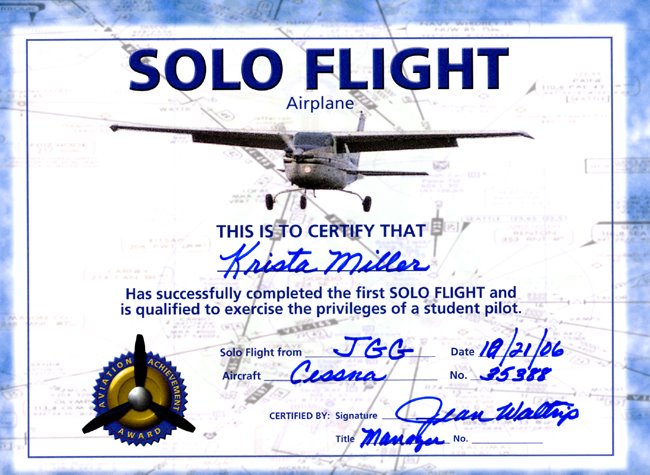
Self-Assessment: Better, happier, more productive...
- Preflight: Good.
- Taxiing: Good.
- Take-off: Good.
- Maintaining airspeed: Good.
- Stalls: Power-off stall, good. Power-on stall, good. Landing stall, needs practice.
- Slow flight (VR and IR): Good.
- Maintain attitude, altitude, heading by instruments: Good.
- Change attitude, altitude, heading by instruments: Acceptable.
- Recover attitude, altitude, heading by instruments: Acceptable.
- Forced landing: Good, need more practice.
- Pattern: Good.
- Landing: Improved :)
- Directional control after landing: Improved :)
- Radio calls: Good.
Next: First fully unsupervised by-myself solo (with no instructor watching from the ground) and also a phase-check with one of the other instructors to make sure I'm learning the right things in the right way. Then in another two weeks or so, we'll start on flight planning, cross-country flights, and night flying.
- More landings.
- Practicing everything.
Hours logged total: 15.0
Instrument hours logged this lesson: 0.0
Instrument Hours logged total: 0.8
Take-offs and landings this flight: 6
Take-offs and landings total: 42
PIC hours total:: 1.0!!!
Sunday, October 22, 2006
Reflecting on the solo
After a good cry, a good nap, good wine, a good night's sleep, and some cookie-baking, here's how I'm feeling about that solo:
Irritated. I'm irritated that the day I did my solo was a day that stretched my abilities. I'm irritated that it involved situations for which I wasn't prepared. I'm irritated that what I do know how to do was lost among what I couldn't do yet.
Still terrified. All day yesterday when I would think about how I felt each time it was time to turn final, the overwhelming anxiety and terror -- no melodrama, seriously -- would come back vividly and I would break down into tears all over again. Reliving the last two minutes of each pattern was torture. It's not as bad today, but gee whiz: I was damn lucky yesterday on all three landings. I reread the previous post about the solo several times, and it sounds so mundane, so blase, but it is the scariest thing I've ever been through.
Regret. I can't change what happened yesterday. My memory of my first solo will always be negative. It's not an experience I can share with people to encourage them to take up flying or happily share with other pilots when reminiscing.
Accomplished. This is kinda strange, but I came out of the solo ok. The plane is ok. The ways that I reacted to the situations allowed at least that much, so my training so far must have instilled some unanticipated-challenge-management tools (beyond by-the-book emergency procedures).
Surprised. In all seriousness, I cannot express how scared I was yesterday. Husband had a hand-held radio receiver while he was videotaping, and I can hear my transmissions on the video. I sound very calm and deliberate, not shaky and wacked out. And despite the fear and gut-wrenching agitation I was feeling, I kept it all together and took care of business. They always say that pilots are the coolest, calmest people in the world, even in the most dire of situations... Not that my situation was dire by most standards, but I am surprised by the cool and calm that governed what happened!
Resignation. This goes along with regret. What happened, happened, and can't be changed. So be it.
Acceptance. What happened, happened. So be it! I learned from first-hand experience. I learned because I had to figure it out in the moment. It wasn't a great solo, but it was my solo and I am now signed off to fly by myself (with range and condition limitations, of course).
I would like to say now that I'm ready to go up again, or that I'm looking forward to continuing the process. I'm not. I'm really dreading the next lesson (scheduled for tomorrow afternoon). Will it be a repeat? Will I hesitate? Will that anxiety come back, even in "easy" situations? Will Chuck treat me with kid gloves? (That's not what I want.) I looked at the completely still autumn leaves on the trees today and thought, "Hmmm, I could go up by myself right now if I wanted to." And it was a tempting thought, to just go out to the airport and do a few patterns alone, regain some confidence. But I didn't. I couldn't. What if it turned gusty again?
Flying is a risk. We learn, we train, we plan, we maintain our planes, we have ways of minimizing a lot of the risk. But it is and will always be a risk. I'm on a knife-edge right now on whether the risk is worth it. Husband is a great pilot, a calm and logical pilot who can handle crosswinds that are within his personal limits. That's encouraging. Then there's the pupil-dilating possibility of being in over your head and wondering what in the hell you could do to improve the situation without injury, death and damage (a.k.a., my solo). That's discouraging. I imagine that when it comes down to it, it's not the routine situations that dictate success as a pilot.
I was freaking lucky yesterday. Luck is not enough. Luck is not a stable foundation. Without the honed, ingrained experience, knowledge and understanding, there's just no point in taking it on. Call it muscle memory, call it reaction grown by repitition, call it training: yesterday taught me that I don't have enough of it. And now my luck bucket is empty. My experience bucket has barely a half-inch in it. My knowledge bucket doesn't have much more. From what am I supposed to draw in times of need?!?
We'll see how it goes tomorrow, supervised.
Irritated. I'm irritated that the day I did my solo was a day that stretched my abilities. I'm irritated that it involved situations for which I wasn't prepared. I'm irritated that what I do know how to do was lost among what I couldn't do yet.
Still terrified. All day yesterday when I would think about how I felt each time it was time to turn final, the overwhelming anxiety and terror -- no melodrama, seriously -- would come back vividly and I would break down into tears all over again. Reliving the last two minutes of each pattern was torture. It's not as bad today, but gee whiz: I was damn lucky yesterday on all three landings. I reread the previous post about the solo several times, and it sounds so mundane, so blase, but it is the scariest thing I've ever been through.
Regret. I can't change what happened yesterday. My memory of my first solo will always be negative. It's not an experience I can share with people to encourage them to take up flying or happily share with other pilots when reminiscing.
Accomplished. This is kinda strange, but I came out of the solo ok. The plane is ok. The ways that I reacted to the situations allowed at least that much, so my training so far must have instilled some unanticipated-challenge-management tools (beyond by-the-book emergency procedures).
Surprised. In all seriousness, I cannot express how scared I was yesterday. Husband had a hand-held radio receiver while he was videotaping, and I can hear my transmissions on the video. I sound very calm and deliberate, not shaky and wacked out. And despite the fear and gut-wrenching agitation I was feeling, I kept it all together and took care of business. They always say that pilots are the coolest, calmest people in the world, even in the most dire of situations... Not that my situation was dire by most standards, but I am surprised by the cool and calm that governed what happened!
Resignation. This goes along with regret. What happened, happened, and can't be changed. So be it.
Acceptance. What happened, happened. So be it! I learned from first-hand experience. I learned because I had to figure it out in the moment. It wasn't a great solo, but it was my solo and I am now signed off to fly by myself (with range and condition limitations, of course).
I would like to say now that I'm ready to go up again, or that I'm looking forward to continuing the process. I'm not. I'm really dreading the next lesson (scheduled for tomorrow afternoon). Will it be a repeat? Will I hesitate? Will that anxiety come back, even in "easy" situations? Will Chuck treat me with kid gloves? (That's not what I want.) I looked at the completely still autumn leaves on the trees today and thought, "Hmmm, I could go up by myself right now if I wanted to." And it was a tempting thought, to just go out to the airport and do a few patterns alone, regain some confidence. But I didn't. I couldn't. What if it turned gusty again?
Flying is a risk. We learn, we train, we plan, we maintain our planes, we have ways of minimizing a lot of the risk. But it is and will always be a risk. I'm on a knife-edge right now on whether the risk is worth it. Husband is a great pilot, a calm and logical pilot who can handle crosswinds that are within his personal limits. That's encouraging. Then there's the pupil-dilating possibility of being in over your head and wondering what in the hell you could do to improve the situation without injury, death and damage (a.k.a., my solo). That's discouraging. I imagine that when it comes down to it, it's not the routine situations that dictate success as a pilot.
I was freaking lucky yesterday. Luck is not enough. Luck is not a stable foundation. Without the honed, ingrained experience, knowledge and understanding, there's just no point in taking it on. Call it muscle memory, call it reaction grown by repitition, call it training: yesterday taught me that I don't have enough of it. And now my luck bucket is empty. My experience bucket has barely a half-inch in it. My knowledge bucket doesn't have much more. From what am I supposed to draw in times of need?!?
We'll see how it goes tomorrow, supervised.
Saturday, October 21, 2006
JEP FI-9: Solo
[Update: added takeoff video]
The goal for this lesson was simple: supervised solo followed by first unsupervised solo.
It was horrible. Exactly the opposite of what I wanted and had been looking forward to. So bad that I have been questioning whether I'll continue my training.
The problem is that all 12+ hours of my training have been in beautifully calm skies. It had even become kinda frustrating that it was always so calm because theory about crosswind maneuvering only goes so far and I need practical experience.
Well, getting that experience during my solo was not what I had in mind. And it was terrifying. The only reason I landed is because I knew of no alternative.
We started out around 8:30 this morning after reviewing the written pre-solo knowledge test. That test covered basics like the V-speeds, information that I'd have to look up on a sectional or airport diagrams, emergency procedures, some flight basics, etc. The intention was for me to do three takeoffs and landings with Chuck in the plane, then he'd hop out and I'd do three by myself.
Wouldn't you know it that the winds were favoring 31 today? The vast majority of my flight time has been using 13. It shouldn't be a problem and I have to be able to land both ways here and any way at any airport, but the catch is that 31 has a challenge known locally as the swamp monster. Final on 31 comes in over the James River and over some tributaries that wind through marshy land, right up to the end of the runway. The wind and turbulence over that spot is kinda unpredictable, so the common wisdom is to come in about 50' higher and a little hotter than you typically would.
Fine, I knew that would be the case and I wasn't thrilled about it but whatever. I have landed there before, I would land there today, and I will land there more in the future.
The first three (supervised) patterns were crap for different reasons. All were landed safely and we made the mid-field turnoff for all three, but my altitudes on the downwind/base and base/final corners were too low and/or my airspeed got low and/or I had too much airspeed coming over the threshold and/or I was off-centerline and/or a combination of those things. It just wasn't coming together. There was a bit of a crosswind, so I was crabbing on downwind to maintain my rectangular pattern and base was taking forever -- that's one reason I was so low on the threshold end of the pattern, because I'd never really flown in a crosswind and so did nothing to *not* sink at the usual 500'/min rate that all my other patterns had and ended up sinking for a longer period of time before turning final and then had to fly a long final at 200-300'. So we did three more with Chuck in the plane, and they got better and better so he asked if I was ready to do it by myself.
I said, "I can land." I was anxious, but mostly just because the big moment had finally come. I dropped Chuck off in front of the terminal where he said he'd be near a radio if I needed to talk to him, which I would need repeatedly.
I taxiied back down to 31 with a nervous cheer knowing that my last three landings had been better so these next three would be opportunities to continue the improvement. The first takeoff was normal and good. About the time I was turning left downwind I noticed just how turbulent it was around the airport. I had my usual bank and suddenly the left wing kicked down even further and my stomach dropped. It shook me up pretty good, so I levelled as quickly as I could and then tried again with better luck the second time. I was in the pattern behind another plane, and he had what seemed like an absurdly long final, which I didn't want to have since I was at risk of having lower-than-normal altitude on account of the long base leg. But since I was following him, I felt I had to really follow his pattern so I kept the power up through base and didn't put my second notch of flaps out until just before turning final.
Final was tough; it was bumpy, I was crabbing, the wings were bobbling around, I was really sweating it. Surprisingly, I was doing ok and was lined up pretty well and didn't notice the swamp monster (so I must have been high/fast enough). I even had a decent flare. But that crab got me -- when I touched down and the nose wheel came down, I was headed straight for the grass on the right of the runway. And that's where I went. I pushed the left rudder pedal and felt like the plane was going to roll right over so I decided that must not be the right thing to do. Before I could really try anything else, I was in the grass and still headed to the right. Fear of plowing down those runway lights was not helping my grip on the situation. I managed to apply the left pedal in a gradual enough fashion to get back onto the pavement without feeling that topple-over feeling again and amazingly without hitting any of the lights, although I was well past them and had to come through them again on the way back to the pavement. And when I did get back to the pavement, the nosewheel was shimmying and shuddering and I was certan that I had damaged it badly.
That totally sucked. I immediately called UNICOM and asked them to have Chuck meet me in front of the FBO. I didn't know how much he would have been able to see from there. When I stopped and he came over, I told him what happened and asked him to check the gear. Aside from some grass in the nosewheel, everything seemed fine. Husband came running over to see that everything was ok, and he shook my hand happily in congratulations on my first solo landing but didn't know just how unsuccessful it had been. (My standard for success is based on more than survivability!)
I was shaking. I was in full-fear mode. But was that just something I needed to get over and try it again? Should part of the experience be to move past one bad landing and not give up? I decided that it was. I knew what had gone wrong. I knew how to correct it. Other than that swerve at the end, it really was a decent landing, despite the challenging conditions. Here's my second takeoff; doesn't the swamp monster's home look pretty out there, with the trees changing colors and the sun glistening on the water?
The second pattern was much like the first. Turbulent, crabby, with other traffic. On this landing, I was lined up and it was looking good, and I let go of my crab too early and started to drift out over the grass to the left of the runway. I jammed in the right rudder to get back over the pavement and swung way to the right. I felt completely out of control. Husband said that what he saw standing on the edge of the taxiway was the wings dipping violently from one side to the other, not the pendulum-style swinging that I felt. He videotaped some of the solo and there's a pretty scary clip of this timeframe that includes the nose of 388 pitching down right over the runway, and then 388 goes out of the frame because Husband forgot the camera and was just watching me intently. That, I'm sure, is from me trying to compensate for flaring too early. But with a bounce I was down and missed the mid-field turnoff by far so scooted to the end of the runway and pulled off. As I was taxiing back, a 152 came in and at the mid-field turnoff he still had not touched down, and when he did he bounced several times.
I was again shaking and fearful. I just happened to be oscillating over the runway when it was time to touchdown; what if I had been way off to one side or a wing had been dipped? I was lucky. There's nothing else to it. I was not feeling confident at all and debated calling it off. Again, though, I told myself that I had gotten down safely and had dealt with the situation, so I needed to learn what I could and move on. As I taxiied again toward 31, Husband came running out to the taxiway so I stopped, idled and opened the window. He said the winds were picking up a lot and that it might be beyond my skill set. Later he would tell me that he had never been more worried about anything in his life and that he was trying to implore me to not go up again without shaking my confidence. I called Chuck on the UNICOM and expressed my concern over the winds and asked his advice. He said the winds weren't really doing anything and that my problem on the last one was that my airspeed was low (which is true, and even lower than it ought to have been given the swamp-monster-evasion strategy of have more than normal airspeed at the threshold) so I didn't have as much authority as I needed and to keep it up the next time around.
So I went up. I was still tentative, but if my instructor felt ok about the situation then I'd go on that. Other than the first two patterns, I have no frame of reference for assessing my own limitations. The pattern went pretty much the same, and on final I was doing ok. I was left of centerline, but still over the pavement so I just held the crab where it was and came down. I neutralized the rudder and flared badly and dropped in and bounced. I bounced up quite a bit, and didn't know what to do, so I figured I needed to kill off more airspeed and pulled back a little more. And bounced again and was headed for the grass on the left (maybe I had "overneutralized" the rudder). Ok, pulling back didn't work, so I thought maybe I needed to reduce pitch so I pushed forward some. And bounced a third time in the grass. At this point I knew I was not doing the right thing so I decided to give it up and see if I could go around -- I really, really didn't want to do this since (1) I've never done a touch and go, (2) the flaps were down, (3) I was in the grass, and (4) the crosswind was stronger. I started to gradually put in the power and viola! Everything stabilized, I was able to finish that final bounce on the runway and without bouncing again. I pulled the power back out, finished the rollout to the end of the runway and headed back. That bouncing is called pilot-induced oscillation: when the pilot's actions worsen the problem by attempting to correct something in the wrong way or by overcorrecting. There's video of me on the rollout going past a nearly fully extended windsock that's perpendicular to the runway.
I picked Chuck up in front of the terminal and we chatted during the taxi back to the tie-down spot. I told him flatly that there were no words to describe how unhappy I was about my performance and about the situation. I don't even really remember what else we talked about. I was on the verge of tears and couldn't really think about a whole lot other than how insanely lucky I was for all three patterns. It could have ended so very badly at any time.
I had my shirttail cut off anyway, despite what I would say was such an unsuccessful solo that it should not be celebrated in any manner. In that same thought, though, the fact that I dealt with the situations and didn't hurt myself or the plane suggest that maybe it was successful -- but that's where the buckets come in. My "luck" bucket is pretty much empty, and only a little of its contents made it into the experience bucket.
When we got home we checked the METARs for JGG to see what the conditions had been. The JGG METARs claim the winds are unreliable, but they nearly matched what PHF was saying and matched what Husband and I both felt was going on. Basically, the winds started out ~5-6 kts with only a partial crosswind component and during my solo patterns they increased in general and had gusts up to 14 kts, almost all of which was a crosswind.
So my solo was one of the worst experiences in my life to date. I should have recognized earlier, maybe even before the first solo pattern, that I wasn't ready for that, that I needed more training than the first 6 supervised patterns to be able to deal with a crosswind.
We're planning right now to do the same thing Monday afternoon, weather permitting. I have zero confidence right now.
The goal for this lesson was simple: supervised solo followed by first unsupervised solo.
It was horrible. Exactly the opposite of what I wanted and had been looking forward to. So bad that I have been questioning whether I'll continue my training.
The problem is that all 12+ hours of my training have been in beautifully calm skies. It had even become kinda frustrating that it was always so calm because theory about crosswind maneuvering only goes so far and I need practical experience.
Well, getting that experience during my solo was not what I had in mind. And it was terrifying. The only reason I landed is because I knew of no alternative.
We started out around 8:30 this morning after reviewing the written pre-solo knowledge test. That test covered basics like the V-speeds, information that I'd have to look up on a sectional or airport diagrams, emergency procedures, some flight basics, etc. The intention was for me to do three takeoffs and landings with Chuck in the plane, then he'd hop out and I'd do three by myself.
Wouldn't you know it that the winds were favoring 31 today? The vast majority of my flight time has been using 13. It shouldn't be a problem and I have to be able to land both ways here and any way at any airport, but the catch is that 31 has a challenge known locally as the swamp monster. Final on 31 comes in over the James River and over some tributaries that wind through marshy land, right up to the end of the runway. The wind and turbulence over that spot is kinda unpredictable, so the common wisdom is to come in about 50' higher and a little hotter than you typically would.
Fine, I knew that would be the case and I wasn't thrilled about it but whatever. I have landed there before, I would land there today, and I will land there more in the future.
The first three (supervised) patterns were crap for different reasons. All were landed safely and we made the mid-field turnoff for all three, but my altitudes on the downwind/base and base/final corners were too low and/or my airspeed got low and/or I had too much airspeed coming over the threshold and/or I was off-centerline and/or a combination of those things. It just wasn't coming together. There was a bit of a crosswind, so I was crabbing on downwind to maintain my rectangular pattern and base was taking forever -- that's one reason I was so low on the threshold end of the pattern, because I'd never really flown in a crosswind and so did nothing to *not* sink at the usual 500'/min rate that all my other patterns had and ended up sinking for a longer period of time before turning final and then had to fly a long final at 200-300'. So we did three more with Chuck in the plane, and they got better and better so he asked if I was ready to do it by myself.
I said, "I can land." I was anxious, but mostly just because the big moment had finally come. I dropped Chuck off in front of the terminal where he said he'd be near a radio if I needed to talk to him, which I would need repeatedly.
I taxiied back down to 31 with a nervous cheer knowing that my last three landings had been better so these next three would be opportunities to continue the improvement. The first takeoff was normal and good. About the time I was turning left downwind I noticed just how turbulent it was around the airport. I had my usual bank and suddenly the left wing kicked down even further and my stomach dropped. It shook me up pretty good, so I levelled as quickly as I could and then tried again with better luck the second time. I was in the pattern behind another plane, and he had what seemed like an absurdly long final, which I didn't want to have since I was at risk of having lower-than-normal altitude on account of the long base leg. But since I was following him, I felt I had to really follow his pattern so I kept the power up through base and didn't put my second notch of flaps out until just before turning final.
Final was tough; it was bumpy, I was crabbing, the wings were bobbling around, I was really sweating it. Surprisingly, I was doing ok and was lined up pretty well and didn't notice the swamp monster (so I must have been high/fast enough). I even had a decent flare. But that crab got me -- when I touched down and the nose wheel came down, I was headed straight for the grass on the right of the runway. And that's where I went. I pushed the left rudder pedal and felt like the plane was going to roll right over so I decided that must not be the right thing to do. Before I could really try anything else, I was in the grass and still headed to the right. Fear of plowing down those runway lights was not helping my grip on the situation. I managed to apply the left pedal in a gradual enough fashion to get back onto the pavement without feeling that topple-over feeling again and amazingly without hitting any of the lights, although I was well past them and had to come through them again on the way back to the pavement. And when I did get back to the pavement, the nosewheel was shimmying and shuddering and I was certan that I had damaged it badly.
That totally sucked. I immediately called UNICOM and asked them to have Chuck meet me in front of the FBO. I didn't know how much he would have been able to see from there. When I stopped and he came over, I told him what happened and asked him to check the gear. Aside from some grass in the nosewheel, everything seemed fine. Husband came running over to see that everything was ok, and he shook my hand happily in congratulations on my first solo landing but didn't know just how unsuccessful it had been. (My standard for success is based on more than survivability!)
I was shaking. I was in full-fear mode. But was that just something I needed to get over and try it again? Should part of the experience be to move past one bad landing and not give up? I decided that it was. I knew what had gone wrong. I knew how to correct it. Other than that swerve at the end, it really was a decent landing, despite the challenging conditions. Here's my second takeoff; doesn't the swamp monster's home look pretty out there, with the trees changing colors and the sun glistening on the water?
The second pattern was much like the first. Turbulent, crabby, with other traffic. On this landing, I was lined up and it was looking good, and I let go of my crab too early and started to drift out over the grass to the left of the runway. I jammed in the right rudder to get back over the pavement and swung way to the right. I felt completely out of control. Husband said that what he saw standing on the edge of the taxiway was the wings dipping violently from one side to the other, not the pendulum-style swinging that I felt. He videotaped some of the solo and there's a pretty scary clip of this timeframe that includes the nose of 388 pitching down right over the runway, and then 388 goes out of the frame because Husband forgot the camera and was just watching me intently. That, I'm sure, is from me trying to compensate for flaring too early. But with a bounce I was down and missed the mid-field turnoff by far so scooted to the end of the runway and pulled off. As I was taxiing back, a 152 came in and at the mid-field turnoff he still had not touched down, and when he did he bounced several times.
I was again shaking and fearful. I just happened to be oscillating over the runway when it was time to touchdown; what if I had been way off to one side or a wing had been dipped? I was lucky. There's nothing else to it. I was not feeling confident at all and debated calling it off. Again, though, I told myself that I had gotten down safely and had dealt with the situation, so I needed to learn what I could and move on. As I taxiied again toward 31, Husband came running out to the taxiway so I stopped, idled and opened the window. He said the winds were picking up a lot and that it might be beyond my skill set. Later he would tell me that he had never been more worried about anything in his life and that he was trying to implore me to not go up again without shaking my confidence. I called Chuck on the UNICOM and expressed my concern over the winds and asked his advice. He said the winds weren't really doing anything and that my problem on the last one was that my airspeed was low (which is true, and even lower than it ought to have been given the swamp-monster-evasion strategy of have more than normal airspeed at the threshold) so I didn't have as much authority as I needed and to keep it up the next time around.
So I went up. I was still tentative, but if my instructor felt ok about the situation then I'd go on that. Other than the first two patterns, I have no frame of reference for assessing my own limitations. The pattern went pretty much the same, and on final I was doing ok. I was left of centerline, but still over the pavement so I just held the crab where it was and came down. I neutralized the rudder and flared badly and dropped in and bounced. I bounced up quite a bit, and didn't know what to do, so I figured I needed to kill off more airspeed and pulled back a little more. And bounced again and was headed for the grass on the left (maybe I had "overneutralized" the rudder). Ok, pulling back didn't work, so I thought maybe I needed to reduce pitch so I pushed forward some. And bounced a third time in the grass. At this point I knew I was not doing the right thing so I decided to give it up and see if I could go around -- I really, really didn't want to do this since (1) I've never done a touch and go, (2) the flaps were down, (3) I was in the grass, and (4) the crosswind was stronger. I started to gradually put in the power and viola! Everything stabilized, I was able to finish that final bounce on the runway and without bouncing again. I pulled the power back out, finished the rollout to the end of the runway and headed back. That bouncing is called pilot-induced oscillation: when the pilot's actions worsen the problem by attempting to correct something in the wrong way or by overcorrecting. There's video of me on the rollout going past a nearly fully extended windsock that's perpendicular to the runway.
I picked Chuck up in front of the terminal and we chatted during the taxi back to the tie-down spot. I told him flatly that there were no words to describe how unhappy I was about my performance and about the situation. I don't even really remember what else we talked about. I was on the verge of tears and couldn't really think about a whole lot other than how insanely lucky I was for all three patterns. It could have ended so very badly at any time.
I had my shirttail cut off anyway, despite what I would say was such an unsuccessful solo that it should not be celebrated in any manner. In that same thought, though, the fact that I dealt with the situations and didn't hurt myself or the plane suggest that maybe it was successful -- but that's where the buckets come in. My "luck" bucket is pretty much empty, and only a little of its contents made it into the experience bucket.
When we got home we checked the METARs for JGG to see what the conditions had been. The JGG METARs claim the winds are unreliable, but they nearly matched what PHF was saying and matched what Husband and I both felt was going on. Basically, the winds started out ~5-6 kts with only a partial crosswind component and during my solo patterns they increased in general and had gusts up to 14 kts, almost all of which was a crosswind.
So my solo was one of the worst experiences in my life to date. I should have recognized earlier, maybe even before the first solo pattern, that I wasn't ready for that, that I needed more training than the first 6 supervised patterns to be able to deal with a crosswind.
We're planning right now to do the same thing Monday afternoon, weather permitting. I have zero confidence right now.
Directional Control in AOPA's Flight Training materials
Well, the Big Fat Kitty woke me up with purring and a belly massage at 4:30 this morning and of course my mind kicked into gear. So since then I set up a DUATS account, downloaded the AOPA Flight Planner, played around with it, and have been reading through a lot of the Flight Training articles at the AOPA website. Some good stuff there...
Directional control during takeoffs and landings -- the theme of my learning-to-fly adventure (other than stall desensitization!)!
Directional control during takeoffs and landings -- the theme of my learning-to-fly adventure (other than stall desensitization!)!
Friday, October 20, 2006
Eeeeeeeeeeeeeeeeeeeeeeeeeeee!!!
8 am tomorrow.... solo! Shall I sleep?!? Me hopes so! I'm already jittery with suspense! (Not nervous, not anxious, but full of anticipation!)
My homework for tonight from Chuck: "Dream about rudder control." Sheesh! :)
My homework for tonight from Chuck: "Dream about rudder control." Sheesh! :)
JEP FI-8: Review, landings, and mistakes
Goals:
Flight:
During my preflight, Husband called as I was finishing up the tail section to say his day of jury duty was over and to wish me a good flight. I stowed my phone and decided I'd better review the checklist items for the tail just to be sure as I walked on to the right wing. It seemed that I had done everything so I went on. Chuck arrived, we chatted, and then prepared to taxi. Throttle up, no movement. More throttle, no movement. I wiggled the brakes and rudder to make sure the brakes weren't sticking, still no movement. Then it dawned on me. OMG, I didn't untie the tail. Can you imagine my embarassment as Chuck took off his headset, got out, and untied it for me?!? I just wanted to melt and ooze out of the plane into a humiliated puddle on the ground. But it was a learning experience and I'll wager that it will never happen again! (Coincidentally, it happened to Husband early in his training, too, 15 years ago and has never happened to him again.)
In any case, it was an omen.
We taxiied on to 13, took off, and obeyed the new noise abatement procedures off the end of 31 -- climb to 500' and turn to 180 to avoid the neighborhood. On to the practice area with a little IR time on the way...
We did a few turn-to-landing stalls. The first one I did was really crummy. I did all the right things, but not in a coordinated fashion and not quickly enough. The second one was much better; I think I only lost about 200' on that one. Stall breaks were good.
We did a practice half-S-turn (a C-turn? :) ) just so I'd get a sense for the constant radius and picking a reference point while planning ahead for the second half of the turn. Then we repositioned over I-64 and executed one. The first half-loop was pretty, and the second half was pretty, but the radii didn't match; the second half was a good bit tighter than the first. That means it was a bad S-turn, so I know I've gotta work on that!
We started heading back southward towards the James River and simulated an engine out. I set our airpseed and picked a field that was just under us and that I could see very well to be a nice, clean field. We were way high, though, so I changed my mind to a neighboring field and started to turn and descend toward it. Long story short, we crossed midfield ~1100', were at ~900' at the key, and everything was looking peachy so we called it off and continued on toward the James, getting more IR time for straight-and-level flight.
We got back to JGG, entered the pattern, and landed. We landed long because I was late getting my flaps out on base and final and so I had more altitude to lose than I should have had. But we landed safely and were still able to use the midfield turnoff.
That's when UNICOM called to us to say that Homeland Security wanted to talk to us. WTF?!?!!!?!!?!?!?!! Why on earth would they possibly want to talk to us?!? I instantly tried to think of anything on the flight that we could have done that would be suspicious, and other than the S-turns possibly being near Camp Peary (CIA) or something else they're sensitive about of which I'm not aware, I couldn't come up with anything. But I detest being disciplined or having to defend myself even when I'm right, so I got extremely anxious. I'm fairly certain the color drained from my face. UNICOM told us the word was that we violated a Presidential TFR around RIC, but we were no where near RIC (which is ~33 nm from JGG according to airnav.com) and how would they know it was us anyway? UNICOM asked us to come on in and get on the phone with RIC ATC, so we parked in front of the FBO and Chuck went in as I tidied up the plane for a minute.
It seemed like ages that he was on the phone. Ages. The butterflies in my tummy had turned to angry hornets. I danced around as Jean, the airport manager, told me of the other time a JGG-based pilot did such a no-no. He was a new private pilot and by the time he got back on the ground, emissaries from the FBI and the CIA were waiting for him. They kept him at the airport for hours, interrogating. Egad! I don't know the particulars of his incident, but surely if RIC was right and it was us, it would be obvious that it was a training lesson and not anything malignant, right?!?
Chuck wrapped up the call and came over with some heading/distance info (112/24, meaning radial 112 from RIC at 24 nm out) that the ATC person gave him as our position of violation. He said they knew it was us because they tracked us all the way back to JGG and called up the FBO to have them contact us, and since there was no one else around at the time, it had to be us. We checked the sectional against the position and by golly it was us! The TFR covered 30 nm from RIC, and that's a helluva lot closer to JGG than it seems.
So you're probably asking why we didn't do our diligent preflight planning and check for TFRs. Well, Chuck did, but got the date mixed up. He saw the RIC TFR of 30 nm but thought that it was for the next day, believing that today's date was actually the day before! We chatted for a few minutes about what all of this meant. Remember the tail being tied down -- was it a sign? Chuck was pilot-in-command, so the authorities would be dealing with him and if any actions were taken they would involve him. That gave me a kinda guilty-helpless feeling about the situation, and naturally I was a little relieved, too, but I was worried about what it would mean for him. Given his long, spotless career, he expected a warning from it, possibly some administrative paperwork. If they felt more serious about it, he might be grounded for 30 days. (He talked with a man from the FAA for a while that night and he said to consider it a "learning experience." WHEW! He says he's still expecting a letter from the FAA and maybe a call from the Secret Service, too.)
We decided to continue the lesson, which entailed several loops through the pattern with emphasis on landings. The first landing was meh, the second landing was better, and the third landing was exceptional until about 2 seconds from touchdown when the nose wandered off to the left and I didn't correct it forcefully enough.
Discussion:
Self-Assessment: Showing improvement. It was an odd lesson overall.
Next: This afternoon's planned solo has been postponed until tomorrow morning due to high winds.
Hours logged total: 12.3
Instrument hours logged this lesson: 0.2
Hours logged total: 0.8
Take-offs and landings this flight: 4
Take-offs and landings total: 27
- Review, review, review.
- S turns.
- Landings.
Flight:
During my preflight, Husband called as I was finishing up the tail section to say his day of jury duty was over and to wish me a good flight. I stowed my phone and decided I'd better review the checklist items for the tail just to be sure as I walked on to the right wing. It seemed that I had done everything so I went on. Chuck arrived, we chatted, and then prepared to taxi. Throttle up, no movement. More throttle, no movement. I wiggled the brakes and rudder to make sure the brakes weren't sticking, still no movement. Then it dawned on me. OMG, I didn't untie the tail. Can you imagine my embarassment as Chuck took off his headset, got out, and untied it for me?!? I just wanted to melt and ooze out of the plane into a humiliated puddle on the ground. But it was a learning experience and I'll wager that it will never happen again! (Coincidentally, it happened to Husband early in his training, too, 15 years ago and has never happened to him again.)
In any case, it was an omen.
We taxiied on to 13, took off, and obeyed the new noise abatement procedures off the end of 31 -- climb to 500' and turn to 180 to avoid the neighborhood. On to the practice area with a little IR time on the way...
We did a few turn-to-landing stalls. The first one I did was really crummy. I did all the right things, but not in a coordinated fashion and not quickly enough. The second one was much better; I think I only lost about 200' on that one. Stall breaks were good.
We did a practice half-S-turn (a C-turn? :) ) just so I'd get a sense for the constant radius and picking a reference point while planning ahead for the second half of the turn. Then we repositioned over I-64 and executed one. The first half-loop was pretty, and the second half was pretty, but the radii didn't match; the second half was a good bit tighter than the first. That means it was a bad S-turn, so I know I've gotta work on that!
We started heading back southward towards the James River and simulated an engine out. I set our airpseed and picked a field that was just under us and that I could see very well to be a nice, clean field. We were way high, though, so I changed my mind to a neighboring field and started to turn and descend toward it. Long story short, we crossed midfield ~1100', were at ~900' at the key, and everything was looking peachy so we called it off and continued on toward the James, getting more IR time for straight-and-level flight.
We got back to JGG, entered the pattern, and landed. We landed long because I was late getting my flaps out on base and final and so I had more altitude to lose than I should have had. But we landed safely and were still able to use the midfield turnoff.
That's when UNICOM called to us to say that Homeland Security wanted to talk to us. WTF?!?!!!?!!?!?!?!! Why on earth would they possibly want to talk to us?!? I instantly tried to think of anything on the flight that we could have done that would be suspicious, and other than the S-turns possibly being near Camp Peary (CIA) or something else they're sensitive about of which I'm not aware, I couldn't come up with anything. But I detest being disciplined or having to defend myself even when I'm right, so I got extremely anxious. I'm fairly certain the color drained from my face. UNICOM told us the word was that we violated a Presidential TFR around RIC, but we were no where near RIC (which is ~33 nm from JGG according to airnav.com) and how would they know it was us anyway? UNICOM asked us to come on in and get on the phone with RIC ATC, so we parked in front of the FBO and Chuck went in as I tidied up the plane for a minute.
It seemed like ages that he was on the phone. Ages. The butterflies in my tummy had turned to angry hornets. I danced around as Jean, the airport manager, told me of the other time a JGG-based pilot did such a no-no. He was a new private pilot and by the time he got back on the ground, emissaries from the FBI and the CIA were waiting for him. They kept him at the airport for hours, interrogating. Egad! I don't know the particulars of his incident, but surely if RIC was right and it was us, it would be obvious that it was a training lesson and not anything malignant, right?!?
Chuck wrapped up the call and came over with some heading/distance info (112/24, meaning radial 112 from RIC at 24 nm out) that the ATC person gave him as our position of violation. He said they knew it was us because they tracked us all the way back to JGG and called up the FBO to have them contact us, and since there was no one else around at the time, it had to be us. We checked the sectional against the position and by golly it was us! The TFR covered 30 nm from RIC, and that's a helluva lot closer to JGG than it seems.
So you're probably asking why we didn't do our diligent preflight planning and check for TFRs. Well, Chuck did, but got the date mixed up. He saw the RIC TFR of 30 nm but thought that it was for the next day, believing that today's date was actually the day before! We chatted for a few minutes about what all of this meant. Remember the tail being tied down -- was it a sign? Chuck was pilot-in-command, so the authorities would be dealing with him and if any actions were taken they would involve him. That gave me a kinda guilty-helpless feeling about the situation, and naturally I was a little relieved, too, but I was worried about what it would mean for him. Given his long, spotless career, he expected a warning from it, possibly some administrative paperwork. If they felt more serious about it, he might be grounded for 30 days. (He talked with a man from the FAA for a while that night and he said to consider it a "learning experience." WHEW! He says he's still expecting a letter from the FAA and maybe a call from the Secret Service, too.)
We decided to continue the lesson, which entailed several loops through the pattern with emphasis on landings. The first landing was meh, the second landing was better, and the third landing was exceptional until about 2 seconds from touchdown when the nose wandered off to the left and I didn't correct it forcefully enough.
Discussion:
- Checklist diligence: I thought I was being diligent when resuming my checklist after taking a phone call by stepping through the items for the tail section checks in my mind. What I learned is that either (1) I should not permit interruptions, which may not always be possible, or (2) I should actually start over in that section of the checklist, not just review mentally that everything was done. Naturally this goes beyond just the preflight checklist and is direct evidence of why there are specific procedures for doing things.
- TFRs: TFRs are temporary flight restrictions. As the name indicates, they are additional restrictions on arbitrary locations for an arbitrary length of time that's expected to be temporary. TFRs are included in NOTAMs.
- (Human) attitude for flight: The Homeland Security thing had me feeling a little unhinged. While Chuck was on the phone, I really didn't know whether I'd be able to focus well enough to continue the lesson, should we be permitted to do so, and was preparing myself for the disappointment of calling it off. Even after we talked over the situation I still felt a little edgy. As we walked out to the plane to continue the lesson, however, my mind geared back into flying and the TFR situation shrank to the background. Focus was not an issue whatsoever. If anything, it might have made me more even deliberate in everything from the engine run-up to radio calls.
- Landing on centerline: My first three approaches to land were squirrelly, like they had been on Wednesday. By the third one, I was getting frustrated because I was actively trying to counter the excursions but was either overcorrecting or just not being effective. I didn't understand what the problem was, and so of course my actions were just simple reactions instead of deliberate counter-measures. After the third landing, I told Chuck that I didn't feel my rudder inputs were effective and asked if I should just be expecting a lag between my input and the plane's response at that slow airspeed. Ah, light bulb goes on. All flight controls are less effective at slow speeds! That was part of my problem -- I wasn't correcting hard enough. The second part of the problem made it hard to diagnose the first part and contributed a lot to the oscillations: not anticipating the corrections.
On the fourth landing, I had that all in mind, and it was a very nice final. Chuck jinxed it by saying twice how pretty it was, and just before touching down the nose started twisting to the left. I didn't correct hard/quickly enough and so the touchdown was not so pretty. That landing went from a 10 in Chuck's estimation to a 5 because of the last few seconds. And I agree; for something that started out so well, I sure phoned it in at the end.
Self-Assessment: Showing improvement. It was an odd lesson overall.
- Preflight: Good.
- Taxiing: Good.
- Take-off: Good.
- Maintaining airspeed: Good.
- Stalls: Power-off stall, good. Power-on stall, good. Landing stall, improved, needs more practice.
- Slow flight (VR and IR): Good.
- Maintain attitude, altitude, heading by instruments: Good.
- Change attitude, altitude, heading by instruments: Good.
- Recover attitude, altitude, heading by instruments: Acceptable.
- Forced landing: Good, still need to commit the entire set of emergency procedures to memory.
- Pattern: Overall, good. Ocassionally I enter the pattern high or fast or whatnot and need to work on getting that situation under control more quickly.
- Landing: Improved, more practice.
- Radio calls: Decent.
Next: This afternoon's planned solo has been postponed until tomorrow morning due to high winds.
- More of the above!
- Forward slips to landing
- Crosswind takeoffs and landings (come on, weather! Give us useful winds!)
Hours logged total: 12.3
Instrument hours logged this lesson: 0.2
Hours logged total: 0.8
Take-offs and landings this flight: 4
Take-offs and landings total: 27
Wednesday, October 18, 2006
JEP FI-6/7: Landings, slip intro, practice
Not much time to write tonight since Husband and I are celebrating our 7th wedding anniversary (which was actually Monday but was inconvenient for celebrating!)...
Today's double-lesson was pretty good. Lots of landing practice, including 3 landings at Wakefield (AKQ), two landings at Franklin (FKN), two go-arounds after demo forward slips at FKN and a landing back at JGG. I did all but one of the landings unassisted, and have a new item to work on: track the centerline while landing!
Sound familiar? To paraphrase myself from previous posts...
"I need to work on keeping to the lines when taxiing." And when that got better, it became...
"I need to work on tracking the centerline during takeoff." That improved and then it was...
"I need to work on tracking the extended centerline after takeoff." Now that's pretty good soooooo....
It's time to work on the same thing on the final stretch of any flight.
My reactions were pretty good during the final approaches and flares, including instinctively powering up a tad when we were going to be short on one landing and nosing down a tad to counter a premature flare and then flaring again at the appropriate height above the runway.
Getting there... 4pm tomorrow for more landings, landings, landings and then maybe the solo on Friday! Husband wants to be at the airport when I do my first solo, so I'll be flying for an audience!
Today's double-lesson was pretty good. Lots of landing practice, including 3 landings at Wakefield (AKQ), two landings at Franklin (FKN), two go-arounds after demo forward slips at FKN and a landing back at JGG. I did all but one of the landings unassisted, and have a new item to work on: track the centerline while landing!
Sound familiar? To paraphrase myself from previous posts...
"I need to work on keeping to the lines when taxiing." And when that got better, it became...
"I need to work on tracking the centerline during takeoff." That improved and then it was...
"I need to work on tracking the extended centerline after takeoff." Now that's pretty good soooooo....
It's time to work on the same thing on the final stretch of any flight.
My reactions were pretty good during the final approaches and flares, including instinctively powering up a tad when we were going to be short on one landing and nosing down a tad to counter a premature flare and then flaring again at the appropriate height above the runway.
Getting there... 4pm tomorrow for more landings, landings, landings and then maybe the solo on Friday! Husband wants to be at the airport when I do my first solo, so I'll be flying for an audience!
Monday, October 16, 2006
Ground school
Looks like I'll be doing a home-study course for ground school. Colonial Flight School at JGG expects it to be several months before ground classes are organized, and the weekend crash-course ground schools are just inconvenient.
Luckily, Jeppesen produces a software-based course that goes along with the curriculum I'm on for flight instruction, and I've got the book and materials so it ought to work out.
Luckily, Jeppesen produces a software-based course that goes along with the curriculum I'm on for flight instruction, and I've got the book and materials so it ought to work out.
Subscribe to:
Posts (Atom)